In summary:
- A fashion set operates like a production line; your role is to be an efficient, reliable component.
- The call sheet is your blueprint. Understanding its hierarchy and timing is non-negotiable.
- Creative direction is top-down. Your input is your performance, not your ideas, unless explicitly requested.
- Professionalism is measured by your respect for the workflow, from punctuality to wrap protocols.
- Your on-set etiquette, especially regarding confidentiality and hierarchy, directly impacts future bookings.
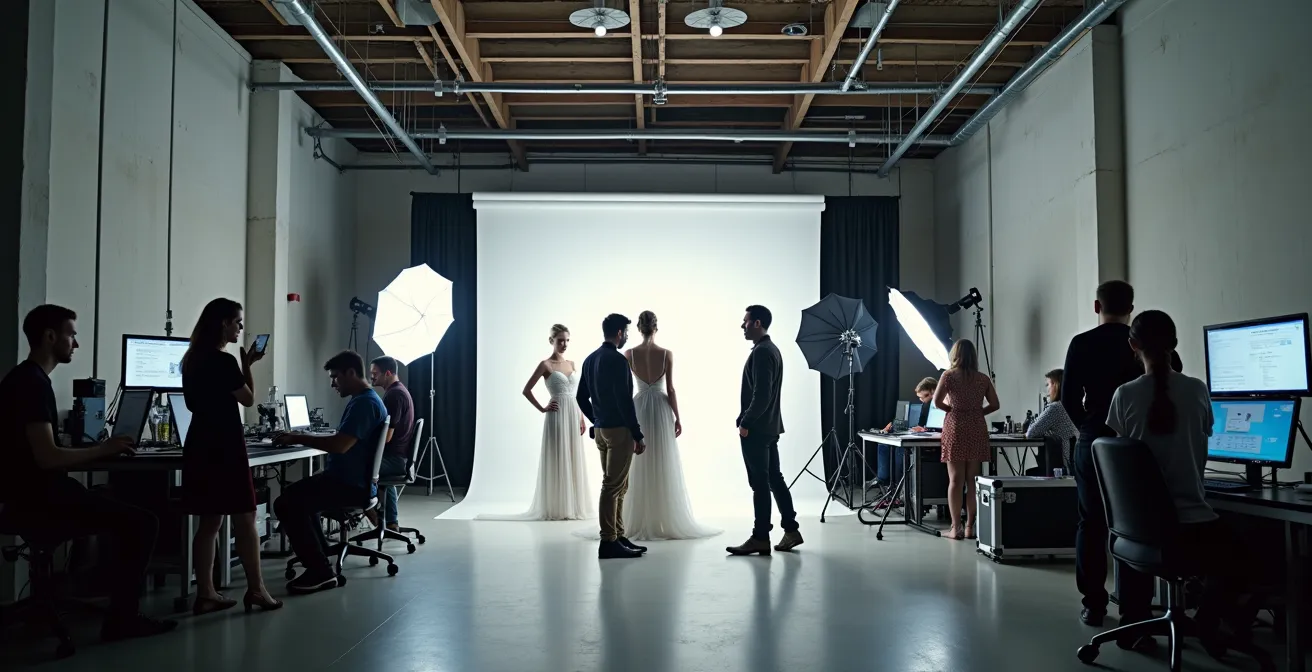
Stepping onto a big-budget fashion set for the first time is an exercise in sensory overload. Banks of lights, a dozen crew members moving with purpose, and an atmosphere of intense focus can be intimidating. Many new models believe their job is simply to look good and follow the photographer’s instructions. While true, this overlooks the fundamental reality of the environment. A high-stakes fashion shoot is not a creative playground; it is a meticulously planned, time-sensitive production line where every minute costs thousands of dollars.
The common advice to “be professional” is too vague to be useful here. True professionalism isn’t about being pleasant; it’s about understanding the complex machinery of the set and your precise role within it. It’s knowing who holds the creative authority, why “on time” is considered late, and what to do during the long periods of technical setup. Misunderstanding this intricate workflow is a significant source of friction on set, and it’s the fastest way to ensure you’re not invited back.
This guide abandons generic advice. Instead, it provides the operational blueprint from a producer’s perspective. The key to success is not just in mastering your poses, but in mastering the unwritten rules of the production workflow. We will deconstruct the process, from deciphering the call sheet to the final “wrap,” revealing how to operate as an indispensable asset rather than a disposable element. By understanding the *why* behind each protocol, you will learn to navigate the set with the confidence and efficiency that gets you rebooked.
This article provides a complete operational overview of on-set procedures. The following sections break down the critical moments in a shoot day, offering a clear roadmap for navigating the professional hierarchy and workflow.
Table of Contents: A Model’s Guide to On-Set Operations
- Call Times and Crew Lists: How to Decipher a Professional Call Sheet?
- Why You Should Never Give Posing Ideas to the Photographer Unless Asked?
- What to Do During the 2-Hour Lighting Setup to Stay Ready?
- Stand-In vs. Talent: When Do You Need to Be on Mark for Lighting Checks?
- The “It’s a Wrap” Protocol: What to Do Before Leaving the Studio?
- The Mistake of Ignoring the Client Monitor That Can Cost You the Campaign
- Why “On Time” Is Actually Late in the Modeling Industry?
- The Unwritten Rules of Set Etiquette That Get You Rebooked?
Call Times and Crew Lists: How to Decipher a Professional Call Sheet?
The call sheet is not just a schedule; it is the strategic blueprint for the entire production day. It codifies the hierarchy, logistics, and creative priorities. Misinterpreting it is a foundational error, and 52% of fashion industry professionals identify crew hierarchy misunderstanding as a primary cause of on-set conflicts. For a model, mastering the call sheet is the first step in demonstrating professional competence. It tells you not only when to arrive, but who holds authority and how the day is structured to maximize efficiency.
Your analysis should go beyond finding your name and call time. Look for the staggered arrival times. A two-hour gap between the lighting crew and the main talent signals a complex technical setup. This is your first clue about the day’s pace and technical demands. Next, identify the creative hierarchy. The client, brand representative, and Art Director are always listed at the top, followed by the photographer. This isn’t arbitrary; it’s the chain of command. The photographer executes a vision approved by the client and Art Director. Understanding this prevents critical etiquette mistakes later.
Finally, treat the call sheet as an operational document. Locate emergency contacts and the nearest hospital—this shows you take your role seriously. Most importantly, identify the key technical roles essential for a high-budget shoot: the Digital Imaging Technician (DIT), the 1st Photo Assistant, and the Producer. Their presence validates the production’s scale and signals the level of professionalism expected from everyone on set. To decode it effectively, focus on these key steps:
- Check the Hierarchy: Client and Art Director names always appear first, followed by the Photographer, then support crew in descending order of creative influence.
- Analyze Call Time Patterns: Staggered arrival times reveal production priorities. A large gap between the lighting crew and talent indicates a complex technical setup.
- Locate Emergency Protocols: Find the nearest hospital information, emergency contacts, and the production company liaison (not a member of the creative team).
- Verify Technical Positions: Ensure the presence of a Digital Tech (DIT), 1st Photo Assistant, and a dedicated Producer. Their presence is a hallmark of a big-budget production.
Why You Should Never Give Posing Ideas to the Photographer Unless Asked?
A common misconception for new models is that their job is to be creatively proactive. While movement and interpretation are part of the role, volunteering unsolicited posing ideas to the photographer or art director is a significant breach of set etiquette. It demonstrates a fundamental misunderstanding of the creative hierarchy. On a commercial or editorial set, the vision is predetermined. The Art Director has translated the client’s or Creative Director’s campaign goals into a tangible mood board and shot list. The photographer’s job is to execute that vision. Your job is to be the vessel for it.
Suggesting a pose, however well-intentioned, can be interpreted as questioning the established creative direction. It introduces “noise” into a tightly controlled “signal.” The most important people on set are the ones paying for it: the client. Their satisfaction is filtered through the Art Director and photographer. Your performance is judged on your ability to interpret their direction, not your ability to generate new concepts. The time for creative collaboration is during test shoots or on smaller, more experimental projects, not on a high-stakes commercial campaign.
Case Study: The Model as a Professional Canvas
A feature in VIE Magazine on professional modeling perfectly encapsulates this principle. It highlights that the job is not about expressing personal style but about embodying the artistic vision of the designer and creative team. One expert notes, “Being a model is not about personal style. It’s about the style and the artistic vision of the designer.” The model’s primary function is to communicate what the client wants to say to their audience. Offering your own ideas, therefore, risks disrupting the established creative workflow and overriding the message the entire team has been paid to create.
The correct approach is to offer a dynamic range *within* the directed poses. Show variations in intensity, angle, and emotion based on the instructions you’re given. This demonstrates skill and responsiveness without overstepping professional boundaries. Save your creative concepts for when a photographer explicitly asks, “What do you feel like doing?” or “Let’s try something for you.”
What to Do During the 2-Hour Lighting Setup to Stay Ready?
One of the first realities of a big-budget shoot is the significant downtime, especially during the initial lighting setup. These one to two hours are not a break; they are a critical preparation window. How you use this time sends a powerful signal to the production team about your professionalism and experience. Scrolling through social media or making personal calls is a red flag. The best models use this time strategically to prepare their mind and body, ensuring they are at peak performance the moment they step on set.
This period should be a structured, multi-phase process. It begins with active observation. Position yourself discreetly where you can see the lighting crew and the stand-in. By observing their work, you can begin to understand the mood, key light direction, and potential movement paths. This is free information that will make the photographer’s job easier once you’re on mark. Following this, if the opportunity arises, a brief and respectful consultation with the Digital Imaging Technician (DIT) can be invaluable. Asking to see the mood board or pre-light tests on their monitor aligns you with the visual goals before the first frame is even shot.
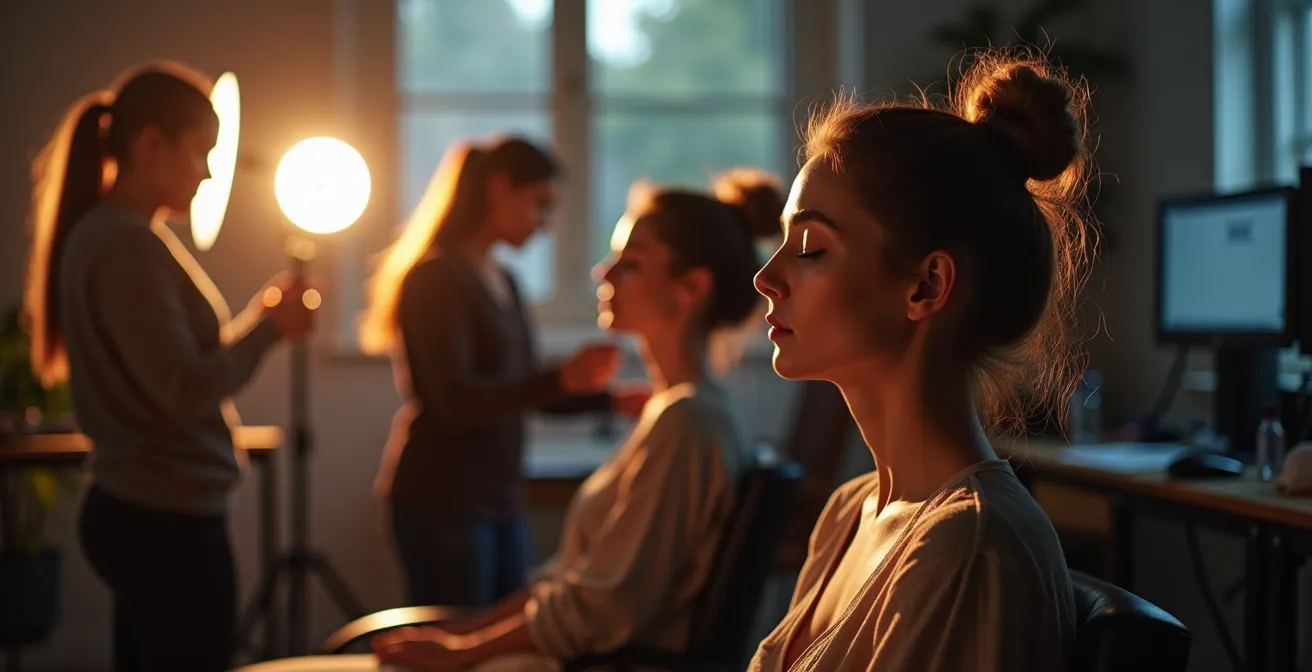
The majority of the time, however, should be dedicated to energy conservation and final checks. As illustrated in the quiet moment of preparation above, this is your time to find a quiet space, hydrate, and mentally center yourself. Avoid heavy snacks or excessive caffeine. This is also the designated time for the hair and makeup team to apply their final, crucial touches, ensuring your look is locked in and will hold under the heat of the studio lights. A professional model’s strategic downtime protocol looks like this:
- Active Observation Phase (0-30 min): Position yourself where you can see the stand-in and lighting crew to understand light placement and mood.
- DIT Consultation (30-45 min): Discreetly approach the DIT to review mood boards and pre-light tests on the monitor for visual alignment.
- Energy Conservation (45-90 min): Find a quiet space away from the main set activity. Practice controlled breathing, hydrate, and avoid phone distractions.
- Final HMU Lock-in (90-120 min): Return to the hair and makeup station for final finessing to ensure everything holds under hot lights.
Stand-In vs. Talent: When Do You Need to Be on Mark for Lighting Checks?
The use of a stand-in is a clear indicator of a high-value production. A stand-in (or second) is a person of similar height and build to the main model, used by the photography and lighting teams to set up and refine the lighting while the main talent is in hair and makeup. Their purpose is purely economic and logistical: to preserve the energy, hair, and makeup of the primary model. Professional workflows show that using stand-ins can reduce main talent’s on-set time by 40-60%, a massive saving in both cost and creative energy over a long shoot day.
As the main talent, your responsibility is to understand when your presence is required and when it is not. During the initial, broad stages of lighting setup, you should remain in your designated preparation area. The crew is working with general light shapes and positions. Interrupting them or hovering on set is counter-productive. You will be called to the “mark” (your designated spot on set) only for critical lighting checks that the stand-in cannot replicate. These moments are specific and deliberate.
You will be called to the set for a few key reasons. First is for skin tone rendering. The team needs to see how the light interacts with your specific complexion. Second is for fabric reflection checks, especially with shiny, sheer, or textured materials that a stand-in’s simple clothing cannot simulate. Finally, you’ll be needed for checks involving key props or specific interactions with the set. Once these brief but vital checks are complete, you will typically be dismissed back to the prep area until shooting officially begins. Respecting this process shows you understand your value and the production’s need to protect it.
The “It’s a Wrap” Protocol: What to Do Before Leaving the Studio?
When the photographer or director calls “It’s a wrap,” the day is over for the creative portion, but your professional responsibilities are not yet complete. How you conduct yourself in the 30 minutes following this call is just as important as your performance on set. This is the “wrap protocol,” a systematic shutdown process that ensures all logistical and financial obligations are met. Leaving prematurely is one of the most unprofessional things a model can do and can create significant problems for the production team.
Your first step is to listen for the “digital handshake.” You should never leave until you hear the DIT (Digital Imaging Technician) confirm that all data from the shoot is backed up and secure, often announced as “data is wrapped.” This is the single most critical checkpoint; leaving before this could be catastrophic if a card fails. While waiting, your next priority is the wardrobe check-out. Every single item you wore, from clothing to accessories, must be returned to the stylist or their assistant. They have a meticulous inventory, especially with high-value designer samples, and you must be formally checked off their list.
Once data and wardrobe are secure, you must handle all production paperwork. This involves finding the Production Coordinator or Manager to sign your model voucher, which is the document that ensures you get paid correctly. You will also need to complete and sign any remaining model release forms. Finally, and only after all other duties are complete, perform strategic thank-yous. Thank the client first (if they are still present), followed by the photographer and art director. A general thank you to the crew is also appreciated. This demonstrates your awareness of the hierarchy and leaves a lasting professional impression.
- Digital Handshake: Wait for the DIT to confirm all data is backed up (“data is wrapped”). Do not leave before this announcement.
- Wardrobe Check-Out: Return every item to the stylist or their assistant for inventory check.
- Production Paperwork: Sign your model voucher and complete all release forms with the Production Coordinator.
- Strategic Thank-Yous: Thank the client first, then the photographer and art director, followed by the crew.
The Mistake of Ignoring the Client Monitor That Can Cost You the Campaign
On set, there are multiple points of view, but only one source of truth: the client monitor. This monitor, often in a separate area known as the “video village,” is where the client, art director, and other key stakeholders watch the images appear in real-time as they are shot. It is managed by the DIT, who applies preliminary color grades (“looks”) and helps rate the images. Ignoring what is happening at this station is a critical mistake for a model. What you feel you are doing and what is being captured can be two different things. The image on that monitor is the only reality that matters.
Your goal is not to hover over the client’s shoulder, which is a major etiquette violation. Instead, you must learn to read the room and listen for feedback originating from that station. You will often hear the photographer receive direction from the art director, who is in turn reacting to what they and the client are seeing. If you hear phrases like “the chin is a bit too high” or “we’re losing the shape of the dress,” that feedback is coming directly from an analysis of the monitor. The most effective models are able to subtly adjust their performance in real-time based on these overheard cues.
Between looks or during brief pauses, you may have an opportunity to glance at the monitor, but always ask for permission from the photographer or DIT first. A simple “May I see?” shows respect for the workflow. Use this opportunity not to judge your appearance, but to understand the technicals: Is the lighting creating an unflattering shadow you can correct with a slight tilt of your head? Is your pose making the garment look less dynamic than intended? The monitor is a feedback tool. Using it wisely allows you to become a more active and intelligent part of the image-creation process, directly contributing to the client’s satisfaction and the campaign’s success.
Why “On Time” Is Actually Late in the Modeling Industry?
In most professions, arriving at the designated start time is considered punctual. In the modeling industry, especially on a large-scale production, arriving at your official call time means you are late. This isn’t an exaggeration; it’s an operational reality. The call time listed on the sheet is the moment you are expected to be fully ready to begin work—seated in the makeup chair, having already checked in, and mentally prepared. It is not your arrival time at the studio door.
The reasoning is rooted in production efficiency and cost. Every member of the crew is interconnected. If the model is not in the makeup chair at 8:00 AM sharp, the makeup artist’s schedule is thrown off. This delays the hair stylist, which in turn delays the start of photography. This cascade of delays can cost a production thousands of dollars. In fact, productions with staggered call times report 35% higher efficiency rates, with protocols for early arrival saving an average of $2,500 per shoot day. Arriving early is your contribution to maintaining that efficiency. It signals to the producer that you are a professional who respects the value of everyone’s time.
The industry standard is to follow the 15-Minute Early Arrival Protocol. This means you should plan to arrive at the studio location at least 15 to 20 minutes before your scheduled call time. This buffer allows you to handle unforeseen issues like parking or finding the entrance without impacting the schedule. It gives you a moment to decompress, use the restroom, grab a coffee, and check in with the production assistant calmly. By the time your official call time hits, you are not flustered or rushing; you are a calm, prepared professional ready to begin.
- Arrival minus 20 minutes: Park, locate the studio entrance, and use the restroom facilities.
- Arrival minus 15 minutes: Check in with the production assistant and get oriented to the space (e.g., model area, catering).
- Arrival minus 10 minutes: Grab coffee or water, find your designated area, and review the call sheet one last time.
- Arrival minus 5 minutes: Engage in mental preparation, reviewing the mood board if it’s available.
- Official Call Time: Be seated in the makeup chair or at your designated first station, fully ready to begin.
Key Takeaways
- The set hierarchy is absolute: Client > Art Director > Photographer. Your role is to execute their vision.
- Your professionalism is judged by your ability to integrate into the workflow, from punctuality to wrap protocols.
- Downtime is preparation time. Use it to observe, align with the creative vision, and conserve energy.
The Unwritten Rules of Set Etiquette That Get You Rebooked?
Beyond the technical aspects of the workflow, a set of unwritten rules of etiquette governs the social dynamics of a shoot. Mastering these is what separates a one-time model from a professional who gets consistently rebooked. These rules all stem from one core principle: respect for the process, the people, and the product. Your attitude and awareness are constantly being evaluated, not just by the photographer, but by every assistant and crew member whose opinion can influence future hiring decisions.
One of the most critical rules concerns digital confidentiality. You should never take personal photos or behind-the-scenes videos with your phone unless you have explicit permission from the producer. The concepts, clothing, and even the lighting setups are confidential intellectual property until the campaign is released. As highlighted in an analysis of industry practices, unauthorized content can lead to immediate blacklisting. Many fashion editorials are created for rates much lower than commercial standards, making the trust and self-promotion from the final images paramount. Violating that trust is a career-ending move.
Another key area is awareness of the crew hierarchy in social settings. Learn the names of the 1st Photo Assistant, the Stylist’s Assistant, and the Production Assistants. Acknowledging their hard work demonstrates you are a team player. At catering, always allow the clients, photographer, and other key creatives to get food first. This small act shows you understand the set’s power dynamics. Finally, maintain a positive but unobtrusive energy. Be available and engaged, but not demanding or distracting. Sound discipline—maintaining absolute silence during takes and when direction is being given—is non-negotiable.
Checklist: Essential Set Etiquette for Rebooking Success
- Digital Protocol: Assume all on-set content is confidential. Never take personal photos or videos without explicit approval from production.
- Assistant Recognition: Learn the names of the 1st Photo Assistant, Stylist’s Assistant, and PAs. Their opinions influence rebooking decisions.
- Catering Hierarchy: Allow clients and key talent (photographer, art director) first access to craft services and catering.
- Sound Discipline: Maintain absolute silence during takes and whenever the photographer or director is giving instructions.
- Energy Management: Stay engaged but not intrusive, available but not demanding, and professional but personable.
Ultimately, your reputation is built on being easy to work with. A model who understands these rules makes the entire production run smoother, which is a quality every client and producer values above all else.
By integrating these protocols into your professional practice, you transform from a simple participant into an indispensable asset. This understanding of the production machine is the ultimate skill that ensures you are not just hired for one job, but booked for a career.