
The core problem for many models is a social media presence that broadcasts “amateur” instead of “premium.” This guide reframes your Instagram from a personal diary into a strategic digital composite card. By applying principles of editorial curation, strategic engagement, and disciplined branding, you will learn to eliminate brand “noise,” project a high-fashion aesthetic, and attract the attention of luxury clients and top-tier booking agents who are looking for their next star.
In the hyper-competitive world of fashion, having a portfolio of stunning photographs is no longer enough. Your social media, particularly Instagram, has become the de facto first impression for booking agents, casting directors, and luxury brands. Yet, many talented models unknowingly sabotage their careers with a digital presence that fails to communicate their high-end potential. You might be posting consistently and showcasing your work, but if your feed is a chaotic mix of professional shots, candid party photos, and random selfies, you’re not building a brand—you’re just creating noise.
The common advice is to “post high-quality content” and “be authentic.” While not incorrect, this is dangerously incomplete. It fails to address the strategic nuance required to appeal to the luxury market. The real challenge isn’t about having good photos; it’s about curating a visual narrative that aligns with the sophisticated aesthetic of high-end fashion. The key isn’t just to be seen, but to be seen as the right fit for brands that value exclusivity and a distinct point of view. This requires a shift in mindset: your Instagram is not a personal album, but your most powerful marketing tool.
But what if the secret to attracting premium clients wasn’t about posting more, but about curating with more discipline? What if your profile could function as a dynamic, editorial-quality composite card that works for you 24/7? This article will guide you through the essential strategies to transform your online presence. We will deconstruct how to plan your content like an editorial spread, engage with industry gatekeepers effectively, and audit your profile to ensure every element signals professionalism and premium value, ultimately turning your digital identity into a powerful client-acquisition machine.
This guide provides a complete roadmap for this transformation. We will cover everything from the foundational mistakes to avoid to the final audit that ensures your profile is client-ready. Here’s a look at the structure we’ll follow to build your premium brand.
Summary: A Strategic Guide to Building Your High-Fashion Personal Brand
- Why Your Party Photos Are Scaring Away Potential Booking Agents?
- Grid Layouts That Mimic Editorial Spreads: How to Plan Your Content?
- How to Comment on Photographers’ Posts to Get Noticed Without Being Annoying?
- What to Write in Your Bio to clearly State Your Representation and Location?
- Model or Influencer: Which Career Path Offers More Longevity for You?
- Pinterest vs. Instagram: How to Build a Mood Board That Communicates Vision?
- Commercial Smiles vs. Editorial Stares: What Is the Right Ratio for You?
- Instagram as a Composite Card: How to Audit Your Profile for Clients?
Why Your Party Photos Are Scaring Away Potential Booking Agents?
In the high-stakes world of fashion, booking agents and casting directors are not just hiring a face; they are investing in a professional. Every post on your social media is a data point in their risk assessment. While a photo from a night out may seem harmless, to an agent, it can be a red flag. It signals a lifestyle that might conflict with the demanding, early-morning call times and rigorous discipline required on a high-fashion set. The industry is rife with stories of agents pressuring models on their lifestyle choices, demonstrating how closely your off-duty behavior is scrutinized. It’s not a judgment on your character, but a business decision based on perceived reliability.
Furthermore, these candid, low-lit photos create “brand noise.” They disrupt the aesthetic cohesion of your profile, diluting the impact of your professional work. A high-end client looking for a model for a luxury campaign needs to see a consistent, aspirational image. A party photo breaks that illusion and positions you as more of a generic social media user than a premium talent. This is particularly critical in an industry where longevity is a challenge. Research reveals that 75% of models face significant age discrimination, making it crucial to build a bulletproof professional brand from day one. Every post should contribute to the narrative of a focused, dedicated, and hireable model.
Think of your grid as the window display of a luxury boutique. Everything inside must be pristine, intentional, and aligned with the brand’s identity. Party photos are the equivalent of a crumpled flyer taped to the glass—they instantly lower the perceived value of everything else. The goal is to build unquestionable professionalism, ensuring an agent sees your profile and thinks “reliable investment,” not “potential liability.” Archiving these photos is not about hiding your personality; it’s about curating your professional identity.
Grid Layouts That Mimic Editorial Spreads: How to Plan Your Content?
To attract high-end clients, your Instagram grid must evolve from a random collection of images into a deliberate, curated visual statement. The goal is to create the same feeling a reader gets when flipping through a luxury fashion magazine: a sense of narrative, rhythm, and aesthetic cohesion. This means thinking like a creative director, not just a content creator. Your grid is a digital editorial, and you are the editor-in-chief. Start by planning your posts in rows of three to ensure a balanced and visually pleasing layout when viewed as a whole. This forces you to consider how each new image interacts with the ones around it.
This process involves defining a clear color palette and mood. Are you aiming for a minimalist aesthetic with muted tones, or a bold, vibrant look? Once defined, this palette should guide your shoots, your editing process, and the order of your posts. You can create visual flow by alternating between close-ups, full-body shots, and more abstract or detailed images (like a hand with jewelry or the texture of a fabric). This variety creates a dynamic rhythm, preventing the grid from feeling monotonous while maintaining a consistent brand feel. The image below illustrates how a strategic arrangement of photos can tell a cohesive color story.
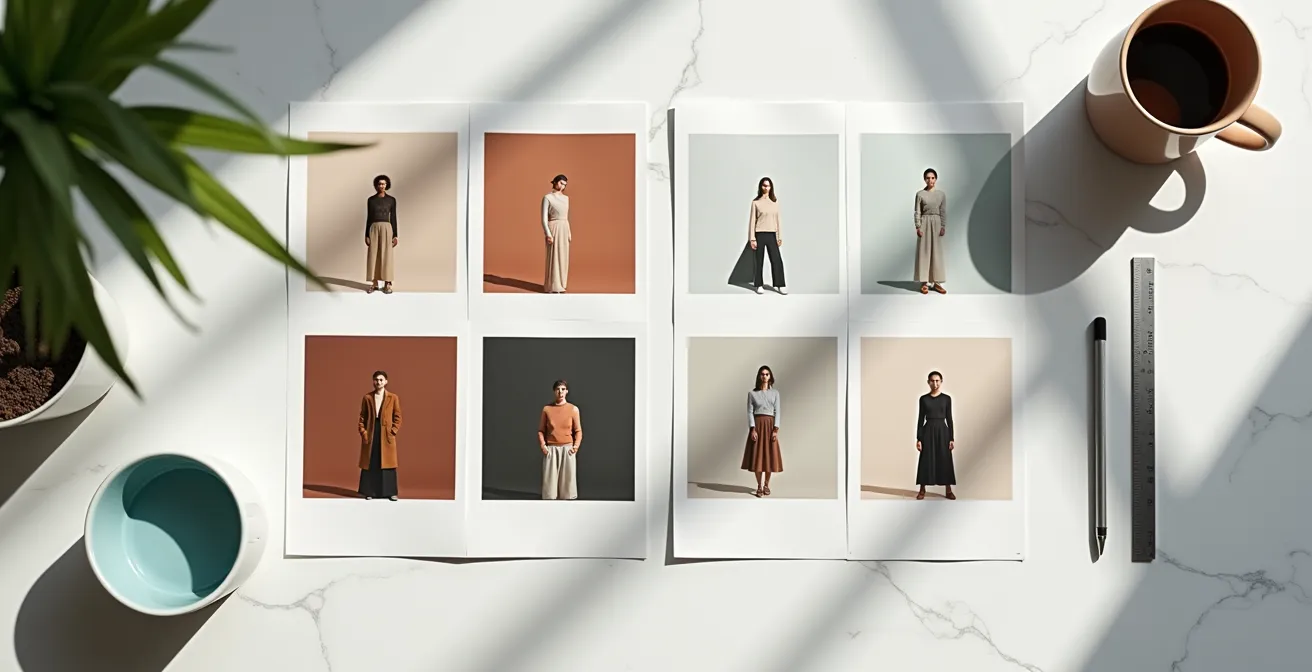
As you can see, planning your grid allows you to create visual “chapters.” You might have a series of nine posts dedicated to a specific color story or a particular editorial theme. This level of planning demonstrates a sophisticated understanding of visual branding that is highly attractive to luxury brands. It shows you’re not just a passive subject but an active collaborator in image-making. Your feed becomes a testament to your creative vision and your ability to execute it, making you a far more compelling candidate for a campaign.
How to Comment on Photographers’ Posts to Get Noticed Without Being Annoying?
Engaging with industry professionals on social media is a delicate art. The goal is to build relationships and get on the radar of photographers, stylists, and editors without coming across as desperate or spammy. Generic comments like “Great shot!” or “🔥” are invisible; they blend into the noise and offer no value. The key to effective engagement is to be specific, insightful, and genuine. Instead of a generic compliment, mention a concrete detail that you appreciate. For example, “The way you captured the light on the silk fabric is incredible,” or “This location perfectly complements the collection’s mood. Inspiring work.”
This approach shows that you have a discerning eye and a genuine appreciation for the craft of image-making. You’re not just seeking attention; you’re participating in a professional conversation. Another powerful strategy is to ask a thoughtful question that invites a response, such as, “Was this shot with a specific filter to achieve that grainy, film-like texture?” This can open a dialogue and make your name memorable. The objective is to position yourself as a peer and a potential collaborator, not just a fan. As industry experts note, this proactive approach is key.
Collaborating with other creators and professionals within the industry can amplify your reach and showcase your versatility. Reach out to photographers, makeup artists, and stylists for collaborative projects. These collaborations not only provide diverse content for your portfolio but also expose you to different audiences.
– The Models Kit UK, Social Media as a Model: Building Your Online Personal Brand
Remember, this is a long-term strategy. Don’t expect a single comment to land you a job. The goal is consistent, value-added interaction over time. By regularly contributing thoughtful comments, you build a reputation as a knowledgeable and engaged professional. When you eventually decide to send a direct message or an email for a potential collaboration, your name will already be familiar, and the reception will be significantly warmer. You will have built a foundation of mutual respect, which is invaluable in this relationship-driven industry.
What to Write in Your Bio to clearly State Your Representation and Location?
Your Instagram bio is your digital business card. In the three seconds it takes for a casting director to glance at your profile, your bio must communicate exactly who you are, where you are, and how to hire you. There is no room for ambiguity, quirky quotes, or a string of unrelated emojis. For a model targeting high-end clients, clarity and professionalism are paramount. Your bio must be a lean, information-dense summary of your professional identity.
The structure should be direct and scannable. The first line should state your profession clearly (e.g., “Model,” “Editorial & Campaign Model”). Immediately follow this with your representation. This is non-negotiable as it legitimizes you and provides a direct channel for professional inquiries. Format it as “[Agency Name] @agencyhandle”. If you are represented in multiple cities, list them. For location, be specific to the markets you work in (e.g., “NYC / Paris / Milan”) rather than a vague “Based in…”. This signals to agents that you are serious about working in those key fashion capitals. Finally, include a professional contact method—either a link to your agency’s booking email or a dedicated professional email address. Avoid using your personal email.
The distinction between a model’s bio and an influencer’s bio is critical. An influencer’s bio is often geared towards audience engagement and brand collaborations, while a model’s bio is a tool for casting. The table below, inspired by expert advice, breaks down the key differences to help you position yourself correctly.
| Bio Element | Model Focus | Influencer Focus |
|---|---|---|
| Primary Identity | Editorial & Campaign Model | Content Creator/Lifestyle Expert |
| Representation | Agency Name + Professional Contact | Management/Direct Business Email |
| Location Format | NYC / Paris / Milan | Based in [City] |
| Call to Action | Portfolio | Polaroids | Video Reel | Latest Video | Shop | Collaborations |
By optimizing your bio with this level of precision, you remove all friction for a potential client. They immediately know your professional status, your key markets, and the correct protocol for booking you. It’s a small detail that makes a massive difference in how you are perceived.
Model or Influencer: Which Career Path Offers More Longevity for You?
The line between model and influencer has become increasingly blurred, but the strategic choice between these paths has significant implications for career longevity. The traditional modeling career, especially in high fashion, is notoriously short-lived. Research has found that for many, it is a brief and financially unstable path; one study found that 47% of models appearing on major catwalks appeared only once, with careers often lasting less than five years. This model is dependent on agents, casting directors, and the ephemeral whims of fashion trends. Your value is tied directly to your physical appearance and its alignment with the current “look.”
In contrast, building a brand as an influencer offers a path to greater autonomy and potentially a longer career. As an influencer, you are not just a face; you are a brand, a content creator, and a business owner. Your value is derived from your voice, your point of view, and the community you build. This allows you to pivot and evolve your brand over time, moving from fashion to lifestyle, beauty, or travel as your interests and your audience’s interests change. You own your platform and your relationship with your audience, which is a powerful asset that transcends age and seasonal trends.
However, the modern industry suggests the most resilient path is a hybrid one. The rise of the “model-influencer” is a dominant trend, with reports indicating that 61% of models now also acting as influencers. This hybrid approach offers the best of both worlds. You can leverage the prestige and access of the high-fashion modeling world to build your initial platform and credibility. Simultaneously, you can build a personal brand and a direct relationship with an audience, creating a safety net and a foundation for a long-term business. This strategy allows you to transition seamlessly from being booked by brands to collaborating with them as a creative partner, ensuring your career has life long after the runway.
Pinterest vs. Instagram: How to Build a Mood Board That Communicates Vision?
While Instagram is your public-facing portfolio, Pinterest is your private creative studio. For a model aiming for the high-end market, using these platforms strategically is crucial for developing and communicating your brand vision. Instagram is for execution; Pinterest is for ideation. A well-curated Pinterest board is an invaluable tool for clarifying your own aesthetic and for showing potential collaborators—like photographers and stylists—that you have a clear, sophisticated creative direction. It’s where you define your brand DNA before you ever post a photo.
On Pinterest, create secret boards dedicated to different facets of your brand. You could have boards for “Lighting & Mood,” “Posing & Movement,” “Styling Inspiration,” and “Dream Collaborators.” Pin images that resonate with the specific aesthetic you want to embody. This isn’t about copying but about collecting influences. Over time, you’ll see patterns emerge that define your unique point of view. This process of curation hones your eye and gives you a powerful visual language to use when discussing shoots. A model who can walk into a meeting with a hyper-curated board for a specific brand or photographer is a model who gets taken seriously.
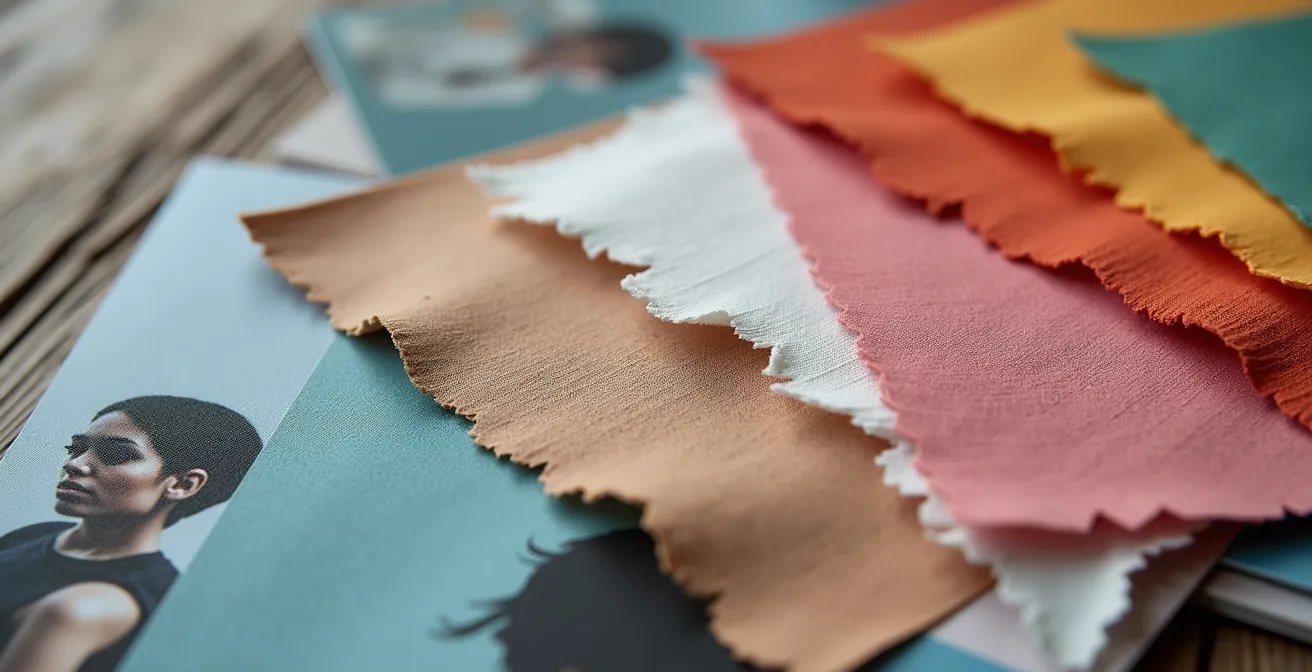
Instagram’s “Saved” collections can then be used in a more tactical way. Use them to create targeted lists, such as “Target Photographers in NYC” or “Brands with My Aesthetic.” This is your active outreach list. While Pinterest is for broad-stroke vision, Instagram collections are for actionable goals. You can then use your refined vision from Pinterest to inform your strategy on Instagram, sharing teasers or behind-the-scenes content that align with your mood boards. This two-platform strategy creates a powerful feedback loop: Pinterest sharpens your vision, and Instagram executes it, demonstrating a level of creative direction that sets you apart from the competition.
Commercial Smiles vs. Editorial Stares: What Is the Right Ratio for You?
The question of whether to smile or to deliver a serious, editorial stare in your photos is not about which is “better,” but which is right for your brand and your target market. A commercial brand selling a relatable lifestyle product often requires warm, accessible, smiling models. In contrast, a high-fashion or luxury brand is typically selling an aspirational, exclusive, and often aloof ideal, which is better conveyed through a powerful, intense, or even vacant stare. Understanding this distinction is the first step in aligning your expression with the clients you want to attract.
Your portfolio—and by extension, your Instagram grid—should demonstrate versatility, but it must be weighted towards your target market. If your goal is to book high-fashion editorials and runway shows, your grid should be dominated by strong, non-smiling images (an 80/20 or 90/10 ratio is a good benchmark). This signals to casting directors that you understand the high-fashion aesthetic and can deliver the specific mood they require. A grid filled with commercial smiles will likely get you typecast and overlooked for these opportunities. Conversely, if you aim for commercial print and TV, a friendlier, more approachable mix is necessary.
Ultimately, the “right ratio” is also about authenticity and playing to your strengths. What is your natural resting expression? What feels most powerful for you on camera? In an industry that has seen a significant 25% increase in diversity representation over the past five years, there is more room than ever for unique looks and expressions. The key is to define your brand’s core emotion—is it joyful and energetic, or is it mysterious and powerful? Once you’ve identified this, you can consciously craft a portfolio of expressions that consistently communicates that feeling. This strategic choice of emotion is far more impactful than randomly alternating between smiling and not smiling.
Key takeaways
- Your Instagram is not a personal album; it is a professional, client-facing digital composite card.
- Eliminate “brand noise” like party photos that signal unreliability and dilute your high-fashion aesthetic.
- Plan your grid like an editorial spread with a cohesive color story and visual rhythm to project sophistication.
Instagram as a Composite Card: How to Audit Your Profile for Clients?
The final, crucial step is to view your Instagram profile through the eyes of a busy, discerning booking agent. This means conducting a ruthless audit to ensure every single element is polished, professional, and aligned with your goal of attracting high-end clients. The first impression is made in seconds. An agent should be able to look at your first nine posts—the “above the fold” content—and understand your brand, your level of professionalism, and your hireability instantly. If the message isn’t clear in five seconds, you’ve likely lost the opportunity.
This audit goes beyond just your posts. Scrutinize your “Highlights” section. This should function as a resume, not a random collection of memories. Structure your Highlights into professional categories like “Published” (for tear sheets), “Digitals” (clean, unedited polaroids), “Movement” (a short video showcasing your walk or posing), and “BTS” (professional behind-the-scenes content). Also, meticulously check your tagged photos. You can’t control what others post, but you can and should hide any tags that are unprofessional or off-brand. The prevalence of scams, causing financial losses exceeding $15 million for aspiring models annually, makes a clean, professional profile a key sign of legitimacy for serious agents.
Finally, your audit must extend to your activity. Review the accounts you follow—do they align with luxury brand values? Scan your past comments to ensure they are professional. Your digital footprint is a holistic representation of your brand. By treating your Instagram as a dynamic composite card, you provide a frictionless, compelling, and ultimately hireable experience for any client who lands on your page. The following checklist will guide you through this essential audit process.
Your Professional Instagram Audit Checklist
- First 9 Posts Review: Does the top of your grid convey a clear, hireable brand message in 5 seconds?
- Highlights as a Resume: Are your Highlights structured into professional sections like ‘Published’, ‘Digitals’, ‘Movement’, and ‘BTS’?
- Content Quality Control: Have you audited and archived old, low-quality, or off-brand posts that dilute your professional image?
- Tagged Photos Management: Have you checked your tagged photos and hidden any that appear unprofessional or inconsistent with your brand?
- Brand Alignment Check: Do the accounts you follow and engage with reflect the values and aesthetic of the luxury brands you want to work with?
By systematically applying these strategies, you elevate your social media from a passive gallery to an active, powerful tool for career advancement. This disciplined, editorial approach is what separates aspiring models from booked, in-demand talent in the luxury fashion space. Begin today by auditing your profile and taking the first step toward building a brand that clients can’t ignore.