
The fastest way to increase your modeling income is to stop posing like a “human hanger” and start performing as a “brand storyteller” who understands sales psychology.
- Success in commercial ads hinges on “emotional transfer”—making the consumer feel what you’re feeling about the product.
- Authenticity isn’t magic; it’s a technical skill built on understanding “relatability triggers” like genuine smiles and relaxed body language.
Recommendation: Ditch the high-fashion ‘cool’ and focus on mastering the micro-stories and expressions that build instant trust and drive conversions for your client.
Alright, let’s talk real talk. You’ve perfected the smize, your angles are sharp enough to cut glass, and you can hold a powerful, static pose for days. You’re a fantastic fashion model. So why do your commercial castings feel… off? You’re told to “just be natural,” “look happy,” or “be more relatable,” but when you try, it feels forced and awkward. The client goes with the model who looks like they could be their friendly next-door neighbor, and you’re left wondering what you’re doing wrong.
The problem isn’t your talent; it’s your training. High fashion rewards you for being a “human hanger”—an aspirational, untouchable canvas for the clothes. But commercial advertising is a completely different game. Here, the product is the hero, and you are the trusted friend recommending it. Your job isn’t to look cool; it’s to generate sales by making a product feel essential to a happy, relatable life. The typical advice to “relax” or “imagine a story” falls flat because it misses the core principle.
This is where we shift our entire mindset. This guide isn’t about simply listing poses. It’s a director’s breakdown of the sales psychology behind every “natural” look. We’re going to move beyond aesthetics and into the mechanics of emotional transfer. We’ll deconstruct why a specific smile triggers consumer trust and how the way you hold a simple prop can make or break a six-figure ad campaign. By the end, you’ll stop *posing* and start *performing* with purpose, transforming yourself into the kind of brand storyteller every commercial client is desperate to hire.
This deep dive will equip you with the strategic tools to master the commercial look. We will explore everything from creating instant on-set chemistry to the financial realities of the industry, giving you a clear roadmap to becoming a top-tier commercial model.
Summary: Your Guide to Mastering Relatable Commercial Posing
- How to Fake Chemistry With a “Family” of Strangers for a Catalog Shoot?
- The “Duchenne Smile”: How to Look Genuinely Happy on Command?
- How to Hold a Coffee Cup So the Logo Shows Without Looking Forced?
- Why Logos and Busy Patterns Are Ruining Your Commercial Test Shoots?
- Lifestyle vs. High Fashion: Which Posing Style Pays the Bills Faster?
- How to Change Poses Every Click Without Losing Your Balance?
- Strips vs. Professional: How to Whiten Teeth Without Destroying Enamel?
- How to Shoot 50 Looks a Day Efficiently for E-Commerce Clients?
How to Fake Chemistry With a “Family” of Strangers for a Catalog Shoot?
The most intimidating part of a lifestyle shoot isn’t the camera; it’s the “husband” you just met 15 minutes ago. High fashion often isolates you, but commercial work throws you into intimate scenarios—family breakfasts, laughing with friends, romantic moments. The brand is selling a feeling of connection, and if the chemistry looks fake, the customer feels it instantly. This is where you move from model to actor. Your goal is to create a believable Micro-Story Blueprint before the first shutter click.
Forget generic thoughts like “be happy.” Get specific. Who are these people to you? What’s your relationship? What inside joke did you just share that made you all laugh? Building this shared narrative, even for a few minutes before shooting, creates a foundation of authenticity. This isn’t just about smiling; it’s about reacting. The Meisner Technique, a core acting principle, is your secret weapon here: focus entirely on your scene partners. React to their subtle movements, their breathing, the way they shift their weight. This creates a chain reaction of genuine interactions that a camera loves.
This shift from internal posing to external reacting is the key. It requires vulnerability and a willingness to play, but it’s what separates a good model from a great one. It builds a believable world that the consumer wants to be a part of. The following checklist provides a concrete framework to build this connection fast.
Your Action Plan: Pre-Shoot Chemistry Building
- Character Assignment: Before shooting, take five minutes to assign specific family or friend roles to each model (e.g., “you’re the witty older sister,” “he’s the goofy dad”).
- Shared Micro-Stories: Actively create small inside jokes or shared background stories with your scene partners during hair and makeup.
- Meisner Focus: During the shoot, make your primary focus reacting truthfully to the subtle movements and expressions of your partners, not just the camera.
- Physical Comfort Practice: Use warm-up time for light exercises or proximity practice to get comfortable being in each other’s personal space.
- Non-Verbal Cues: Secretly establish a few simple, non-verbal signals (like a specific glance or a light touch on the arm) to communicate and reconnect during the shoot.
Ultimately, when you create a genuine connection with your on-set “family,” you’re not just taking a picture; you’re inviting the customer into a warm, desirable moment that they associate with the brand.
The “Duchenne Smile”: How to Look Genuinely Happy on Command?
“Smile!” It’s the simplest direction, yet the hardest to execute authentically. A forced, mouth-only smile is a “relatability killer.” It signals “salesperson” to the consumer’s brain, not “trusted friend.” The gold standard we’re chasing is the Duchenne smile—a genuine expression that involves not just the zygomatic major muscle (lifting the corners of the mouth) but also the orbicularis oculi muscle, which crinkles the corners of your eyes. This is a powerful, subconscious relatability trigger. It’s difficult to fake consciously, which is precisely why it’s so believable when you get it right.
So, how do you conjure it on a long, grueling shoot day? The secret isn’t to “think happy thoughts.” It’s sensory recall. Instead of thinking about the abstract concept of joy, recall a specific, physical sensation. Remember the feeling of sun on your skin, the smell of your favorite food, or the sound of a specific person’s laugh. Connect the emotion to a physical memory. This neurological shortcut helps trigger the facial muscles associated with genuine feeling, bypassing the part of your brain that “fakes” a smile.
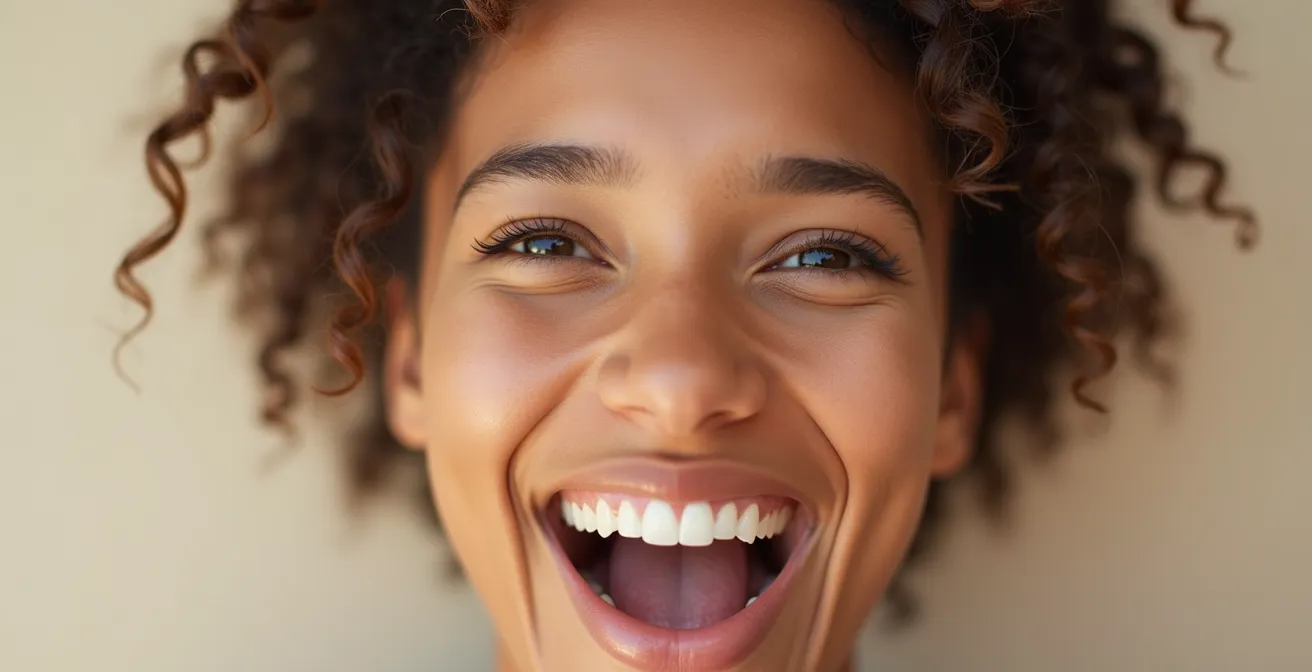
As the image above illustrates, a real smile lives in the eyes. Notice the engagement of the muscles around them. That’s your target. As a professional, you need to develop a library of these sensory triggers you can call upon instantly. It’s a trainable skill, not a happy accident. This is what separates amateurs from models who can deliver authentic emotion take after take.
Case Study: Ruth Crilly’s “Micro-Movement” Method
Veteran British model Ruth Crilly, with over a decade of experience, champions a technique perfect for mastering expressions. She advises against making drastic facial changes between shots. Instead, start with a neutral-positive expression and make tiny, incremental movements. Let the photographer guide you. A slight squint, a soft parting of the lips, a fractional head tilt. This allows you to explore the nuances of a smile and find the “Duchenne moment” without ever looking like you’re forcing a massive, fake grin.
Mastering your emotional triggers is a non-negotiable part of your toolkit. It’s the most direct way to build that “emotional transfer” that clients pay for.
How to Hold a Coffee Cup So the Logo Shows Without Looking Forced?
Here it is: the ultimate test of a commercial model. You’re handed a product—a coffee cup, a smartphone, a bottle of shampoo—and told to “interact with it naturally,” all while keeping the logo perfectly aimed at the camera. This is where high-fashion instincts can fail you spectacularly. A tense, claw-like grip or a stiffly angled wrist screams “I’m being paid to hold this,” instantly shattering the illusion of a casual, everyday moment. The goal is relaxed intentionality.
First, always start with your Micro-Story Blueprint. Why are you holding this cup? Are you warming your hands on a cold morning? Are you about to take a thoughtful first sip? Are you casually listening to a friend while holding it? Each story dictates a different, more natural hand position than simply “holding for the logo.” Your hand becomes a supporting actor, not a desperate product display stand. A relaxed forearm and wrist are critical; tension is visually jarring and signals inauthenticity. Use the “shelf” of your fingers to support the object from below rather than gripping it tightly from the side.
Furthermore, integrate the prop with your entire body. A “casual contrapposto” stance, where your weight is shifted to one leg, will naturally affect how you hold an object in the opposite hand, creating a more dynamic and believable posture. As professional photographer Brandon Andre emphasizes, every part of your body should be engaged, from your head to your toes. The prop shouldn’t feel like an attachment; it should feel like a seamless part of your life’s narrative. This is the essence of conversion posing—making the product look so at home with you that the consumer can’t imagine their own life without it.
When you master this, you’re no longer just holding a product; you’re endorsing a lifestyle, and that’s an infinitely more valuable skill to a brand.
Why Logos and Busy Patterns Are Ruining Your Commercial Test Shoots?
Let’s get straight to the point: when you show up to a commercial casting or a test shoot designed for your commercial portfolio, your trendy, logo-emblazoned t-shirt is actively costing you jobs. As a commercial model, your primary role is to be a relatable canvas onto which the consumer can project themselves and the brand can project its message. Your personal style, no matter how cool, is a distraction. The client isn’t hiring *you*; they’re hiring a character who will sell their product.
Busy patterns, bold graphics, and visible logos from other brands create visual noise. They draw the viewer’s eye away from the two things that matter: your expressive face and the client’s product. A casting director needs to see if your look is versatile enough to represent a bank, a cereal brand, or a pharmaceutical company. A loud t-shirt immediately boxes you in and makes it harder for them to envision you in their campaign. You must be a brand-neutral vessel. This means your test shoot and casting wardrobe should consist of solid, neutral colors: grays, navies, olives, beiges, and clean whites. Think simple, well-fitting t-shirts, jeans, and sweaters with no distracting elements.
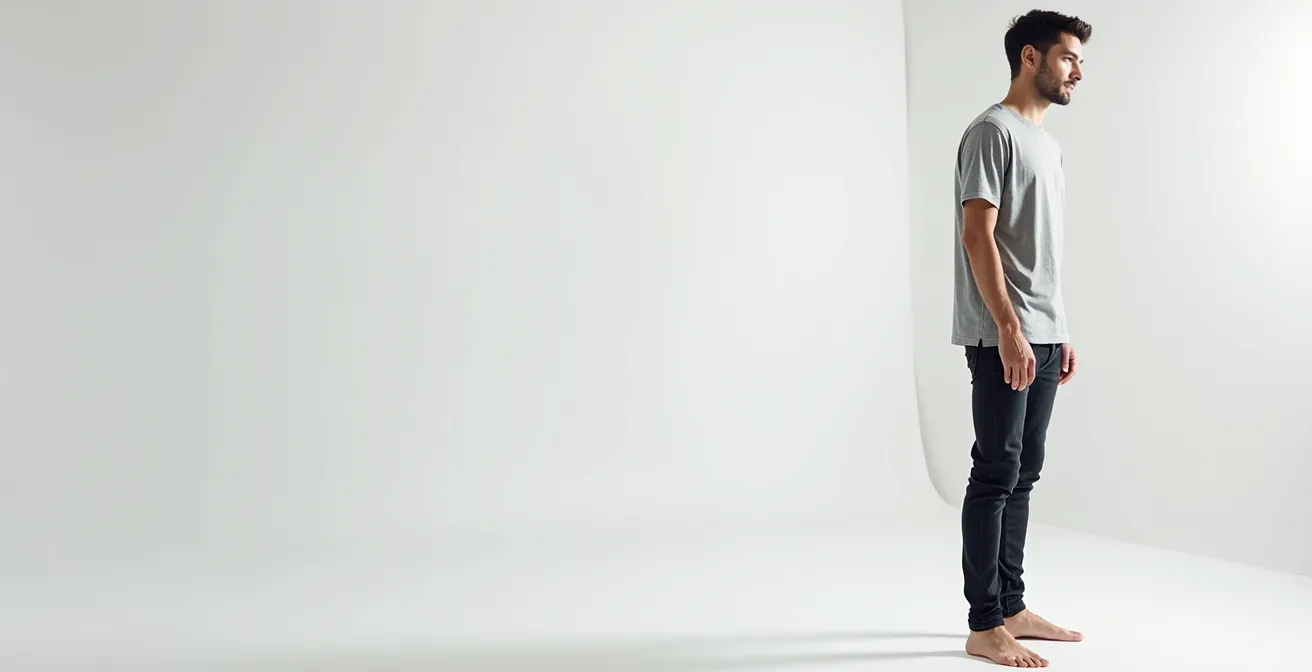
This isn’t just about clothing. It extends to every part of your presentation. As one fashion photographer for TREND45 bluntly put it, “I’ve been unable to use some photos because of the model’s feet and hands.” Chipped nail polish, unkempt hands, or neglected feet can ruin an otherwise perfect shot, especially in lifestyle ads where these details are often visible and need to look clean and relatable. You are the complete package, and every detail must be polished and neutral, ready to be molded into the brand’s story.
By presenting a clean, polished, and brand-neutral appearance, you’re telling the client you understand your role: to make their brand the star of the show.
Lifestyle vs. High Fashion: Which Posing Style Pays the Bills Faster?
For many models transitioning from high fashion, the allure of editorial spreads and runway shows is powerful. But from a purely financial and career-longevity perspective, the commercial lifestyle market is an undeniable powerhouse. While a high-fashion campaign might offer a huge payout, those jobs are sporadic and hyper-competitive. Commercial modeling provides a steadier, more reliable income stream because the volume of work is exponentially larger.
Think about it: for every single high-fashion magazine, there are thousands of companies that need models for their websites, social media ads, catalogs, packaging, and TV spots. An industry analysis from MasterClass highlights a key distinction: the high-fashion world often seeks a “human hanger” to display clothes, while the commercial world looks for a “human story” to sell a product. This fundamental difference opens the door to a much wider range of opportunities. The physical requirements are far more inclusive, embracing all ages, ethnicities, and body types. The industry needs models who look like real, trustworthy people, not unattainable ideals.
This table breaks down the key career differences:
| Aspect | Lifestyle/Commercial | High Fashion |
|---|---|---|
| Job Volume | High (catalogs, e-commerce, ads) | Low (campaigns, editorials) |
| Pay Per Job | Moderate but consistent | High but sporadic |
| Physical Requirements | Inclusive, all body types | Strict height/size requirements |
| Market Saturation | Growing with social media | Highly saturated |
| Casting Mindset | Looking for ‘human story’ | Looking for ‘human hanger’ |
While high fashion offers prestige, commercial modeling offers stability and a longer career path. Mastering the art of relatable, emotive posing isn’t just adding a new skill; it’s making a strategic business decision to tap into a larger, more sustainable market. It’s about ensuring you can pay your bills with modeling for years to come, not just for one spectacular season.
Choosing to develop your commercial skills is an investment in your own longevity as a professional model.
How to Change Poses Every Click Without Losing Your Balance?
You’re on set. The photographer is in the zone, shooting at a rapid pace. “Give me more! Change it up! Every click!” This is where fashion models can either shine or stumble—literally. The instinct to strike a completely new, dramatic pose every second can lead to frantic, unbalanced movements that look awkward and disconnected. The commercial director’s secret is the Rhythm Method: a system of continuous, controlled micro-shifts that generates maximum variety with minimum effort.
Forget about creating 50 entirely different poses. Instead, think in “posing families.” You start with a strong, stable base pose. From there, you flow through a series of small, deliberate variations. This creates a fluid, dance-like movement rather than a series of disconnected jerks. Your core should always be engaged; it’s your anchor point for stability. From that stable center, you can make a series of micro-shifts in a predictable rhythm.
Expert Technique: The TREND45 Posing System
Remy, CEO of TREND45 and a signed model, teaches a simple yet powerful system for dynamic posing that you can adopt right now. As detailed in their professional posing guide, the rhythm is: look in a different direction after every click, and change your major pose every third click. This simple rule ensures you’re constantly providing the photographer with new angles for the face (the most important part) while maintaining a stable body position. The key is to never be symmetrical and to make deliberate, controlled movements. This methodical approach gives the client a rich variety of usable shots without ever looking chaotic.
Your goal is to become a “variety generator” for the client. By mastering a system of micro-shifts—a head tilt, a change in gaze, a slight bend of the knee, a subtle hand movement—you can deliver dozens of unique options from a single core stance. This level of efficiency and control is what makes you an invaluable asset on any fast-paced commercial shoot.
Practice this rhythm until it becomes second nature. It’s the key to looking both dynamic and effortlessly in control.
Strips vs. Professional: How to Whiten Teeth Without Destroying Enamel?
In the world of commercial modeling, your smile isn’t just an expression; it’s a valuable asset. A bright, healthy-looking smile conveys vitality and trust. However, the quest for the perfect shade of white can be a minefield. The biggest mistake models make is over-whitening or using harsh methods that lead to sensitive teeth and unnatural-looking results. The goal is a bright, natural white, not an opaque, “chiclet white” that looks artificial and distracts from the product.
Over-the-counter whitening strips are popular for their convenience and low cost. They typically use a lower concentration of peroxide gel. While generally safe for short-term use, their one-size-fits-all design can lead to uneven results and gum irritation if the strip doesn’t fit your teeth perfectly. Prolonged or excessive use of strips can absolutely lead to enamel erosion and significant tooth sensitivity, which is a disaster on a shoot day when you need to smile comfortably for hours.
Professional, in-office whitening administered by a dentist offers a safer, more controlled alternative. The dentist uses a higher concentration of peroxide, but protects your gums with a barrier and can precisely control the application. This delivers faster, more even results. Custom-molded take-home trays from a dentist are another excellent option, offering professional-grade results with the convenience of at-home use, but with a much lower risk of gum irritation than strips. While more expensive upfront, professional options should be seen as an investment in your career’s longevity and comfort. Damaging your enamel is irreversible and can lead to a lifetime of sensitivity and dental issues.
Always consult a dentist to find the best approach for your specific needs, prioritizing the long-term health of your enamel over a quick, temporary fix.
Key Takeaways
- Your primary job in commercial modeling is to transfer a relatable emotion to the product, not just to look good.
- Authenticity is a technical skill: master “relatability triggers” like the Duchenne smile and relaxed body language.
- Treat every pose as a “Micro-Story Blueprint” to make your interactions with products and people believable and engaging.
How to Shoot 50 Looks a Day Efficiently for E-Commerce Clients?
Welcome to the e-commerce marathon. Shooting 50, 75, or even 100+ looks in a single day is the ultimate test of a commercial model’s professionalism, stamina, and efficiency. This isn’t about creative exploration; it’s a high-volume manufacturing process where time is money. Your ability to deliver clean, consistent, and varied poses at speed is what will get you rebooked. To survive and thrive, you need a strategy. You must think and prepare like an athlete.
First, preparation is everything. Arrive on set with a pre-written “posing playbook” of 10-15 go-to poses that you know work for your body. This eliminates the need to “find it” on the day. Fuel your body properly: complex carbs the night before and protein-rich snacks during the shoot will maintain your energy levels and prevent a crash. But the most important skill is mental energy management. Use a system like the Pomodoro Technique: give 25 minutes of intense focus, then use the 5-minute changeover to deliberately disconnect. Close your eyes, practice deep breathing, and reset. Don’t waste that precious time scrolling on your phone.
Start the day with your strongest, most energetic poses. Save more experimental or difficult poses for the middle of the session when you’re warmed up but not yet exhausted. As photographer and posing expert David Genik states, you must view this as a performance designed for a specific outcome. His powerful insight reminds us that “Mastering the intentional art of striking an ecommerce pose proves essential for encouraging high conversion.” Every pose has a purpose: to show the product clearly and entice a customer to click “add to cart.”
By combining physical preparation, mental discipline, and a clear posing strategy, you transform yourself from a model into a highly efficient, indispensable partner for any e-commerce brand.
Frequently Asked Questions on a Model’s Appearance
When should models whiten their teeth before a shoot?
Allow a ‘whitening window’ of at least 1-2 weeks before bookings to avoid shoot-day sensitivity that can make smiling painful for hours.
What shade of white works best for commercial modeling?
Aim for bright but translucent ‘natural white’ rather than opaque ‘chiclet white’ which can look artificial and distracting in lifestyle roles.
Are there alternatives to chemical whitening for last-minute needs?
Use color-neutralizing techniques like blue-toned lipstick or avoid coffee/tea on shoot day to optically brighten teeth without harsh chemicals.