High fashion doesn’t want conventional beauty; it requires a precise, functional canvas to execute a creative vision.
- Measurements, particularly the 90cm hip rule, are economic decisions driven by the fixed costs of sample size production, not aesthetic preferences.
- “Imperfections” are only assets if they create a memorable brand signature that casting directors can leverage, not if they disrupt facial harmony.
Recommendation: Stop trying to be ‘pretty.’ Start analyzing if your physical and mental attributes meet the non-negotiable technical specifications of the brands you target.
Forget what you’ve heard about being “discovered” in a shopping mall. The path to the high fashion runways of Paris, Milan, or New York is not a fairy tale; it’s a brutal filtration process. Aspiring models often cling to vague advice like “be confident” or “have a unique look,” believing their passion is enough. It is not. This industry does not run on passion; it runs on precision, economics, and a very specific aesthetic functionality.
The truth is, luxury brands are not looking for the most beautiful person in the room. They are looking for a specific canvas that aligns with their collection’s narrative and, more importantly, fits their pre-existing sample garments without alteration. Your body is not just a body; it is a set of technical specifications. Your face is not just a face; it is a potential brand signature. Understanding this distinction is the first and most critical step.
But if the entire system is built on such rigid, impersonal metrics, how does one navigate it? This is not about changing who you are, but about understanding where—or if—you fit. This is about deconstructing the myth of beauty and replacing it with the reality of commercial viability. This article will dissect the unwritten rules and expose the logic behind the industry’s most demanding standards. We will cover the hard metrics, the value of strategic “flaws,” the psychological resilience required, and the business decisions that will define your career trajectory.
Contents: The Unfiltered Guide to High Fashion Standards
- Why 90cm Hips Are the Absolute Limit for Paris Runways?
- Gap Teeth and Large Ears: Why “Imperfections” Are Assets in High Fashion?
- How to Handle 15 Rejections a Day During Paris Fashion Week?
- Why You Must Wear Zero Makeup to a High Fashion Polaroid Session?
- Too Short for Runway: How to Pivot Your High Fashion Look to Beauty?
- Why Your Shoulders Are Moving Too Much and How to Stabilize Them?
- How to Pose in Restrictive Couture Garments Without Looking Stiff?
- Mother Agency vs. Booking Agency: Which Representation Model Accelerates Your Career?
Why 90cm Hips Are the Absolute Limit for Paris Runways?
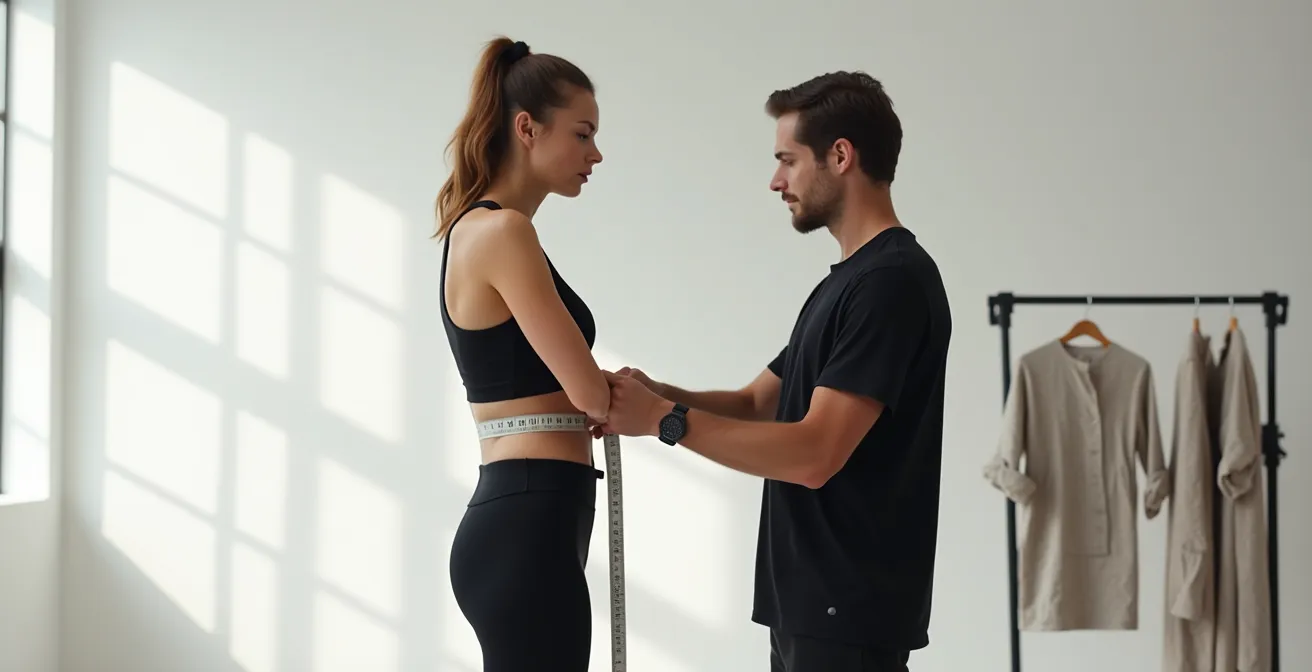
Let’s be clear: the 90cm (35.5 inches) hip measurement is not an aesthetic preference. It is an industrial standard. Every single sample garment, from a Dior haute couture gown to a Prada skirt, is created on a standardized dress form. Altering these one-of-a-kind samples to fit a model is expensive, time-consuming, and risks damaging the garment. The house needs a model who fits the clothes, not the other way around. Your measurements are the first line on your resume, and if they don’t match the technical specifications, you won’t even be considered.
This is a rule of pure economics. While there is a slight tolerance, anything significantly over 90cm means you simply do not fit the product you are hired to display. In fact, most working runway models are even smaller. Research shows that runway models typically maintain an average hip measurement closer to 86cm. This is the brutal reality. The designer’s vision is paramount, and that vision is executed on a specific, non-negotiable frame.
To succeed, you must view your body as a high-performance tool that must meet a set of precise requirements. The way a luxury fabric drapes is calculated to the millimeter, and your body is the structure that brings that calculation to life. A few centimeters can be the difference between making the fabric flow as intended or disrupting its entire line.
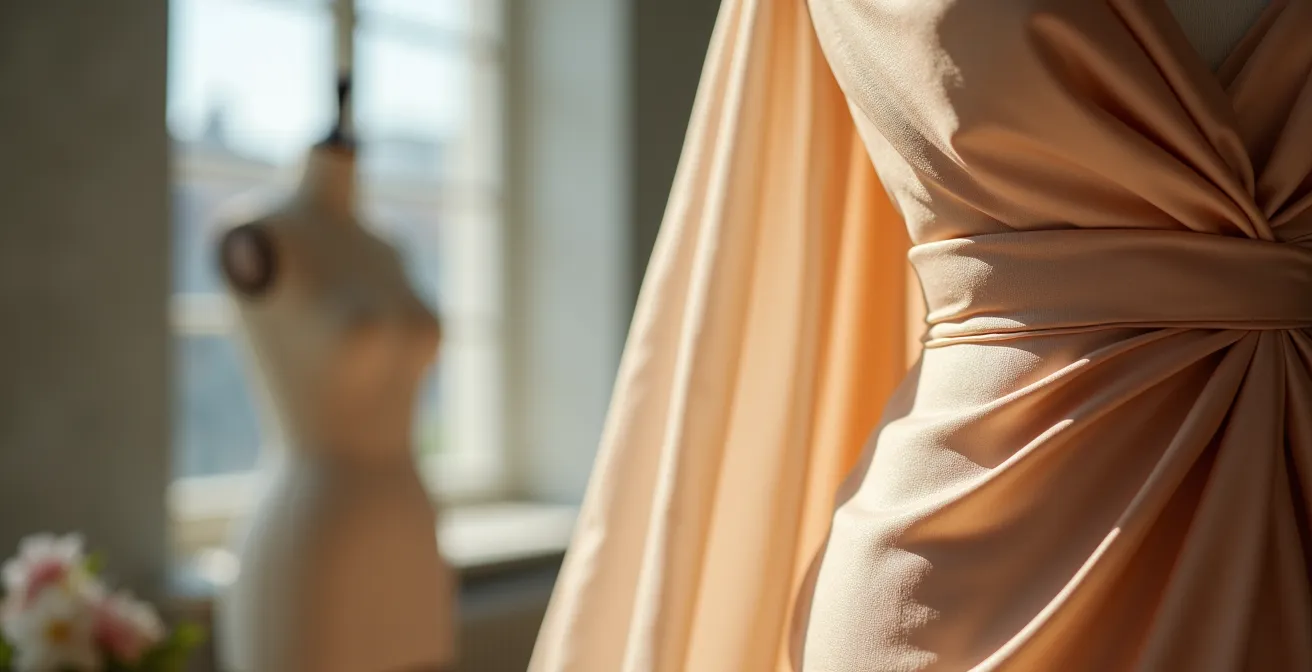
As you can see, the precision of the fit is everything. The fabric is the star, and the model is the perfect, unobtrusive frame that allows it to perform. This isn’t personal; it’s a fundamental requirement of the job. If your measurements are not within this range, runway work in the major European markets is, realistically, not a viable career path.
Gap Teeth and Large Ears: Why “Imperfections” Are Assets in High Fashion?
While measurements are a rigid science, the face is where art and commerce intersect. A common misconception is that high fashion wants “perfection.” It does not. It wants a memorable signature. A conventionally pretty face is often forgettable. A face with a strong, unique feature—a “signature flaw”—can cut through the noise of a casting and stick in a designer’s mind. Think of Lara Stone’s gap teeth, Daphne Groeneveld’s full lips, or Alek Wek’s striking features. These are not flaws; they are brand assets.
However, not all imperfections are created equal. The key is whether the feature adds character without disrupting the overall harmony of the face. Does it draw the eye in an interesting way, or does it distract? A casting director is evaluating if your “flaw” can be leveraged. Can it tell a story? Can it sell a product? A strong jawline might be perfect for a powerful, minimalist brand like Jil Sander, while delicate, otherworldly features might be ideal for Givenchy.
The goal is to be a “character” canvas, not a generic one. Your unique features must be photogenic and versatile enough to work under various lighting conditions and with different creative concepts. The industry celebrates features that are distinctive, not features that are simply “odd.” This is a critical distinction that many aspiring models fail to make. Your look is either a tool that can be used or it isn’t.
How to Handle 15 Rejections a Day During Paris Fashion Week?
Paris Fashion Week is not a glamorous party; it is a high-stakes, high-volume job interview that you will fail, repeatedly. You might attend 15 castings in a single day and hear “no” (or, more likely, a deafening silence) at every single one. If you internalize this rejection personally, you will break. The psychological toll is immense, and studies from the fashion industry reveal that nearly 48.8% of models report psychological difficulties. Your mental resilience is as important as your measurements.
The professional approach is to reframe rejection as data collection. You are not being told “you are not good enough.” You are being told “you are not the right fit for this specific project.” Each “no” is a data point. Is there a pattern? Are you being rejected by commercial brands but getting callbacks from avant-garde designers? This is market feedback. Use it to refine your strategy, not to erode your self-worth. Imposter syndrome is rampant, but treating rejection as an emotional failure is a rookie mistake.
You must build a mental fortress. This involves disciplined routines and a complete separation of your professional identity from your personal self. The models who have long, successful careers are not the ones who never get rejected; they are the ones who have systemized their response to it. They treat it as part of the job, like filling out paperwork or waiting for a flight. It is impersonal, and you must become impersonal in your reaction to it.
Your Mental Armour Protocol for Fashion Week
- Pre-Casting Visualization: Before your first appointment, spend 5 minutes visualizing successful, professional interactions, focusing on your conduct, not the outcome.
- Mid-Day Reset: Between castings, practice box breathing (4-second inhale, 4-second hold, 4-second exhale, 4-second hold) to lower cortisol levels and reset your nervous system.
- Post-Day Debrief: At the end of the day, journal three positive interactions or moments, regardless of booking outcomes. This trains your brain to see progress beyond just a “yes.”
- Feedback Analysis: Track any specific feedback you receive. Look for patterns in the types of clients who respond positively to your look.
- Worth Separation: End your day by consciously stating, “The feedback I received today was about my market fit for a specific product, not my value as a person.”
Why You Must Wear Zero Makeup to a High Fashion Polaroid Session?
Showing up to a casting or a polaroid session with makeup is one of the fastest ways to be dismissed. It sends a clear signal: you are an amateur, and you do not understand your role. Your role is to be a blank canvas. A casting director, designer, or makeup artist needs to see the raw material they have to work with: your bone structure, your skin texture, your natural lip color, and the shape of your brows. Makeup obscures all of this.
They are not interested in how you see yourself or how “good” you can make yourself look. They are interested in your potential for transformation. Their job is to envision you in a dozen different looks, from a no-makeup “natural” campaign to a highly conceptual editorial with avant-garde makeup. Foundation, concealer, and mascara hide the very features they need to assess. It’s like a painter being handed a canvas that someone has already sketched on. It’s useless.
The professional standard is non-negotiable. You arrive with a clean, moisturized face and nothing else. This shows confidence in your natural look and respect for the creative team’s process. It demonstrates that you understand that you are not the final product; you are the starting point. Here are the exact rules:
- Arrive with completely clean, well-moisturized skin. No foundation, no powder, no tinted moisturizer.
- Wear your hair down in its natural state. No styling products, no elaborate updos. They need to see its texture and length.
- Choose simple, form-fitting clothing in a solid, neutral color (usually black or white). A simple tank top and skinny jeans or a black bikini is standard.
- Remove all jewelry. Small, simple ear studs may be permissible, but nothing else.
- Bring your portfolio and a positive, professional attitude. Trust that the team can see your potential without any enhancement.
Too Short for Runway: How to Pivot Your High Fashion Look to Beauty?
Let’s be blunt. If you are under the standard height requirement for runway (typically 5’9″ / 175cm for women), your chances of a runway career are virtually zero. This is another hard, economic reality of the industry. While exceptions exist, they are so rare they prove the rule. In fact, recent industry data shows that only around 2.3% of professional modeling contracts go to models considered “petite.” Wasting your time and energy chasing an impossible goal is a strategic error.
However, having a high-fashion “look” on a shorter frame is not a dead end. It is a signal to pivot. The most lucrative and viable alternative is the beauty market. Cosmetics, skincare, and jewelry campaigns do not depend on your height. They depend on the quality of your skin, the symmetry of your features, your facial expressiveness, and the elegance of your hands and neck. Your face becomes your primary asset.
This requires a complete strategic overhaul of your portfolio and your skills. Full-length body shots become irrelevant. Your book must be dominated by pristine, high-impact beauty shots and expressive close-ups. You are no longer selling a full look; you are selling a mood, a flawless complexion, or the way a diamond earring catches the light. The skill set shifts from walking to micro-expressions and holding intense poses for long periods.
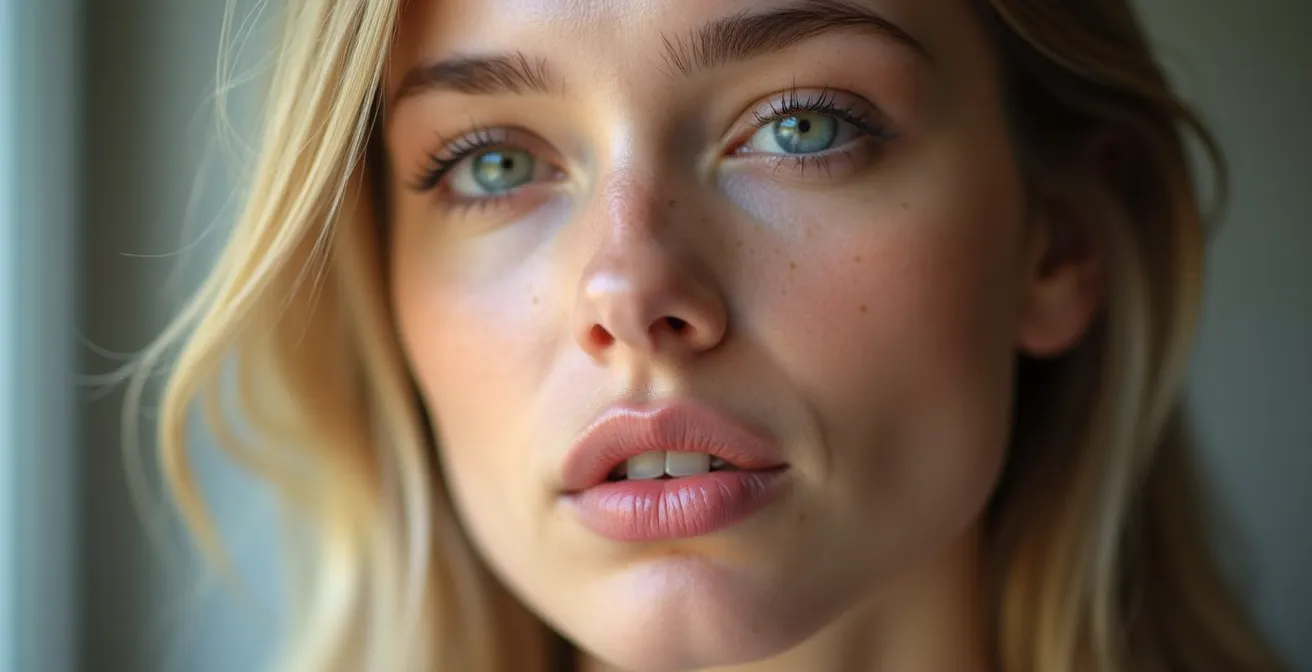
This pivot requires a conscious business decision. Your portfolio must be ruthlessly curated to reflect this new focus.
- Remove all full-length body shots from your main portfolio. They highlight what you are not (a runway model).
- Commission new test shoots with top beauty photographers that focus exclusively on face-dominant, clean beauty looks.
- Add commercial-style beauty shots that demonstrate your ability to work with products (e.g., lipstick application, skincare).
- Showcase expressive close-ups that display a range of subtle emotions. Can you convey joy, serenity, or longing with just your eyes?
- If applicable, create specialized shots focusing on hands and face for jewelry or nail polish clients.
Why Your Shoulders Are Moving Too Much and How to Stabilize Them?
A model’s walk is often misunderstood. It’s not about being dramatic or putting on a show. The purpose of a runway walk is to make the clothes move beautifully. The model should be almost invisible, a “suspended” frame that provides a stable base for the garment to come alive. One of the most common mistakes aspiring models make is excessive shoulder movement. Swinging or bouncing shoulders are distracting and make the clothes look cheap. They disrupt the clean lines the designer worked so hard to create.
Your torso, from your shoulders to your hips, should move as a single, stable unit. The movement should originate from your hips and legs, propelling you forward with a smooth, gliding motion. Your shoulders should remain perfectly still and level, acting as a “hanger” for the clothes. This requires immense core strength and stability. It’s a technique that looks effortless but is the result of disciplined physical conditioning, much like a dancer or an athlete.
If your shoulders move when you walk, it’s a sign of a weak core and poor posture. You are compensating for a lack of control by using your upper body for momentum. This is an immediate red flag for any casting director. The solution is not to “try” to keep your shoulders still; it is to build the underlying core strength that makes stability automatic. This is achieved through targeted, off-runway training.
- Daily Planks: This is non-negotiable. Hold a perfect plank for 60 seconds, rest, and repeat 3 times. This builds foundational core stability.
- Pilates Hundreds: Perform 100 counts daily. This exercise specifically targets the deep abdominal muscles required to stabilize the torso.
- Resistance Band Scapular Retractions: Loop a band around a pole at chest height. Pull back, squeezing your shoulder blades together. Do 3 sets of 15 reps to strengthen the muscles that hold your shoulders in place.
- Wall Slides: Stand with your back against a wall, feet slightly forward. Ensure your lower back, shoulder blades, and head are touching the wall. Slide down and up without letting your back arch. This drills perfect posture.
- Suspended Walk Practice: Practice your walk for 20 minutes daily with a book balanced on your head. This forces you to engage your core and eliminate any bouncing.
How to Pose in Restrictive Couture Garments Without Looking Stiff?
Wearing a couture garment can feel like being encased in a beautiful, fragile sculpture. These pieces are often heavy, restrictive, and delicate. The amateur model will either look terrified of breaking it or become completely stiff, resulting in a lifeless photograph. The professional model understands how to work with the garment, not against it. They use a technique of internal opposition to create dynamic tension and life within the pose, even with minimal movement.
Internal opposition is a concept borrowed from dance and yoga. It means that while you are holding a pose, you are creating subtle, opposing forces within your own body. For example, if you are wearing a heavy, structured jacket that limits arm movement, you can still create energy by internally reaching through your fingertips while simultaneously rooting down through your spine. The garment is static, but your internal energy is dynamic. This reads on camera as poise and strength, not stiffness.
Breath is your most powerful tool. A stiff model holds their breath. A great model breathes into the constraints of the garment. Controlled, micro-breaths can create subtle shifts in posture and expression that bring a photograph to life. You must learn to feel the garment’s weight and structure and use it to your advantage—letting a heavy sleeve elongate your line, for instance. Your job is to portray the look, and that requires you to become a master of your own internal mechanics.
- Feel the Garment: Before shooting, take a moment to move in the garment. Understand its weight, where it pulls, and where it restricts. This is your new anatomy.
- Create Internal Forces: In any pose, actively think about creating two opposing points of energy. Lengthen your spine upwards while grounding your feet downwards.
- Use Micro-Breaths: Instead of holding your breath, take small, controlled sips of air. Use the exhale to subtly deepen a pose or relax your shoulders.
- Work with the Weight: Use the garment’s weight to enhance your posture rather than letting it collapse you. A heavy shoulder piece can help you find a stronger, more elegant neck line.
- Release Between Shots: As soon as the photographer says “cut,” take a deep, full exhale to release all tension. This prevents stiffness from building up over a long shoot.
Key Takeaways
- High fashion demands a specific, functional canvas; conventional “beauty” is often irrelevant.
- Physical measurements are non-negotiable technical specifications driven by the economics of sample size production.
- “Imperfections” are only valuable if they can be leveraged as a memorable brand signature.
- Mental resilience and the ability to treat rejection as impersonal data are core professional skills.
- Your career path (runway vs. beauty) must be a strategic decision based on a brutal assessment of your physical metrics.
Mother Agency vs. Booking Agency: Which Representation Model Accelerates Your Career?
Securing representation is the primary business objective for any serious model. However, many new talents are confused by the different types of agencies. Understanding the distinction between a Mother Agency and a Booking Agency is critical, as choosing the right one at the right time can dramatically accelerate—or stall—your career. They serve fundamentally different purposes.
A Mother Agency is a development agency. Their primary function is to discover raw talent, develop their look, build their initial portfolio, and provide the training and guidance needed to enter the market. They are an investment partner. They take a higher commission (often an additional 10-20% on top of the booking agency’s cut) because they are investing significant time and resources upfront to build your career from scratch. This is typically the correct first step for a new model in their first 0-2 years.
A Booking Agency (or “placement agency”) is focused on revenue generation. They are the major agencies in the main fashion capitals (e.g., Ford, Elite, IMG). Their job is not to develop you; it’s to book you for jobs with their extensive client network. They expect a model to arrive fully developed, with a strong portfolio and a professional understanding of the industry. They work on a standard commission (around 20%). A mother agency’s goal is to place their developed models with these powerful booking agencies in international markets.
This table outlines the core differences. A mother agency invests in your potential; a booking agency capitalizes on your established value. As Modnet, an industry resource, explains, the agency relationship is central to a high-fashion career. They provide the infrastructure for success.
| Aspect | Mother Agency | Booking Agency |
|---|---|---|
| Primary Function | Development & Training | Booking & Revenue Generation |
| Career Stage | Years 0-2: New Models | Years 2-7: Established Models |
| Investment Type | High development investment | Market penetration focus |
| Commission Rate | Higher (20-30%) | Standard (15-20%) |
| Geographic Reach | Local/Regional | International |
The traditional route involves securing representation with reputable agencies specializing in high-fashion models. Top agencies provide crucial connections to major clients while handling business aspects like booking and payment.
– Modnet, What is a high-fashion model and the requirements to be one?
Choosing your representation is the most important business decision you will make. Do not rush it. Analyze your current stage of development and select the partner—Mother or Booking—that aligns with your immediate needs. Your career is a business; treat it as such.