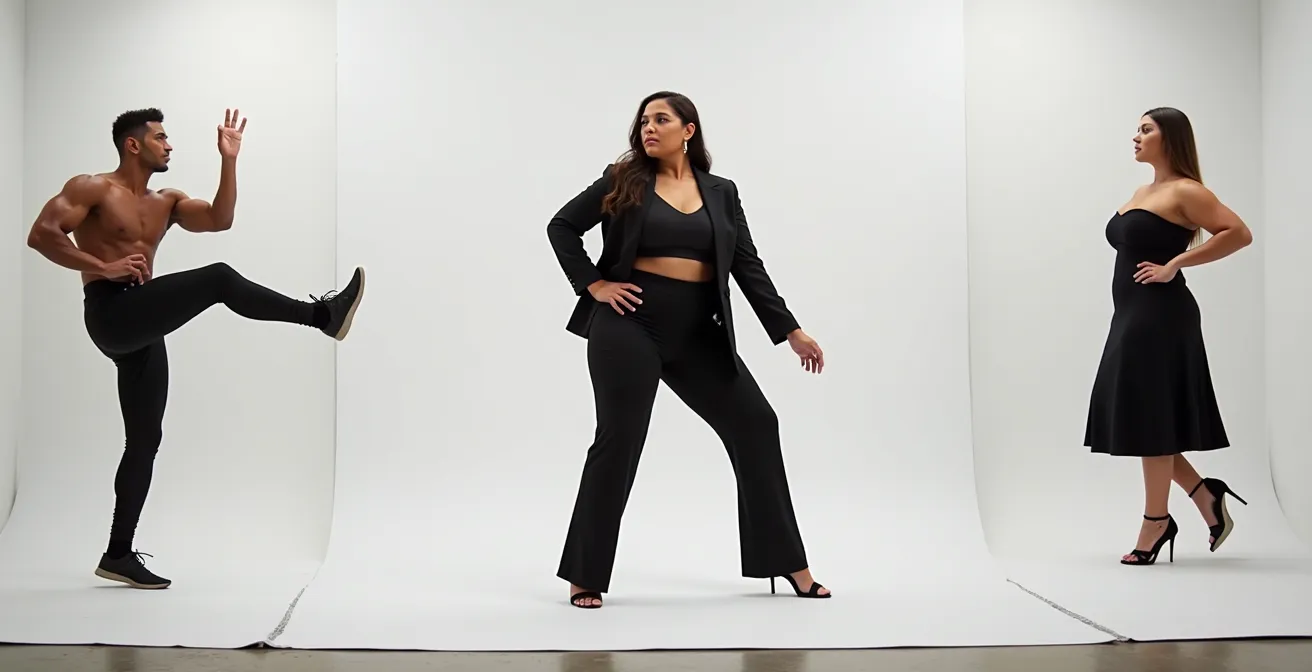
Contrary to popular belief, maximizing your modeling income has less to do with fitting a narrow beauty standard and more to do with strategically targeting the niche with the best business mechanics for your unique physical assets.
- High-demand niches like parts modeling and fit modeling often offer higher and more stable pay rates than traditional commercial work.
- Success isn’t just about your “look”; it’s about understanding the client’s technical needs and delivering professional, efficient performance.
Recommendation: Shift your mindset from “How do I look?” to “What is the market value of my specific attributes?” and build your portfolio as a targeted business proposal to that niche.
For decades, the path to a successful modeling career seemed singular and unforgiving: be tall, be thin, be young. This narrow definition has left countless aspiring models feeling excluded, believing that if they don’t fit the runway mold, they have no real earning potential. The common advice is often to “find a niche that fits you,” a vague platitude that ignores the most critical question for any professional: where is the money?
The conversation around modeling is often stuck on aesthetics, but the industry itself runs on cold, hard economics. While one model struggles for inconsistent editorial bookings, another is earning a stable, six-figure income because their size 8 proportions are the perfect technical standard for a major clothing brand. This isn’t about luck; it’s about strategy. It’s about understanding that different niches operate with entirely different business models, pay scales, and career trajectories.
This guide breaks that paradigm. We’re going to move beyond the surface-level discussion of “types” and delve into the economic mechanics of the most profitable modeling niches. Forget what you’ve been told about having the “right look.” The key to a lucrative and sustainable career lies in identifying your most marketable assets—whether it’s your hands, your athletic ability, or your precise measurements—and leveraging them in the market that values them most. This is about transforming your unique features into a reliable source of income by thinking like an entrepreneur, not just a model.
This article will provide a strategic roadmap to understanding and selecting your most profitable modeling path. By analyzing the financial realities and specific demands of each niche, you can make an informed decision that aligns your unique attributes with genuine market opportunities.
Summary: A Strategic Guide to Profitable Modeling Niches
- Modeling After 40:Mental Health Day: How to Disconnect Without Losing Momentum?
- How Being a “Perfect Size 8” Can Make You a Full-Time Fit Model?
- Hands, Feet, and Lips: Do You Have What It Takes to Be a Parts Model?
- Size 10 to 16:What Casting Directors Look for in the First 30 Seconds of a Go-See?
- Abs and Agility: Why Fitness Modeling Requires More Than Just Being Skinny?
- Why Moving to the German Market Can Extend Your Career by 10 Years?
- How the Demand for Diverse Skin Tones Is Reshaping Beauty Contracts?
- How to Shoot 50 Looks a Day Efficiently for E-Commerce Clients?
Modeling After 40: Mental Health Day: How to Disconnect Without Losing Momentum?
The fashion industry has a well-known obsession with youth. For models, turning 40 can feel like facing an expiration date, creating immense pressure and anxiety. This constant stress to remain relevant while navigating a youth-centric market is a significant mental health challenge. The fear of losing career momentum can make taking a necessary mental health day feel like a professional risk. However, the most successful mature models reframe this challenge as a strategic pivot, not an endpoint. It’s about trading the high-turnover, youth-focused market for one that values experience and relatability.
The strategy is to find markets where age is an asset, not a liability. These are typically brands catering to an affluent, mature demographic that wants to see products on a body that reflects their own. This requires a mental shift: you are no longer just a model; you are a brand ambassador for a specific consumer profile. Your life experience and authenticity become your unique selling proposition. Disconnecting is not about stopping; it’s about recharging to pursue these more targeted, and often more stable, opportunities with renewed focus.
This approach transforms a “mental health day” from a moment of retreat into a day for strategic planning. Instead of worrying about missed castings for teen brands, you can research companies that target your demographic, network with agents who specialize in mature talent, and refine your portfolio to showcase a sophisticated, aspirational lifestyle. It’s about preserving your mental well-being by actively building a longer, more sustainable career runway where your value appreciates, rather than depreciates, with age.
How Being a “Perfect Size 8” Can Make You a Full-Time Fit Model?
In the world of fashion, being a “standard” sample size (0-4) is often seen as the key to success. However, one of the most stable and lucrative niches in the industry has nothing to do with the runway: fit modeling. For brands that mass-produce clothing, a fit model is not an aesthetic object but a crucial technical tool. They are the live mannequins on whom designers and pattern makers perfect the fit, drape, and movement of a garment before it goes into production. And for many mainstream brands, the ideal sample size isn’t a 2, but a size 8 or 10—the center of the bell curve for their target customer.
This is where your “average” size becomes an extremely valuable asset. A fit model’s job is to have precise and consistent measurements. If your body perfectly matches the brand’s target specs, you become indispensable. This work is less about a specific “look” and more about professionalism, physical endurance, and the ability to provide clear, technical feedback on how a garment feels and moves. It’s a world measured in millimeters, and consistency is king. The financial rewards reflect this specialized role, with an average hourly rate of $49.22 in the USA, often leading to full-time, stable employment with major retailers.
This niche is the ultimate example of asset monetization. You are not selling an image; you are providing a technical service. Success requires a different kind of portfolio—one that lists your exact measurements (bust, waist, hips, inseam) and showcases your posture and proportions clearly. It’s a shift from creative posing to technical precision.
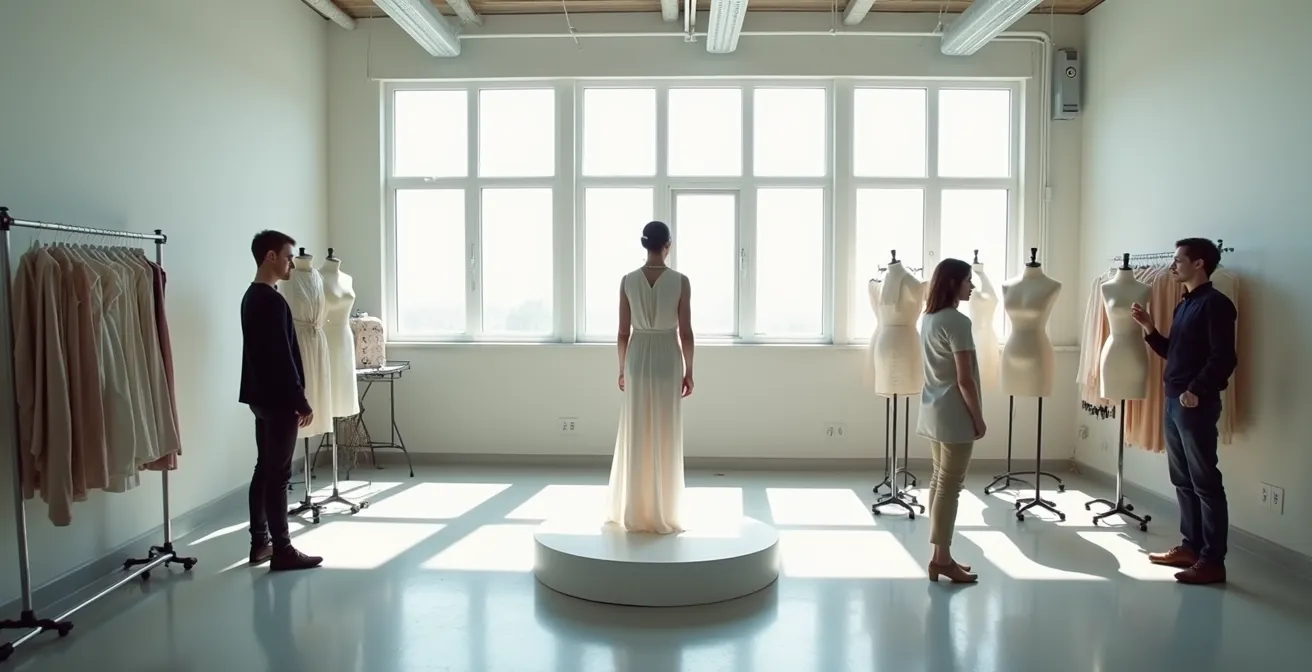
As the image illustrates, fit modeling is a collaborative and technical process. The focus is on how the garment interacts with a real body, ensuring that the final product will serve thousands of customers. For models with the right proportions, this niche offers a long-term career path shielded from the fickle trends of editorial fashion.
Hands, Feet, and Lips: Do You Have What It Takes to Be a Parts Model?
While most models focus on their face and full body, a highly profitable and often overlooked niche lies in specializing in a single, perfect body part. Parts modeling is the art of showcasing products—from jewelry and nail polish to shoes and lipstick—where the focus is entirely on the hands, feet, lips, eyes, or even hair. In this world, the overall look of the model is irrelevant; what matters is the flawless quality of the specific asset being photographed. Do you have long, elegant fingers with perfect nail beds? Symmetrically shaped, full lips? These are not just features; they are potential six-figure assets.
The financial incentive for this specialization is significant. Because the demand for truly exceptional parts is low and the requirements are strict, top professionals are compensated handsomely. While a commercial model might have a day rate of a few hundred dollars, famous parts models can earn between $2,000 and $5,000 per day for major campaigns. A successful foot model, for example, can build a career earning over $75,000 annually by working with high-end shoe brands. This is niche arbitrage at its finest: finding a specialized market where your unique attribute is in high demand and commands a premium price.
Becoming a parts model requires meticulous care and maintenance of your star feature. It means protecting your hands from any nicks or scars, undergoing regular manicures, or keeping your feet in perfect condition. Your portfolio should consist of macro shots that highlight the perfection of your part, demonstrating its ability to sell a product. The following table breaks down the potential and requirements for the most common specialties.
| Body Part | Daily Rate Range | Key Requirements |
|---|---|---|
| Hands | $1,000-$5,000 | Perfect manicure, no scars, graceful movement |
| Feet | $1,000-$3,000 | Well-maintained, specific size requirements |
| Lips | $500-$2,000 | Full shape, smooth texture, expressive |
| Eyes | $500-$2,000 | Clear, expressive, various colors in demand |
The data is clear: specializing in a single part can be far more lucrative than being a generalist. It requires discipline and a specific genetic lottery, but for those who have it, parts modeling offers a direct path to high-income work.
Size 10 to 16: What Casting Directors Look for in the First 30 Seconds of a Go-See?
The term “plus-size” is rapidly becoming outdated as the industry acknowledges that sizes 10-16 represent a significant portion of the consumer market. As modeling agent Gary Dakin, a pioneer in the field, rightly questions, “They’re models. They do the same exact job as everyone else. Do we define a model by her color? Why are we doing it by size?” This shift in perspective is crucial for any model in this size range. In a casting, the director is not looking for a “plus-size model”; they are looking for a professional who can sell their clothes to their target audience.
They’re models. They do the same exact job as everyone else. Do we define a model by her color? Why are we doing it by size?
– Gary Dakin, Modeling agent, co-founder of Jag Models
In the first 30 seconds of a go-see, a casting director makes a rapid assessment based on factors that go far beyond your measurements. They are evaluating your confidence, your movement, and your understanding of their brand. They need to see, instantly, that you can bring their garments to life. This is not the time to be shy or apologetic about your body; it’s the time to own your space and demonstrate your value as a professional.
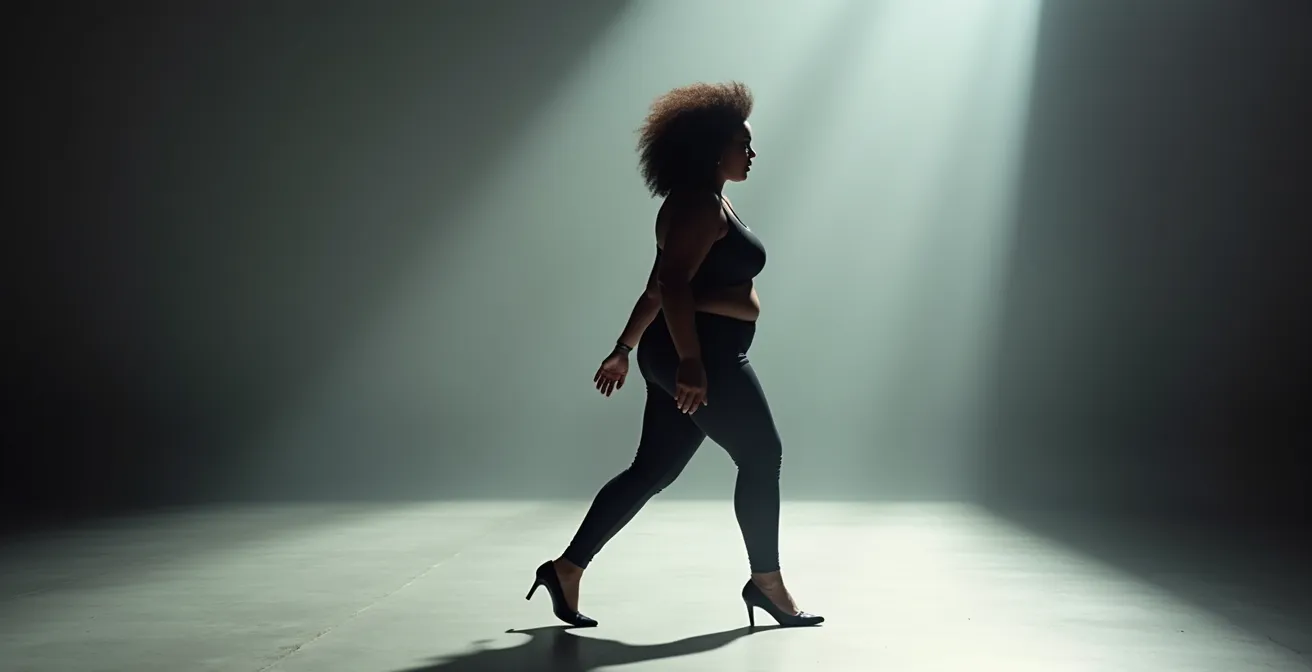
Your ability to move fluidly and show how the fabric drapes on your curves is a marketable skill. They are looking for someone who understands their own proportions and knows how to make the clothes look incredible. It’s a performance, and your confidence is the main event. A model who walks in with a straight spine, a warm smile, and an energy that says “I can sell this for you” will always have an edge over someone who is technically a perfect size but lacks presence.
Your First Impression Go-See Checklist
- Project Confidence: Enter with a straightened spine, shoulders back, and chin held high. Your posture communicates professionalism before you say a word.
- Embody the Brand: Research the client’s aesthetic and target customer beforehand. Dress in a way that reflects their style while still flattering your shape.
- Demonstrate Fluid Movement: Be prepared to walk. Practice a strong, graceful walk that showcases your dynamism and how garments move on your body.
- Prepare Professional Answers: Have positive, concise responses ready for basic questions about your experience and measurements. Show you are easy to work with.
- Highlight the Garment: When trying on a piece, use your posing and movement to showcase its best features—a cinched waist, a flowing skirt, the structure of the shoulders.
Ultimately, casting directors are looking for a problem-solver. Their problem is needing to sell clothes to women of all sizes. By walking in as the confident, professional solution, you make their decision easy.
Abs and Agility: Why Fitness Modeling Requires More Than Just Being Skinny?
Fitness modeling projects an image of peak health, strength, and dynamism. It’s a niche that seems incredibly glamorous, filled with athletic photoshoots and endorsements from major sportswear brands. However, the economic reality of being a traditional fitness model can be surprising. The job requires an immense level of physical dedication—maintaining low body fat, visible muscle definition, and often, proficiency in a specific sport or activity. Yet, the direct financial compensation for this work can be modest. The average annual salary for a fitness model is around $37,240, which is significantly lower than the potential in more technical niches like fit or parts modeling.
The reason for this discrepancy lies in the business model. For many brands, a fitness model is an interchangeable component used to display apparel. While a high level of fitness is required, the supply of athletic-looking individuals is relatively large. The real financial opportunity in the fitness space is not in being a model, but in becoming a brand. This is the critical distinction between a fitness model and a fitness influencer. While the model is paid a day rate to show up for a shoot, the influencer builds an audience and monetizes it through multiple streams.
Top fitness influencers can earn six or even seven figures annually. Their income doesn’t come from a single client’s day rate but from a diversified portfolio of revenue: sponsored posts, their own product lines, selling personalized workout plans, affiliate marketing, and brand ambassadorships. They leverage their expertise and personality to build a community that trusts them, transforming their audience into a powerful economic engine. Their physical condition is the foundation, but their business acumen is what generates wealth.
Therefore, for a model with a passion for fitness, the strategic question is not “How can I get booked as a fitness model?” but “How can I use my athletic abilities to build an audience and a personal brand?” It requires more than just abs and agility; it requires content creation skills, social media savvy, and an entrepreneurial mindset.
Why Moving to the German Market Can Extend Your Career by 10 Years?
For models, particularly those over 30, the pressure to maintain an impossibly youthful appearance in markets like New York or Paris can be exhausting. An often-overlooked strategy for career longevity is geographical arbitrage: moving to a market whose cultural and commercial values align better with a mature, healthy, and “real” aesthetic. The German market stands out as a prime destination for this strategy. It’s not just a small niche; the fashion industry in Germany is a powerhouse, generating a projected revenue of US$28,775m in 2024.
What makes Germany unique is its consumer culture. German advertising and catalogs often prioritize a look that is trustworthy, healthy, and relatable over the extreme, high-fashion ideals seen elsewhere. This creates a sustained demand for models in their 30s, 40s, and even 50s who look aspirational yet authentic. Brands want to connect with their customer base, and in a country with a significant and affluent mature population, that means using models who reflect that demographic. This extends a model’s viable working years dramatically.
This market offers more than just catalog work. With a strong economy and high consumer spending on apparel, there are abundant opportunities in e-commerce, commercial campaigns, and brand ambassadorships. For a model who has built a professional portfolio and a reputation for reliability, the German market can represent a “second act”—a stable, respectful, and financially rewarding chapter of their career. It’s a strategic move away from a market that discards experience to one that actively values it.
The key is to proactively target this market. This means connecting with German agencies, tailoring your portfolio to showcase a more natural and sophisticated look, and potentially learning some of the language. It’s an investment that can pay dividends in the form of a career that lasts decades, not just a few years.
How the Demand for Diverse Skin Tones Is Reshaping Beauty Contracts?
For years, the beauty industry operated within a narrow spectrum of “marketable” skin tones. Models of color were often tokenized or relegated to campaigns that specifically targeted a niche demographic. Today, that landscape is undergoing a seismic shift. Driven by consumer demand for inclusivity and authenticity, major beauty brands are finally expanding their foundation shade ranges and building campaigns that reflect the true diversity of their customer base. This has created an unprecedented economic opportunity for models with diverse skin tones.
This isn’t just about social progress; it’s about powerful market mechanics. Brands have realized that inclusivity is profitable. As a result, models who were previously overlooked are now in high demand, and this demand is reshaping the structure of beauty contracts. The role is evolving from simply being a “face” to being an on-set expert. Models who deeply understand how lighting interacts with their specific skin tone, and who can articulate that to a photographer or makeup artist, bring immense added value. This expertise is a new form of asset monetization.
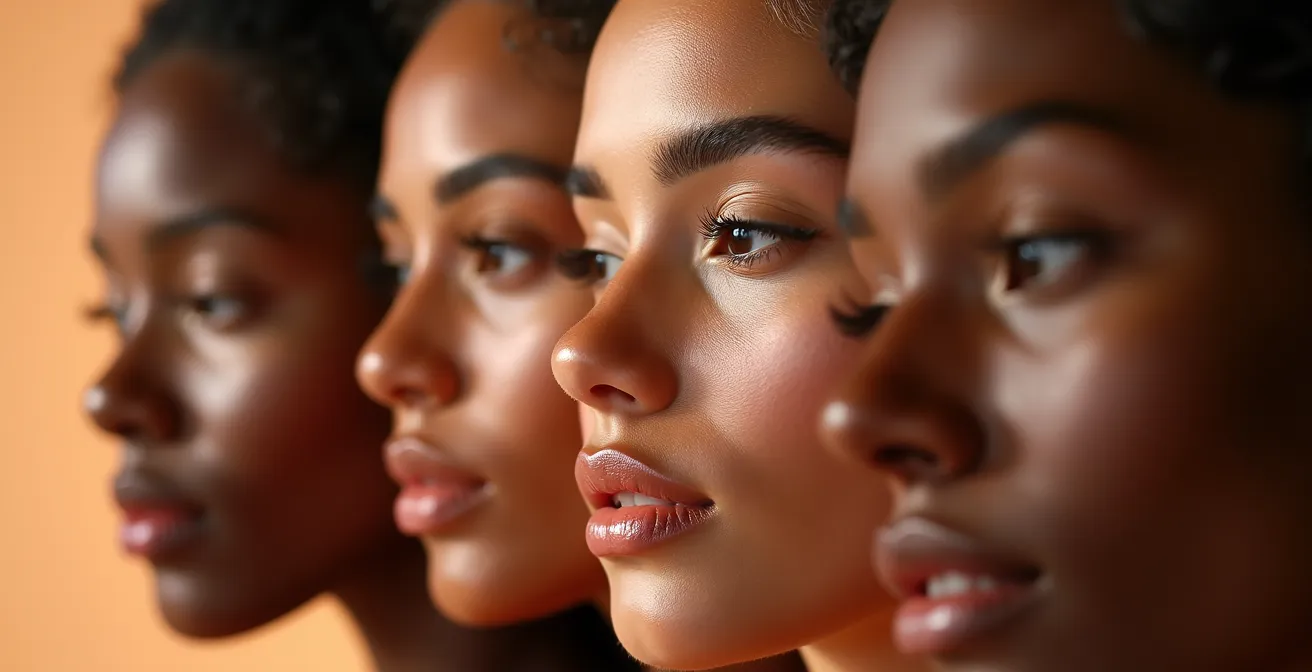
This new dynamic gives models more leverage in negotiations. It’s no longer just about a day rate, which for commercial work can average around $200 per hour. Models and their agents can now negotiate for “shade inclusivity” bonuses, long-term contracts as brand ambassadors for specific shade ranges, or consulting fees for their expertise. A model is no longer just showing up; they are a key partner in ensuring the brand’s message of inclusivity is executed authentically and effectively. This elevates their earning potential far beyond a standard booking.
To capitalize on this, models should build a portfolio that showcases their skin under various lighting conditions, network with brands known for their expansive shade ranges, and be prepared to articulate their value beyond their appearance. In this new era, your unique skin tone is not just a feature; it’s a highly sought-after specialization.
Key Takeaways
- Your income is determined by the business mechanics of your chosen niche, not just your “look.”
- Treat your unique physical attributes—be it a specific size, a flawless feature, or your age—as marketable assets to be monetized.
- Operational excellence, such as shooting efficiency or providing technical feedback, is a skill that directly increases your earning potential.
How to Shoot 50 Looks a Day Efficiently for E-Commerce Clients?
E-commerce modeling is the engine of the modern fashion industry. While it may lack the glamour of a high-fashion editorial, it offers consistent, high-volume work that forms the financial bedrock of many models’ careers. In this niche, the most valuable skill is not an esoteric look, but pure, unadulterated efficiency. Clients are not paying for art; they are paying for product shots. The faster a model can produce high-quality images for each look, the more profitable they are to the client, and the more in-demand they become. The ability to shoot 50, 70, or even 100 looks in a single day is a superpower.
The economic mechanics are simple. A standard e-commerce booking might involve grossing $1,000 for a full day of eight hours. If one model can shoot 40 looks in that time and another can shoot 60, the second model provides 50% more value to the client. This reputation for efficiency quickly leads to being re-booked constantly and gives you the leverage to command higher rates or negotiate per-look bonuses. It’s a direct conversion of speed and professionalism into cash.
Achieving this level of efficiency is a learned skill. It involves developing a “posing flow” where you can transition between 3-5 standard poses for each garment with minimal direction. It means working seamlessly with the photographer and stylist, anticipating their needs, and minimizing downtime. It also requires physical and mental stamina—staying energized, hydrated, and focused through long, repetitive hours. Some top e-commerce models even create “team packages,” partnering with a photographer they have a great workflow with and selling their combined efficiency to brands at a premium.
In essence, in e-commerce, you are not a muse; you are a high-performance athlete in a commercial arena. Mastering the choreography of a high-volume shoot is one of the most reliable ways to build a stable and lucrative modeling career.
Frequently Asked Questions About E-Commerce Modeling
Should I negotiate per-look or day-rate for high-volume shoots?
For shoots exceeding 50 looks, negotiate a per-look rate with a baseline minimum to maximize income, especially if you can maintain high efficiency.
How can I maintain energy during 10-hour e-commerce shoots?
Conserve energy during simple shots and ‘spend’ it on complex garments. Proper nutrition and hydration directly impact your looks-per-hour rate.
What’s the benefit of offering a ‘team package’ to brands?
Highly efficient models can partner with specific photographers/stylists they work well with, selling this ‘team package’ at a premium for guaranteed efficiency.