In summary:
- Vague instructions like “be more nostalgic” are a call to perform, not just pose. The solution is to build an internal character.
- Deconstruct the mood board for sensory cues—texture, color, and light—to inform your character’s physical and emotional state.
- Define a specific persona (an archetype, an animal, a memory) to serve as your conceptual anchor throughout the shoot.
- Treat the garment as a scene partner, allowing its movement and structure to guide your physical expression.
- True artistry often requires letting go of vanity. Unconventional, “ugly” poses can convey powerful, high-art concepts.
You’re on set. The art director looks through the lens and says, “Great, but can you give me more… ‘future’?” Or perhaps, “I need to feel more ‘nostalgia’ here.” This is the moment that separates the mannequin from the model. It’s a common frustration for models who receive vague, abstract briefs and are expected to deliver a specific, tangible performance. The typical advice is to “feel the emotion” or “use your hands and face,” but this rarely provides a clear path from an abstract idea to a compelling photograph.
Many models look to the mood board for literal poses to copy or try to guess what the client wants. This approach is a gamble. It relies on external cues rather than internal generation. But what if the key isn’t about finding the right pose, but about becoming the kind of person for whom that pose is a natural, inevitable expression? What if embodying “nostalgia” isn’t about a sad look, but about creating an entire inner world steeped in a specific, sensory memory?
This is the shift from posing to performing. The true craft lies in translating an abstract concept into a physical and emotional reality. It is an actor’s work. This guide is built on a single, powerful premise: embodying an abstract concept is not about striking a pose; it’s about building an entire inner world—a character—whose natural state *is* that concept. The pose is merely the final, authentic expression of that internal reality. It’s a method that gives you, the model, a concrete intellectual framework to turn ambiguity into art.
Throughout this guide, we will explore the practical steps of this interpretive process. We will deconstruct how to read the hidden language of a mood board, build a powerful character anchor, let the garment guide your movement, and know when to push beyond the brief to create something truly memorable. This is your training to become an active interpreter, a collaborator who brings concepts to life from the inside out.
Summary: How to Embody Abstract Concepts Like “Future” or “Nostalgia” in Posing?
- Beyond the Photos: How to Read the Texture and Color Cues in a Mood Board?
- Who Is She? Creating a Persona to Anchor Your Performance?
- How to Move So the Garment Supports the Concept, Not Fights It?
- When Ugly Is Good: How to Let Go of Vanity for High Art Concepts?
- Safe vs. Bold: When to Offer a Pose That Wasn’t in the Brief?
- When the Concept Changes Mid-Shoot: How to Pivot Your Energy Instantly?
- Pinterest vs. Instagram: How to Build a Mood Board That Communicates Vision?
- How to Interpret an Art Director’s Vague Instructions into Concrete Poses?
Beyond the Photos: How to Read the Texture and Color Cues in a Mood Board?
A mood board is not just a collage of pictures; it’s a sensory script. The most common mistake models make is looking only at the poses. To truly embody a concept, you must look deeper, at the non-literal cues that communicate emotion: texture and color. These elements are your first clues into the internal world you need to build. Color isn’t just visual—it’s emotional. A wave of bright yellows and electric blues on a mood board might signal hope and energy, while muted, earthy tones could suggest groundedness or melancholy.
Texture is the physical translation of feeling. A board filled with rough wool and raw silk speaks to a different character than one dominated by smooth satin and cotton. The first might be rugged, resilient, and strong in her movements; the second is likely more fluid, elegant, and relaxed. Your job is to perform a sensory translation, turning these visual cues into a physical state. How does “satin” feel on the skin? It feels cool, effortless. How does that translate into a posture? Perhaps with relaxed shoulders and elongated lines. How does “raw silk” feel? It has friction, a history. That might translate into more controlled, deliberate movements.
By analyzing these elements, you move beyond mimicry. You’re not copying a pose; you’re absorbing the atmosphere of the concept. This allows you to generate original movements that are thematically coherent, even if they aren’t explicitly pictured on the board. You are decoding the director’s vision on a subconscious level. The following table breaks down the psychological effect of common fabric textures, providing a starting point for your physical interpretation.
| Texture Type | Fabric Examples | Psychological Effect | Movement Quality |
|---|---|---|---|
| Smooth | Silk, Satin, Cotton | Often associated with luxury and comfort, making you feel more relaxed, elegant, and confident. | Fluid, graceful |
| Rough | Wool, Raw Silk | Evokes feelings of ruggedness, durability, and strength. | Jerky, strong |
| Stiff | Organza | Conveys formality and structure, making you feel more disciplined and poised. | Sharp, controlled |
Your Checklist for Interpreting a Mood Board’s Sensory Cues
- Identify the Dominant Color Palette: What is the overall mood? Is it warm (passion, energy) or cool (calm, aloofness)? Are the colors saturated (intensity) or desaturated (subtlety, nostalgia)?
- Analyze the Textures: Look beyond the clothes to the environment. Are there images of rough concrete, smooth water, or soft clouds? Let these textures inform the quality of your movement.
- Find the Light: Is the lighting on the board hard and dramatic, or soft and diffused? Hard light suggests sharpness and strength. Soft light suggests vulnerability and gentleness. Embody the light itself.
- Look for Non-Fashion Analogies: Are there pictures of animals, architecture, or nature? A panther moves differently than a willow tree. Use these as a physical reference for your character.
- Synthesize a Core Feeling: After analyzing the parts, what is the one core feeling or physical sensation that unites them all? Is it “electric chill,” “sun-baked warmth,” or “damp earth”? Hold onto this sensation.
Who Is She? Creating a Persona to Anchor Your Performance?
Once you’ve decoded the sensory data from the mood board, your next task is to build a vessel for these feelings: a persona. An abstract concept like “future” is impossible to perform directly. But a specific character *embodying* the future is not only possible, it’s a powerful tool. Who is this woman? Is she an android from 2049, whose movements are precise and economical? Or is she a bio-hacker from a utopian future, whose energy is fluid and connected to nature? Each choice gives you a concrete physical and emotional blueprint.
This technique is borrowed from the world of design, where personas are used as “empathy exercises” to understand a user’s needs. As a model, you are using the same tool to generate empathy for the concept. You create a conceptual anchor—a fully realized character—that keeps your performance consistent and deep. This isn’t just about making up a backstory; it’s about defining the character’s internal state. What is her dominant thought? What is her secret? What does she want in this moment? The answers will manifest in your gaze, the tension in your hands, and the subtle shifts in your posture.
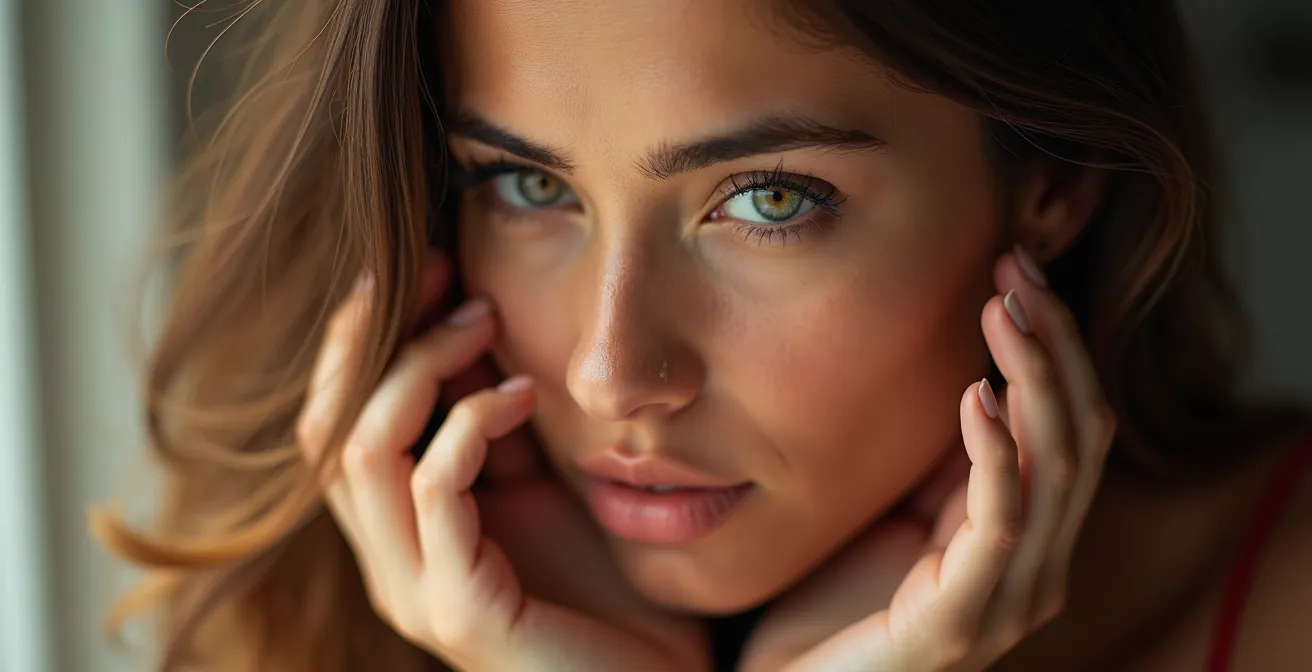
For example, to embody “nostalgia,” you don’t just “look sad.” You create a specific persona: a woman in her late 70s revisiting her childhood home. You anchor yourself in a specific memory—the smell of her mother’s baking, the feel of a worn wooden floorboard under her feet. This specific, sensory-rich internal monologue will produce a far more authentic and compelling expression of nostalgia than a generic attempt at the emotion. The camera doesn’t capture “nostalgia”; it captures the flicker of a specific memory in a person’s eyes.
This method frees you from the pressure of “posing.” You are no longer trying to arrange your body in a pleasing shape. Instead, you are simply *being* this character, and the photographer is capturing moments of her existence. Your focus shifts from your external appearance to your internal monologue, which is the engine of all authentic expression. This process transforms you from an object to be photographed into a subject with agency and a story to tell.
How to Move So the Garment Supports the Concept, Not Fights It?
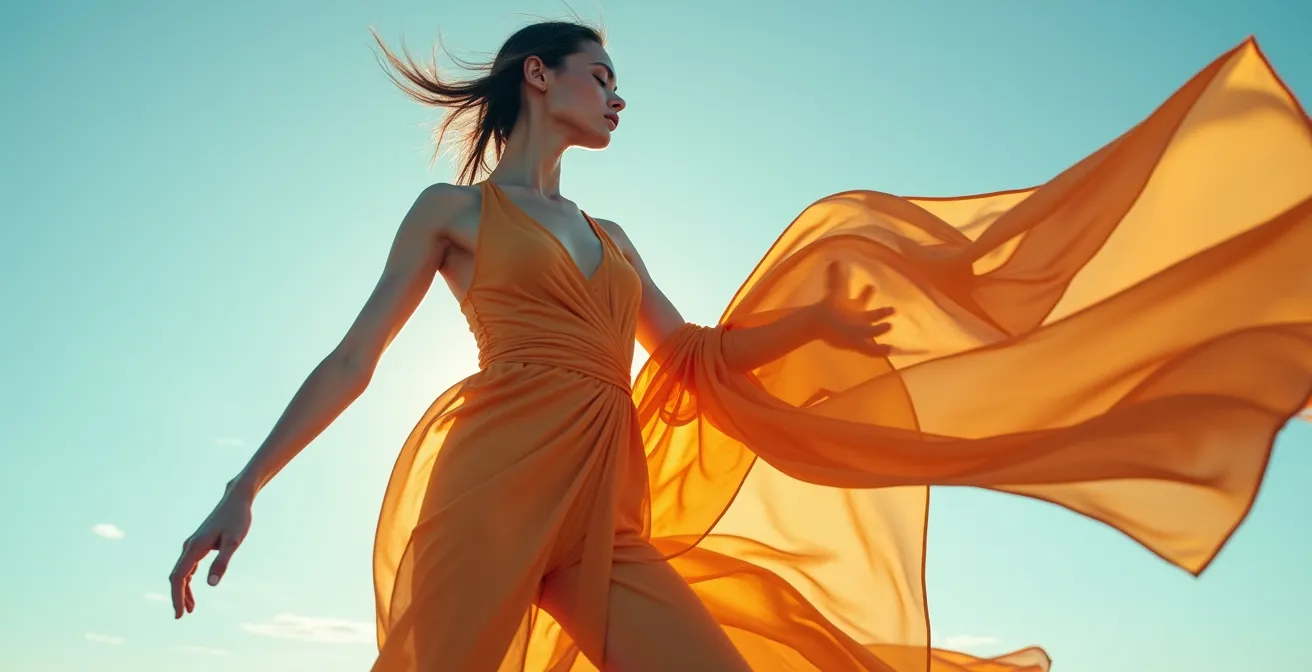
The garment is not a costume; it’s your scene partner. Your movement must enter into a dialogue with the fabric, cut, and structure of what you’re wearing. A common mistake is to impose a pose on a garment that is designed to move in a completely different way. Fighting the garment creates visual tension and breaks the illusion. Supporting it, however, amplifies the concept and brings the clothing to life.
To achieve this, you must first understand the garment’s physical properties. How does it want to move? A silk dress wants to flow; your movement should be fluid and graceful to showcase its drape. A stiff, architectural jacket wants to hold its shape; your movements should be sharper, more controlled, highlighting its structure. This is where your persona work pays off. Your android from the future would move with the precision that a structured blazer demands. Your nostalgic grandmother would move with a softness that makes a cashmere sweater look comforting.
As professional photographer Frank Doorhof notes, great modeling is about giving a feeling, not just presenting an item:
Modeling is acting on 1/2000 rule – the model in lifestyle photography should give a ‘feeling’ instead of just presenting
– Frank Doorhof, Professional Fashion Photography Blog
This “feeling” comes from the synthesis of your internal character and the physical reality of the garment. It’s a performance that acknowledges the clothing’s role. To start this dialogue, ask yourself:
- Drape: How does the fabric hang, fall, and move over the body? Create poses that let it do this beautifully. A simple walk or a gentle turn can be more powerful than a static pose.
- Fit: What part of the body does the garment highlight? A cinched waist or a sharp shoulder? Angle your body to emphasize that feature.
- Details: Where is the focus? Special buttons, intricate stitching, or unique embroidery? Use your hands or posture to draw the viewer’s eye to these details without being too literal.
This collaborative approach is what top agencies look for. It’s not just about having the right measurements; it’s about having a purpose and presence on set. Industry veterans confirm that agencies seek unique qualities and authentic presence, which is demonstrated by a model’s ability to interpret and interact with the clothing. You are not just wearing the concept; you and the garment are performing it together.
When Ugly Is Good: How to Let Go of Vanity for High Art Concepts?
In commercial modeling, the goal is often to look approachable, beautiful, and aspirational in a conventional sense. In high fashion and conceptual art, the rules are inverted. The goal is not to be “pretty,” but to be interesting, provocative, and emotionally resonant. This often requires you to let go of vanity and embrace poses that might be considered unflattering or “ugly” in a traditional context. A hunched back, a contorted limb, a grimace—these are not mistakes; they are tools of expression.
Think of the images you see in high-art magazines. The poses are deliberately far removed from reality. A model might hunch forward, bringing her shoulder to her chin, creating a strange, almost uncomfortable silhouette. This is not a pose you would strike in everyday life, but in the context of an avant-garde concept, it can convey vulnerability, defiance, or a sense of being trapped. These “ugly” poses break the viewer’s expectations and force them to engage with the image on a deeper, more intellectual level. They create an energy signature that is memorable and jarring, which is often the entire point.
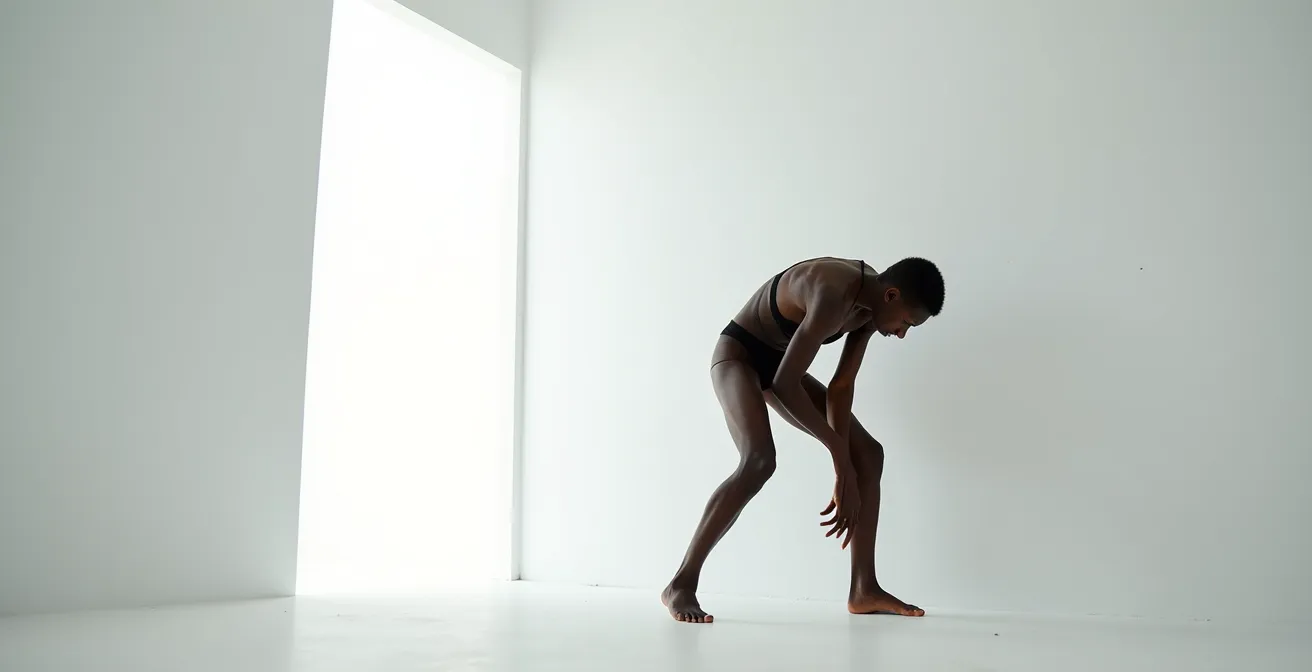
Letting go of the need to look beautiful at all times is one of the most significant leaps a model can make. It requires trust—in the photographer, in the art director, and most importantly, in yourself and the character you’ve built. Your persona isn’t concerned with looking pretty; she is concerned with her own internal reality. If that reality is one of angst, struggle, or alien detachment, her body will reflect that, regardless of whether it aligns with conventional beauty standards.
This is where the distinction between commercial and high-art modeling becomes clearest. Commercial work sells a product by making you want to *be* the model. High-art work sells an idea by making you *think* about what the model is representing. To do this effectively, you must be willing to sacrifice your own ego for the sake of the concept. Your body becomes a sculptural element, a piece of the overall composition, used to evoke a feeling or an idea, not just to look attractive.
Safe vs. Bold: When to Offer a Pose That Wasn’t in the Brief?
The brief is your map, but it’s not always the entire territory. A good model delivers what’s asked for; a great model delivers what’s asked for, and then shows the client what they didn’t know they wanted. Knowing when to stick to the script and when to offer a bold, unscripted pose is a delicate art that hinges on communication, trust, and a deep understanding of the project’s context.
The first step is to identify the type of shoot. As a general rule, high fashion editorial allows significantly more creative freedom than commercial modeling. Commercial shoots for mass-market brands often have very specific, pre-approved shot lists designed to sell a product in a clear, unambiguous way. Here, your job is to execute those shots flawlessly. High fashion, on the other hand, is about creating a mood and telling a story. There is more room for interpretation and happy accidents.
Even in a creative environment, you must build trust before you can take risks. The best strategy is to dedicate the first part of the shoot to nailing the safe shots. Give the photographer and client exactly what they asked for in the brief. Start with simple, clean poses. Once they have what they need “in the bag,” the pressure is off, and the atmosphere becomes more collaborative and experimental. This is your moment to propose an idea.
When you do, frame it as an offer, not a demand. A simple, “I have an idea, would you mind if I try something?” is usually all it takes. Because you’ve built your performance on a solid persona, your suggestions won’t be random. They will be organic extensions of the character you’re embodying. Perhaps your “nostalgic” character suddenly crumples to the floor, or your “future” android glitches in her movement. These moments of boldness are where iconic images are born. Keep your movements fluid, making small, continuous adjustments. This provides the photographer with a range of micro-moments to capture and keeps the energy from becoming static.
When the Concept Changes Mid-Shoot: How to Pivot Your Energy Instantly?
“Let’s try something completely different.” These words can be terrifying if your entire preparation was based on a single concept. But for a model trained in performance, they are an exciting challenge. The ability to pivot your energy instantly is what makes you an invaluable asset on set. This skill isn’t magic; it’s a direct result of having a structured, actor-based technique like building a persona.
The key to a fast pivot is improvisation. You don’t have time to go back to the mood board and do a full analysis. Instead, you must rely on your interpretive skills in real-time. The art director gives you a new concept, for example, changing from “serene” to “chaotic.” Your first step is to ask one or two clarifying questions to find your new conceptual anchor. “What kind of chaotic? A joyful party, or an internal anxiety?” The answer gives you the seed for a new micro-persona.
Once you have this new anchor, you need to change your energy signature. This is a physical and mental reset. Take a deep breath, shake out your limbs, and consciously let go of the previous character. Then, find the physical center of the new character. “Serenity” might be centered in the breath, with slow, fluid movements. “Chaotic anxiety” might be centered in the stomach, with jerky, sharp, and contained movements. This is a technique adapted from acting, where understanding character development and emotional expression is crucial for an authentic performance.
This is where your practice in sensory translation comes in. Quickly translate the new abstract word into a physical sensation. What does “chaotic” feel like in your body? A buzzing in your fingertips? A tightness in your chest? A sudden heat? Latch onto that physical feeling and let it drive your movements. You are not “acting” chaotic; you are generating the physical sensation of chaos and letting the camera capture your body’s reaction to it. This ability to instantly switch from one internal world to another is a high-level skill that demonstrates immense range and professionalism.
Pinterest vs. Instagram: How to Build a Mood Board That Communicates Vision?
As a model, you are typically on the receiving end of a mood board, not the creator. However, understanding *how* a mood board was constructed, and on which platform, gives you critical insight into the art director’s thought process and the project’s goals. The platform choice itself is a clue. A mood board built on Pinterest often signals a more exploratory, thematic, and layered vision. An Instagram collection, on the other hand, might point to a more trend-driven, immediate, and commercially-focused concept.
A Pinterest board allows for a tiered structure of ideas. An art director can have a main board for the core concept, with sub-boards for texture, color, and lighting. It’s a tool for deep-diving. When you receive a Pinterest board, look for these layers. Is there a consistent theme in the non-fashion images? This is often where the real conceptual meat is. An Instagram board is more linear and immediate. The “saved” folder acts as a stream of consciousness. It’s less about deep connections and more about a current aesthetic. Look for the most-repeated elements—a specific color, pose, or filter—as this is likely the key takeaway.
Understanding the construction method can also help you decode the message, whether the board is digital or physical.
| Method | Advantages | Best Use Case | Tools/Materials |
|---|---|---|---|
| Physical Mood Board | Allows for tangible texture and dimension using real materials like fabric swatches or clippings. | Studio presentation, tactile concepts | Fabric swatches, magazines, foam board |
| Digital Mood Board | Offers flexibility, allowing for easy rearrangement and modification of elements. | Remote collaboration, quick iterations | Pinterest, Canva, Adobe Creative Suite |
Regardless of the platform, your interpretive process for decoding the color story remains the same. Identify the main colors that dominate the board; these set the core mood. Then, look for secondary or accent colors. A pop of clashing color is intentional; it’s meant to create tension or draw attention. By understanding the tools and thought patterns behind the board’s creation, you’re not just looking at images; you’re reading the mind of the creative team and getting a head start on building your persona.
Key takeaways
- Abstract direction is an invitation to perform, not just pose. Your primary tool is the creation of a specific, internal character.
- A mood board is a sensory script. Analyze its colors, textures, and light to find the physical and emotional basis for your character.
- Let go of conventional vanity. In high fashion, “ugly” or unconventional poses are powerful tools for expressing complex ideas.
How to Interpret an Art Director’s Vague Instructions into Concrete Poses?
You have done your homework. You’ve analyzed the mood board, created a persona, and practiced your movements. Now, on set, the art director gives you a vague instruction. This is the final test: translating a single word or phrase into a concrete physical expression in real time. The bridge between their words and your pose is the character you have already built. Every instruction must be filtered through her.
If the director says “more power,” you don’t just strike a generic “power pose.” You ask, “What is *my character’s* version of power?” For the android, power might be stillness, an economy of motion that shows absolute control. For the nostalgic grandmother, power might be a quiet, unshakeable resolve in her eyes. The instruction is the “what,” but your persona is the “how.” This makes your performance specific and unique, not a cliché.
To aid this interpretation, your pre-shoot preparation is vital. Successful models know they must research and understand the company, brand, or products they will represent. Is this a brand known for minimalism or for extravagance? This context helps you understand the “language” of the client and interpret their directions within that brand world. A request for “joy” from a minimalist brand is different from a request for “joy” from a vibrant, youthful brand.
When in doubt, offer a question that gives you a playable direction. Instead of asking “What do you want me to do?”, ask “Is she feeling this in her chest, or in her hands?” This gives the director a concrete choice and shows that you are thinking like a performer. You are collaborating on the psychological gesture—the core physical action that reveals the character’s inner state. By consistently using your persona as the ultimate filter, you turn every vague instruction into an opportunity for authentic, character-driven performance.
Embracing this performance-based approach transforms your role on set. You are no longer waiting for precise instructions but are an active participant in the creation of the image. By building an internal world, you gain the power to turn any abstract concept into a compelling, physical reality, ensuring that every shot is not just a picture of a model, but a portrait of a character.