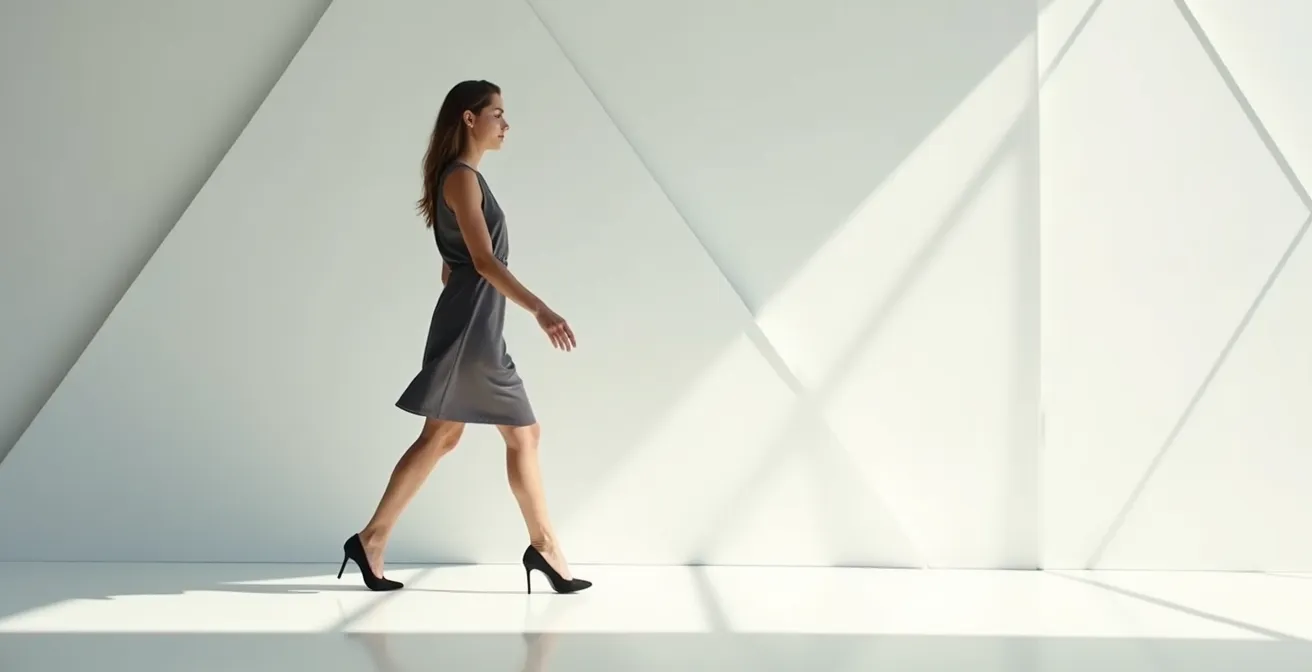
Forget the “signature walk”; high-fashion demands a chameleon. Your value isn’t a single, recognizable gait but a physically engineered toolkit that allows you to embody any brand’s identity on command.
- Your power comes from a stabilized core and controlled shoulders, not exaggerated movement. This is your chassis.
- The industry’s strict physical standards are driven by the economics of sample sizing, not just aesthetics.
Recommendation: Stop performing and start engineering. Focus your training on muscular control, balance, and proprioception to build a versatile kinetic vocabulary.
Listen up. You’ve been told to “find your signature walk.” It’s the most common advice given to aspiring models, and it’s a trap. A signature walk makes you a one-trick pony in an industry that demands versatility. A powerful, memorable walk is essential, but a rigid one is a liability. When a casting director for Versace is looking for that potent, hip-driven power and you give them the ethereal, floating glide of a Balenciaga show, you’ve already lost the job. The real skill isn’t having a walk; it’s having every walk.
The masters of the runway don’t have a single identity. They are kinetic chameleons. They understand that their body is an instrument and the designer is the composer. Mastering the runway isn’t about confidence alone—that’s the baseline. It’s about deep physical intelligence, muscular control, and the ability to translate a brand’s abstract vision into a precise, rhythmic physical form. It’s about engineering a walk from the ground up, starting with your core and extending to the very focus of your gaze.
This is not a guide to finding “your” walk. This is your new training manual for deconstructing your movement and rebuilding it into a versatile, adaptable weapon. We will break down the mechanics of stability, from your shoulders to your heels. We will dissect the subtle art of the runway gaze and the brutal efficiency of the backstage quick-change. Finally, we will confront the unflinching physical standards of the industry, not as an obstacle, but as a set of parameters to be understood and mastered. Forget what you think you know. The real work begins now.
To help you navigate these core principles, we have broken down this guide into specific, actionable modules. Each section addresses a critical component of runway mastery, from foundational mechanics to industry realities.
Summary: The Complete Guide to Engineering a High-Fashion Catwalk Presence
- Why Your Shoulders Are Moving Too Much and How to Stabilize Them?
- Heels on Polished Concrete: How to Avoid Falling During the Show?
- The “Zombie” Stare vs. The Confident Gaze: What Are Designers Asking For?
- How to Change a Full Outfit in 30 Seconds Without Ruining the Clothes?
- Height and Hip Measurements: Why Is Runway the Strictest Category?
- Why 90cm Hips Are the Absolute Limit for Paris Runways?
- Tech Neck Correction: Exercises to Lengthen Your Neck for Photos?
- Do You Have the Measurements and Look Required for High Fashion Markets?
Why Your Shoulders Are Moving Too Much and How to Stabilize Them?
Stop swinging your arms. The power of a walk doesn’t come from your shoulders; it comes from your core and is projected through your hips. Unstable, swaying shoulders are a sign of a weak kinetic chain. It signals a lack of control and cheapens the garment. The clothes should move because of the energy you generate, not because you are flailing. Your upper body must be a stable chassis—a solid, controlled frame that allows the clothes to hang and move as the designer intended. Any movement in the shoulders should be a deliberate, minimal reaction to the opposing hip’s motion, not an action in itself.
This stability begins in your core. A strong transverse abdominis and engaged obliques are the engine of your walk. They prevent rotational sloppiness and keep your torso elongated and powerful. Think of your spine as a steel rod, anchored from your pelvis to the base of your skull. Your shoulders are connected to this rod, and their job is to remain square and composed, providing a clean, architectural line. The goal is to isolate movement, driving it from the legs and hips while the upper body glides with an almost unnerving stillness. This control is what separates an amateur from a professional.
To achieve this, your training must focus on core-to-shoulder connection. This isn’t about building bulk; it’s about activating deep stabilizer muscles. Planks, bird-dog exercises, and dead bugs are your new best friends. They teach your body to resist rotation and maintain a neutral spine under tension—the exact skill needed on the runway.
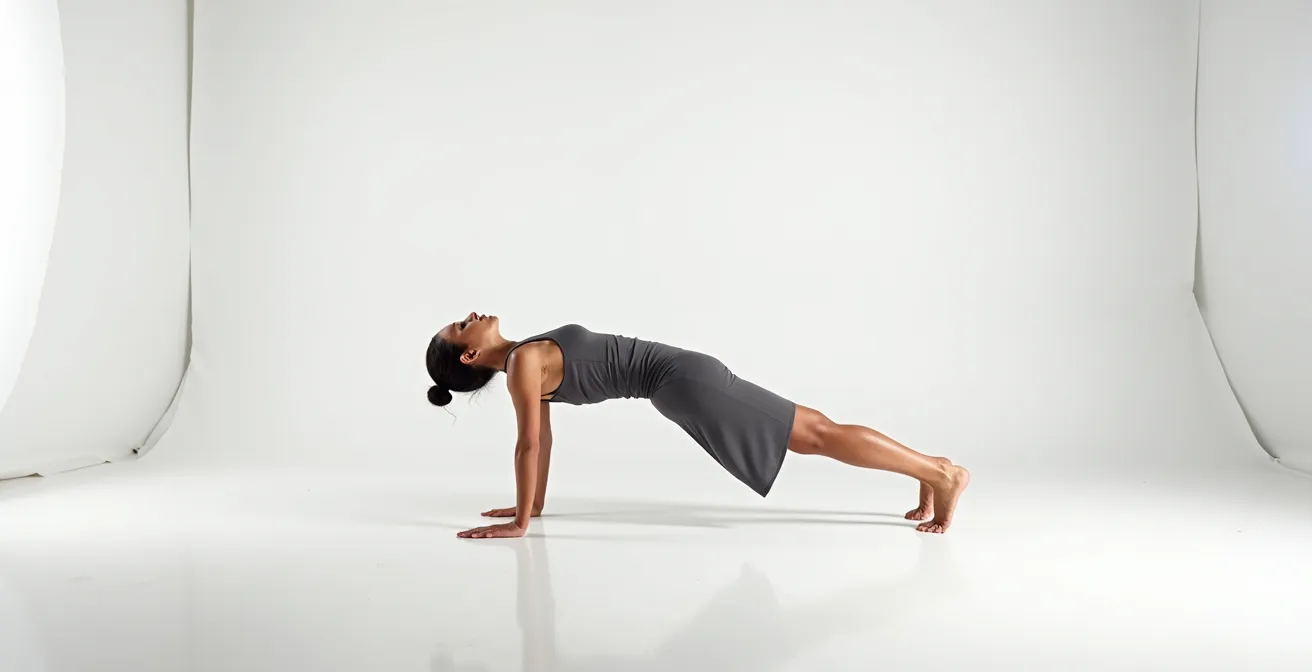
Look at the perfect alignment in this plank. From head to heels, the body forms a single, rigid line. This demonstrates the absolute connection between an engaged core and locked-in shoulders. This is the foundation of your power. Without this underlying strength, you will never achieve the effortless glide required for high fashion. Your focus must be on building this internal frame so your external movements become fluid and intentional.
Your Action Plan: 5 Drills for Absolute Shoulder Stability
- Foundation Posture: Stand tall, shoulders pulled back and down, chest slightly forward, and chin parallel to the ground. Hold this. This is your new default stance.
- The Spacer Drill: Place a rolled towel between your ribs and elbow. Rotate your arm towards and away from your body, focusing on keeping the towel pinned. This isolates the rotator cuff.
- Wall Slides: Stand with your back flat against a wall. Place your elbows and the back of your hands against the wall. Slowly slide your arms up and down without letting your back arch or your hands lift off.
- Band Pull-Aparts: Holding a resistance band, start with pinkies touching and thumbs pointing out. Squeeze your shoulder blades together as you pull your hands apart.
- Controlled Tempo: Perform all movements slowly and with intent. According to physical therapy guidelines, the focus should be on keeping the shoulders level throughout the entire range of motion.
Heels on Polished Concrete: How to Avoid Falling During the Show?
The surface is irrelevant. Polished concrete, slick marble, uneven cobblestones—a professional doesn’t blame the floor. Your balance is your responsibility. It’s not a matter of luck; it’s a matter of technique and relentless practice. The key to staying upright in treacherous heels is distributing your weight correctly and maintaining a powerful forward momentum. You don’t walk *on* the floor; you drive *through* it. Each step should land with the ball of your foot first, immediately followed by the heel, creating a fluid, rolling motion. This gives you more control than a clunky heel-toe stomp.
Your stride must be long, but not comically so. You are aiming for a powerful glide, placing one foot directly in front of the other as if walking on an invisible tightrope. This cross-body motion is what creates the signature hip sway, but more importantly, it centralizes your gravity and provides a stable base of support. Your gaze is also critical. Look at a fixed point at the end of the runway. This is a technique borrowed from ballet called “spotting,” and it’s essential for maintaining balance and a straight path. Never look down. Looking at your feet is an admission of defeat and a guarantee you’ll lose your line.
This control is not born overnight. It is forged through repetition. Industry veterans advise that consistent, short bursts of practice are more effective than infrequent, long sessions. It’s recommended that models carry out at least five rotator cuff exercise sessions each day, taking only about five minutes each, to build the necessary strength and endurance for a stable walk. Apply this same discipline to your walk itself. Five minutes, five times a day, in your most challenging heels. Walk your apartment, back and forth, focusing on the line, the foot placement, and the forward gaze. This builds muscle memory and proprioception, turning a conscious effort into an unconscious skill.
The “Zombie” Stare vs. The Confident Gaze: What Are Designers Asking For?
Your face is the final punctuation mark of the look. It must not distract, but it must have intent. The blank, dead-eyed “zombie stare” is the mark of an amateur. It conveys nothing. The opposite—an overly expressive, smiley, or theatrical face—is equally wrong. It pulls focus from the clothes. What designers want is controlled confidence. Your expression should be relaxed yet powerful, neutral yet intentional. It’s a subtle energy that radiates from the eyes, not a grimace or a forced pout.
The mood is set by the choreographer or designer. They might ask for “arrogant,” “melancholy,” or “serene.” Your job is to translate that abstract direction into a physical expression. However, the technical execution remains the same. As runway legend Naomi Campbell’s coaches advise, you must pick a spot at the back of the room, at eye level, and fix your gaze on it. Your chin should be held parallel to the floor or angled slightly down. This elongates the neck and projects an air of authority. This forward focus prevents your eyes from darting around, which reads as nervous and unprofessional.
The expression must be set *before* you take your first step onto the runway. Establish the mood with your face while you are still waiting in the wings. Hold it consistently through your entire walk, your turn at the end of the runway, and your walk back. Do not break character. Your default practice expression should be one of composure and relaxation. Practice in front of a mirror, not to admire yourself, but to train your facial muscles to hold this neutral-powerful state without tension. Your jaw should be unclenched, your mouth soft, and your eyes focused and direct. This is your canvas, ready for whatever emotion the designer wishes to paint on it.
How to Change a Full Outfit in 30 Seconds Without Ruining the Clothes?
The show doesn’t pause for you. Backstage is a high-pressure, organized chaos where seconds matter. A model’s professionalism is tested not just on the runway, but in the frantic moments of a quick change. You may have as little as 30 seconds to be stripped out of one look and perfectly fitted into the next. As one industry blog notes, dressers often have a window of just 30-60 seconds to get a model changed from head to toe. There is no room for error, fumbling, or damaging a multi-thousand-dollar garment.
This is not improvisation; it is a meticulously choreographed dance. Your only job is to be a calm, still mannequin. You will have a team of dressers—sometimes two or three people—assigned to you. Your role is to stand straight, lift your arms when needed, and step into shoes without hesitation. Do not try to “help” by pulling at zippers or buttons unless specifically instructed. You will only get in their way. Trust your dressers. They have rehearsed this sequence and know the exact order of operations to get you dressed efficiently and safely.
To facilitate this, you must prepare your body. Wear minimal, seamless, nude-colored undergarments unless a specific type is required for a look. Avoid lotions, oils, or heavy makeup on your body that could transfer to the clothes. Be aware of your jewelry, hair, and makeup—protect them with your hands as garments are pulled over your head. The key is to remain calm, breathe, and follow the silent cues of your dressing team. Your panic is contagious and counterproductive. Your composure is what makes a 15-second change possible.
Case Study: The Backstage Choreography
The process of a quick change is planned with military precision long before show day. A transition chart maps out every model’s sequence on the runway, identifying which changes are the tightest. Dressing stations are strategically prepared near stage exits, with each piece of the next look laid out in the order it will be put on—shoes on the floor, trousers unzipped, shirt unbuttoned. Dressers rehearse the change multiple times. During the show, a backstage manager uses cues from the music or lighting to signal the dressers, who stand ready the moment their model exits the stage. It is a silent, synchronized effort where every second is accounted for.
Height and Hip Measurements: Why Is Runway the Strictest Category?
Let’s be blunt: the standards for high-fashion runway are rigid and unforgiving for a reason. This isn’t about a subjective ideal of beauty; it’s about a functional requirement of the industry. The clothes come first. A runway model is, first and foremost, a human hanger designed to showcase a designer’s collection in its purest form. The physical measurements are standardized to ensure that the sample garments, which are created months before the show, fit a range of models without costly and time-consuming alterations. Your body must fit the clothes, not the other way around.
The industry benchmark is strict. For female fashion models, the standard is a minimum height of 5’9″ (175cm), with waist size typically 10 inches smaller than the chest and hips. This creates a long, linear silhouette that allows fabrics to drape and move as intended. A taller frame provides a better canvas for the proportions of couture and ready-to-wear. The specific bust-waist-hip measurements (classically around 34-24-34 inches or 86-61-86 cm) correspond directly to the “sample size” used by design houses.
While these standards are the gateway to the top markets, there are slight variations between fashion capitals. Paris and Milan are notoriously the strictest, demanding adherence to classic haute couture proportions. New York may offer slightly more flexibility, while London is often seen as more open to unique and unconventional looks. However, the core requirements remain the foundation of the runway category.
This table from Modnet.io illustrates the subtle but important differences between the major fashion markets. Understanding these nuances is key to targeting your career effectively.
| Fashion Capital | Female Height | Measurements | Special Requirements |
|---|---|---|---|
| Paris | 5’9″-6’0″ | 34-24-34 inches | Most prestigious, strictest standards |
| Milan | 5’9″-6’0″ | 34-24-34 inches | Emphasis on haute couture fit |
| New York | 5’9″-5’11” | 34-24-34 inches | Slightly more flexible |
| London | 5’8″-6’0″ | Varies by brand | More open to unique looks |
Why 90cm Hips Are the Absolute Limit for Paris Runways?
The 90cm (approximately 35.5 inches) hip measurement is not an arbitrary number pulled from thin air. It is the cornerstone of the high-fashion production process. It is a standard born of economics, logistics, and tradition. When a designer creates a collection, they produce a set of “sample pieces.” These are the master garments shown to buyers, editors, and clients at fashion shows and in showrooms. To streamline production and minimize costs, these samples are all made in a single, standardized size.
This sample size is the blueprint. In the European market, particularly for high fashion, this corresponds to a German size 34 or a French size 36. As leading model agencies confirm, these collections are meticulously tailored for a model who is typically around 178 cm (5’10”) tall with these precise proportions. A hip measurement larger than 90-91cm means the sample garments simply will not fit. Trousers won’t close, skirts will pull, and the silhouette the designer spent months perfecting will be distorted. There is no time or budget to create custom samples for each model in a 50-look show.
Therefore, the 90cm hip measurement is a practical filter. It ensures that any model hired for a show can wear any look in the collection interchangeably. It’s a matter of industrial efficiency. An analysis of the process highlights that fashion collections are cut to a certain size long before models are even cast. Your ability to fit this pre-determined size is your entry ticket. It is a harsh reality, but it is the mechanical and economic foundation upon which the spectacle of Paris Fashion Week is built.
Tech Neck Correction: Exercises to Lengthen Your Neck for Photos?
Your posture doesn’t stop at your shoulders. In the age of smartphones, a new enemy has emerged: “tech neck.” The constant downward gaze at a screen shortens the neck muscles, rounds the upper back, and pulls the head forward. On the runway or in a photograph, this is a disaster. It breaks the clean, elongated line that is essential for high fashion. It makes you look shorter, less confident, and it ruins the neckline of any garment. Correcting this is not a matter of vanity; it is a professional necessity.
Good posture is the frame that enhances the artwork of the clothes. It’s about holding your body in a way that creates a powerful silhouette. This means standing up straight, keeping your shoulders back, and, crucially, aligning your ears directly over your shoulders. To counteract tech neck, you must actively train the opposing muscles. Chin tucks are your most important exercise: gently pull your head backward as if making a double chin, holding for a few seconds to stretch the front of your neck and strengthen the back. Wall angels and doorway stretches help to open up the chest and pull the shoulders back into proper alignment.
This precision must not lead to stiffness. While control is paramount, there must be a sense of relaxation and natural movement to prevent the walk from appearing forced or robotic. It’s about finding the delicate balance between absolute control and perceived authenticity. Your neck should appear long and graceful, an elegant column supporting your head. This requires constant awareness. In your daily life, hold your phone at eye level. Adjust your computer screen. Be mindful of your posture when sitting and standing. Your career is built on your silhouette, and that silhouette begins with the alignment of your neck.
Key Takeaways
- A versatile walk is more valuable than a signature walk; adaptability is your greatest asset.
- True power and stability on the runway originate from a strong, engaged core, not from arm or shoulder movement.
- Strict physical measurements are primarily driven by the practical economics of industry-standard sample sizes.
Do You Have the Measurements and Look Required for High Fashion Markets?
The term “model” is broad, but “runway model” is a highly specific specialization. Understanding where you fit is critical to building a successful career. Not everyone is built for the high-fashion runways of Paris or Milan, and that is not a failure. It is a matter of market segmentation. Commercial modeling, for instance, is a vast and lucrative field that embraces a much wider range of heights, sizes, and looks to appeal to a mass-market audience. There are also growing markets for plus-size, petite, and fitness models, each with its own set of requirements.
High fashion, however, remains the most exacting category. It functions as the pinnacle of aspirational, avant-garde design, and its physical requirements reflect that. As detailed in the comparative table below, the standards for runway are significantly stricter than for any other category of modeling. This isn’t a judgment of worth, but a definition of a specific tool for a specific job. Your measurements, height, and look must align with the demands of the market you wish to enter. Honesty with yourself about this is the first step toward a strategic career path.
| Model Type | Height Requirements | Size Requirements | Market Flexibility |
|---|---|---|---|
| Runway/Fashion | Female: 5’9″+ Male: 6′-6’5″ |
Female: 34-24-34 Male: 40-42 top, 32″ waist |
Strictest standards |
| Commercial | Any height | Any size | Most flexible |
| Plus-Size | Standard varies | Size 12+ | Growing market |
| Petite | 5’2″-5’6″ | Smaller proportions | Specialty market |
While the numbers seem rigid, the industry is slowly, incrementally, evolving. There is a growing conversation around diversity and a broader definition of beauty. As the Backstage Editorial Team notes in an article on becoming a runway model:
The modeling world is starting to embrace more diverse looks, body types, and features
– Backstage Editorial Team
This shift is happening, but it is gradual. For now, mastery of the existing standards is your most reliable path forward. Knowing the rules inside and out is what gives you the power to one day help redefine them.
The work is to transform your body into a precise, responsive, and adaptable instrument. It demands discipline, intelligence, and an obsession with mechanics. Stop hoping for a signature walk to be discovered and start engineering the kinetic toolkit that will make you indispensable. Begin today by focusing on your foundation: your core. Build the chassis, and the rest will follow.