
Your portfolio’s job is not to show you’re pretty; it’s to prove you are a profitable investment.
- Ruthless curation is the most critical skill; every photo that doesn’t strengthen your business case is a liability.
- Your book must tell a story, with your best photo as the hook and your second-best as the unforgettable conclusion.
- Clean, well-executed digitals are more valuable for initial submissions than a portfolio of mediocre “professional” photos.
Recommendation: Stop collecting photos and start building a strategic argument. Every image must have a purpose and a clear market signal.
You have a hard drive filled with hundreds, maybe thousands, of photos. You’ve collaborated with photographers, tried different looks, and collected a vast library of images. Yet, the response from top-tier agencies remains lukewarm, or worse, silent. The common advice is to “show your range” or “include a variety of shots,” leading models to believe that more is always better. This approach results in bloated, unfocused portfolios that do more harm than good.
But what if the opposite is true? What if the key to getting noticed by the right people isn’t about showing everything you can do, but about presenting a surgically precise, undeniable case for your specific market value? An agent doesn’t have time to decipher your potential; you must present it to them on a silver platter. They are not looking for a collection of your favorite pictures. They are looking for evidence that you understand your brand, can execute a client’s vision, and, ultimately, will make them money.
This is not a guide about taking pretty pictures. This is a strategic manual on how to weaponize your portfolio. We will dismantle the idea of the portfolio as a scrapbook and rebuild it as a powerful business proposal. Forget about what you like; it’s time to think like an editor. It’s time to practice curatorial ruthlessness and understand that every image you include is either an asset or a liability.
To construct this powerful argument, we will break down the essential editorial decisions you must make. This article provides a clear framework for analyzing your existing photos, identifying what to keep and what to discard, and understanding the strategic purpose behind every choice, from the first image to the last.
Summary: How to Select Portfolio Images That Secure Castings With Top Agencies?
- Commercial Smiles vs. Editorial Stares: What Is the Right Ratio for You?
- Why Your Strongest Photo Should Be First and Your Second Best Last?
- The One Bad Photo That Can Ruin an Entire Portfolio Presentation
- iPad or Printed Book: Which Format Do Clients Prefer in 2024?
- When to Archive Old Photos: The 2-Year Rule for Fashion Portfolios
- Where to Find Talented Photographers Willing to Shoot TFP in Your City?
- Why Professional Photos Are a Waste of Money for Your First Agency Submission?
- Where to Find Legitimate Casting Calls for New Faces Without an Agent?
Commercial Smiles vs. Editorial Stares: What Is the Right Ratio for You?
The first mistake in portfolio construction is trying to be everything to everyone. The ratio of commercial to editorial shots in your book is not a matter of personal preference; it is the most fundamental brand signal you can send. An agent needs to categorize you in seconds. A book that is 50/50 is not versatile, it’s confusing. It signals that you don’t know your market.
A commercial look—often characterized by a bright, accessible smile and direct engagement with the viewer—sells a product or lifestyle. Think catalogs, brand campaigns, and television commercials. An editorial look is more severe, atmospheric, and fashion-forward. The stare is often distant, the mood is conceptual, and the goal is to sell a fantasy or a high-fashion narrative. An analysis by Model Management highlighted that top-tier fashion agencies like DNA Model Management demand portfolios with as much as 80% editorial content, while beauty-focused agencies such as The Wall Group look for a 70% concentration of clean commercial shots. The study concluded that models who tailored their books to these specific ratios had a signing rate three times higher than those with generic, mixed portfolios.
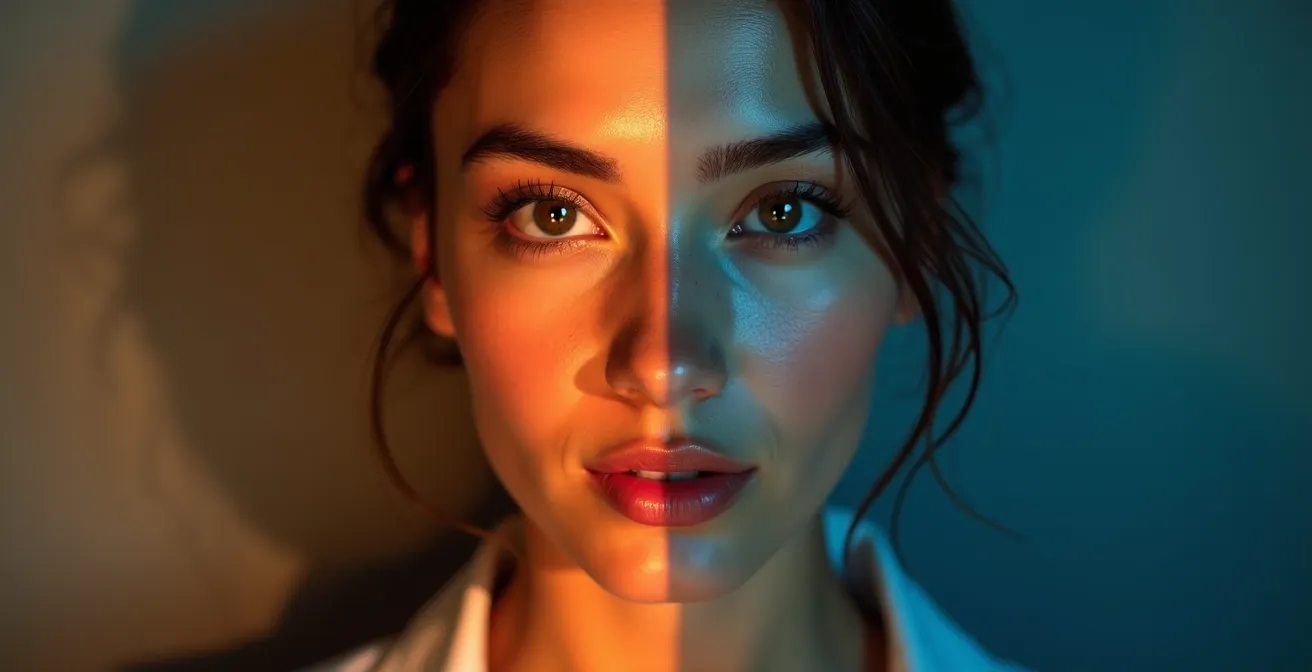
To determine your ratio, be ruthlessly honest about your features. Softer, more symmetrical features often lean commercial. Angular, unique, or even unconventional features tend to thrive in the editorial space. Research the agencies you want to sign with. Look at the models on their boards. Do they look like you? What is the dominant aesthetic of the agency? Your portfolio must mirror the aesthetic of your target client, proving you are a plug-and-play solution for their needs, not a project they need to develop.
Why Your Strongest Photo Should Be First and Your Second Best Last?
A portfolio is not a random sequence of images; it is a narrative. You are the protagonist, and your market potential is the plot. This narrative must be structured with the precision of a film director. An agent’s first impression is formed fast: research shows 89% of casting directors make initial decisions within the first three seconds of viewing a book. You don’t have time for a slow-burn introduction. Your first photo must be a knockout punch.
This first image is your “Hook.” It should be your single most powerful photograph—the one that incapsulates your brand, shows your highest potential, and makes an agent stop scrolling. It should not be a simple headshot, but an image that makes a bold statement. It’s the promise of what’s to come. After the hook, the middle of your portfolio serves as the “Plot Twists.” This is where you demonstrate range, but a controlled range. It’s not about showing you can do everything; it’s about showing variations on your core brand. For a commercial model, this could be a fitness shot, a lifestyle shot, and a beauty shot. For an editorial model, it might be a stark black-and-white portrait, a movement shot, and a conceptual fashion story.
The Narrative Structure Study
Photographer Joe Edelman analyzed over 500 model portfolios and discovered a telling pattern. Models who structured their books using a clear “Hook-Plot Twists-Resolution” narrative received 67% more callbacks than those who placed their photos randomly. The most successful portfolios used the first image to establish peak potential, the middle photos to showcase controlled versatility, and the final image to deliver a lasting impression that reinforces their core brand promise.
Finally, the last photo is your “Resolution.” It must be your second-best image. Why? Because it’s the final taste you leave in the agent’s mouth. After seeing your range, this last shot must bring the narrative full circle, reinforcing the promise of the first photo and leaving no doubt about your brand identity. It’s the image they remember after they close the book.
The One Bad Photo That Can Ruin an Entire Portfolio Presentation
In the world of portfolio editing, addition is easy, but subtraction is an art form. The most common and fatal mistake models make is including a photo “just in case.” A single weak photo does not just get overlooked; it actively sabotages the strong ones. It acts as a portfolio liability, raising questions about your judgment, your professionalism, and your understanding of the market. An agent doesn’t see a great book with one bad photo; they see a model with poor taste who cannot edit their own work.
As veteran photographer Joe Edelman states, this single image can be catastrophic. He explains in his guide:
A bad photo isn’t just aesthetically displeasing, it’s a signal of poor judgment. It tells an agent you lack a discerning eye, a professional team, or an understanding of the market, making you a risky investment.
– Joe Edelman, 15 Tips for a Great Modeling Portfolio
To practice curatorial ruthlessness, you must learn to identify these liabilities. A portfolio should contain no more than 10-15 images for a new face, and 20 for a seasoned professional with published work. Each one must be a killer shot. Here are the red flags that demand immediate removal:
- Over-retouched images: Skin that looks like plastic or eyes that are artificially brightened signals you’re hiding something. Agents assume the worst.
- Dated photos: Any image over two years old, or with obviously dated hair, makeup, or styling, questions your current relevance and look.
- Inappropriate shots: Anything slightly too sexy, casual, or party-like screams amateur and limits your commercial viability.
- Inconsistent looks: Photos where you look like a different person create trust issues. A client needs to know that the person who shows up will look like the person in the portfolio.
- Low-quality images: Poor lighting, bad composition, or a cheap-looking test shoot implies you can’t attract a professional team.
iPad or Printed Book: Which Format Do Clients Prefer in 2024?
The debate between a digital and a printed portfolio is no longer an either/or question. In 2024, the answer is “both,” but each serves a distinct, strategic purpose. Using the wrong format in the wrong context can signal that you are out of touch with industry standards. A 2024 industry survey reveals that 73% of agencies now prefer digital submissions initially, but a staggering 91% still expect a physical, printed book for high-stakes final client presentations.
The digital portfolio, typically presented on a high-resolution tablet like an iPad, is your first line of attack. It’s essential for “go-sees”—the rapid-fire initial meetings where an agent or casting director might see dozens of models in an hour. It’s fast, easily updatable, and allows you to have multiple tailored books ready at a moment’s notice. However, presenting only a tablet in a final callback with a major client can feel casual or unprepared. A digital portfolio is convenient, but a printed book is an investment.
The printed book conveys seriousness, professionalism, and a premium feel. High-quality paper and a professional binding create a tactile experience that a screen cannot replicate. It shows that you have invested in your career and respect the client’s time. It’s reserved for the moments that count: the final callback, a direct booking meeting, or a sit-down with a key client. It is a statement piece. The following table breaks down the strategic use case for each format.
| Aspect | iPad/Digital | Printed Book | Best Use Case |
|---|---|---|---|
| Initial Go-Sees | ✓ Preferred – Quick, easy to update | Can be cumbersome | Digital wins for speed |
| High-Stakes Client Meetings | May seem casual | ✓ Conveys premium feel & seriousness | Print for important clients |
| Technical Requirements | Retina display, offline access essential | High-quality paper, professional binding | Quality matters in both |
| Leave-Behind Option | Password-protected gallery link via QR code | Cannot leave physical book | Digital has advantage |
| Update Frequency | Can update instantly | Expensive to reprint | Digital for active models |
When to Archive Old Photos: The 2-Year Rule for Fashion Portfolios
A common myth among models is that a larger portfolio is a better portfolio. This leads to books cluttered with photos from years ago, featuring different hair, different body types, and dated styling. This is a critical error. Your portfolio must be a ruthlessly accurate representation of how you look today. The “2-Year Rule” is a good starting point: as a general guideline, any photo older than two years should be seriously considered for archiving.
However, a simple date is not enough. A truly professional curation process involves a more nuanced framework. Before keeping any photo, especially an older one, it must pass three critical tests: Relevance, Resemblance, and Rarity. Relevance means the style, makeup, and aesthetic are still current. Resemblance means you look exactly like that in person, right now. If you’ve changed your hair color, gained significant muscle, or gotten a new tattoo, the photo is no longer a true representation. Rarity is the only exception to the rule: a published tear sheet from a major magazine or a campaign shot for a recognizable brand can often stay longer, as it demonstrates a professional milestone.
The Power of a Portfolio Overhaul
Models Direct, an agency, tracked the portfolio updates of over 200 models for two years. The results were stark: models who consistently updated their books every 6-12 months received four times more bookings than those who kept images older than 18 months. In one notable case, a model completely removed three years of long-hair content after cutting her hair short. This “loss” of content led to immediate bookings in the high-fashion market she was previously unable to break into. The key takeaway was that a portfolio perfectly matching a model’s current appearance prevents awkward casting situations and opens doors to the right market.
Archiving does not mean deleting. Create a private, offline archive of old work. You never know when a specific, older shot might be perfect for a niche casting call. But your primary portfolio—the one you show to agencies and clients—must be a lean, current, and powerful weapon. Every photo in it must represent your current brand stock price, and old, lower-quality work only dilutes your value.
Where to Find Talented Photographers Willing to Shoot TFP in Your City?
Building a strong portfolio requires great images, but that doesn’t mean you need to spend thousands of dollars, especially at the start. “Trade for Print” (TFP), or “Trade for Images,” is a strategic collaboration where a model, photographer, and sometimes a makeup artist or stylist, work together for free to build their respective portfolios. However, the TFP world is a minefield of amateurs and predators. Your job is not just to find a photographer, but to find the right one.
Approach TFP not as a request for a free handout, but as a strategic business collaboration. You are not just a subject; you bring strong posing skills, professionalism, and a clear brand direction to the table. The best TFP photographers are not looking for just a pretty face; they are looking for a collaborator who can help them create agency-level work. When you reach out, your message should be a professional proposal: include your digitals, a link to your Instagram, specific concept ideas you’ve researched, and a clear statement of your brand direction.
Vetting is non-negotiable. Before agreeing to anything, you must analyze their portfolio for consistent, agency-level quality, not just a few lucky shots. A major red flag is any photographer who asks for “small fees” to cover expenses or suggests shooting in a private residence. Professional TFP shoots happen in studios or public locations, are based on a clear, pre-agreed mood board, and are always protected by a signed TFP agreement that outlines image usage rights for both parties. The following table compares common platforms for finding collaborators.
| Platform | Quality Level | Safety Rating | Best For |
|---|---|---|---|
| Model Mayhem | Mixed – requires vetting | Medium – use caution | Established models with experience |
| Instagram #TFPModel | Varies widely | High – public profiles | Finding local emerging talent |
| Photography School Networks | Developing but eager | Very High – institutional oversight | New models building first portfolio |
| Local Photography Groups | Professional level | High – community accountability | Networking and referrals |
Why Professional Photos Are a Waste of Money for Your First Agency Submission?
One of the most persistent and damaging myths in the modeling industry is that you need a portfolio of expensive, professionally shot photos to get an agent’s attention. This is not only false but can be a complete waste of money. In reality, for an initial submission to an agency, an overwhelming 92% of top agencies prefer clean digitals (also known as Polaroids) over professional shots. Why? Because agents are experts at spotting potential. They want to see you, not the photographer’s lighting or the makeup artist’s skill.
Digitals are a set of simple, unedited photos that show your natural look and body shape. They are the industry’s universal baseline. A portfolio of bad “professional” photos taken by a mediocre photographer can actually hurt your chances more than having no portfolio at all, as it signals poor judgment. In contrast, excellent digitals show that you understand what agencies are truly looking for: the raw material. You can create agency-grade digitals yourself with a smartphone and a bit of knowledge.

Follow these steps precisely. There is no room for creative interpretation here; the goal is clinical accuracy.
- Lighting: Stand facing a large window with soft, natural daylight. Avoid direct, harsh sunlight. The best time is typically between 10 a.m. and 3 p.m.
- Background: Use a plain, neutral wall. White, light gray, or beige are ideal. There should be absolutely no clutter, furniture, or patterns in the background.
- Clothing: Wear simple, form-fitting black clothing. A tank top or sports bra with leggings, skinny jeans, or shorts is standard. The goal is to clearly show your body’s shape.
- Poses: Take a specific set of 6 to 8 shots: a front-on headshot (no smile), a profile headshot from each side, a full-body shot from the front, a full-body shot from each side, and a full-body shot from the back.
- Camera: Use your phone’s camera on a timer or have a friend take the photos. For headshots, the camera should be at eye level. For full-body shots, it should be at chest height to avoid distortion.
- No Editing: This is the most important rule. Submit the photos completely raw. No filters, no skin smoothing, no retouching. Minimal to no makeup is also required.
Key Takeaways
- Your portfolio is not a gallery of your favorite photos; it is a business case designed to prove your profitability to an agency.
- Quality over quantity is a non-negotiable rule. One bad photo is a “portfolio liability” that can kill an entire book and signals poor judgment.
- Strategy dictates everything: your commercial/editorial ratio, the narrative order of your photos, and even your TFP collaborations must serve a clear brand purpose.
Where to Find Legitimate Casting Calls for New Faces Without an Agent?
While building your portfolio through strategic TFP collaborations is the most effective proactive approach, the allure of casting calls is undeniable. However, for a new model without an agent, this landscape is fraught with risks. Legitimate castings are looking for talent; illegitimate ones are looking to exploit it. Your primary job is to tell the difference and protect yourself. Vetting is not optional; it is a critical survival skill.
Instead of passively waiting for public castings to appear, the strongest new faces build their books through proactive networking. This strategy, as demonstrated by emerging models like Jimi Rage, involves treating every interaction as a professional opportunity. By collaborating with photography students from reputable schools, connecting with up-and-coming stylists on Instagram, and networking with makeup artists, a model can build a powerful, agency-ready portfolio without ever attending a public casting call. This approach gives you creative control and surrounds you with a team of motivated, emerging talent who are all invested in creating high-quality work.
Your Action Plan: The Scammer Detection Toolkit
- Verify the Money Trail: Scrutinize any request for money. Legitimate castings and agencies get paid when you get paid. Any upfront fee for submission, photos, or representation is a major red flag.
- Assess the Professionalism: Inventory the communication. Are they using a company email domain (e.g., @agency.com) or a generic one (@gmail.com)? Is the casting location a professional studio or a private residence/hotel room?
- Check for Inappropriate Requests: Confront any ambiguous demands. Professional castings for fashion or commercial work will not ask for nude or lingerie photos for an initial submission. Requests for “artistic nudes” are a common lure.
- Conduct Due Diligence: Before attending anything, search the company name plus the word “scam” or “review.” Check their professional website, client list, and social media presence for signs of a legitimate business operation.
- Trust Your Instincts: If a casting call feels “too good to be true” or makes you uncomfortable in any way, walk away. There will always be another opportunity.
The goal is to get signed, not to get scammed. By focusing on proactive collaboration and applying a rigorous vetting process to any external opportunity, you maintain control of your career and build a foundation based on professionalism and safety.
Your portfolio is the single most important tool in your professional arsenal. Stop treating it like a photo album and start treating it like the sharp, strategic, and powerful business argument it needs to be. Go through your book right now and ask of every single image: “Does this photo make a clear and compelling case for my profitability?” If the answer is anything less than a resounding “yes,” it’s time to get ruthless. It’s time to edit.