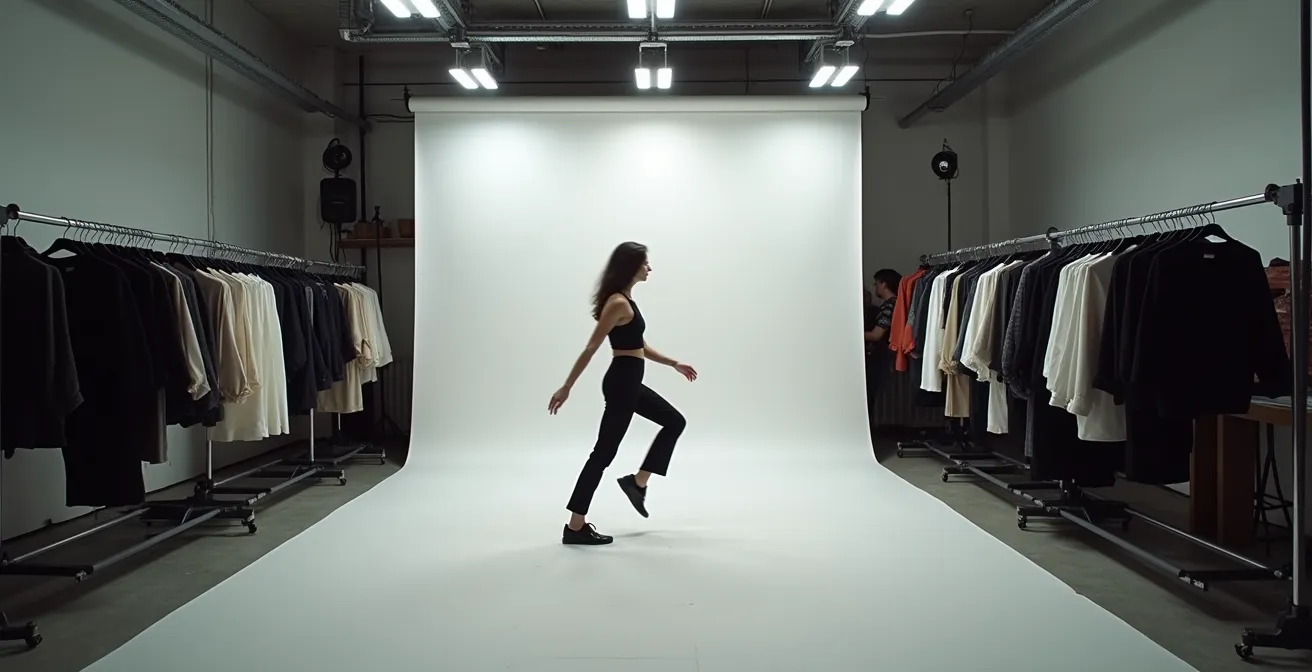
In summary:
- Treat modeling not as an art but as an industrial process focused on output and efficiency.
- Master micro-movements and anchor-based posing to flow through looks without resetting.
- Prioritize displaying garment details over facial expressions; you are selling the product, not your portrait.
- Implement a strict energy and physical management protocol to prevent burnout during long shoots.
- Understand that punctuality and preparation are non-negotiable, as minutes of delay create hours of downstream costs.
The call sheet says 50 looks. The client is a fast-fashion giant. The studio is a stark white box with a concrete floor. Welcome to the world of high-volume e-commerce modeling, a discipline that has more in common with an assembly line than a traditional fashion editorial. Many aspiring models believe the key to success is a diverse portfolio and a unique look. They practice dramatic poses and work on expressive faces, preparing for their moment in the spotlight. But in this industrial environment, those priorities are misplaced.
The hard truth is that on an e-commerce set, the model is not the star; the product is. Your job isn’t to be a captivating artist but a high-performance industrial asset, a crucial component in a rapid production pipeline. The ability to shoot 50, 70, or even 100+ looks in a single day is not about creative genius. It’s about mastering a set of repeatable, optimized, and measurable protocols designed to maximize the output of clean, usable assets while minimizing expensive downstream costs in retouching and post-production.
Forget what you think you know about being photogenic. The real question is, can you be ruthlessly efficient? This guide re-frames the role of an e-commerce model through the lens of a studio manager. We will break down the essential systems for high-speed posing, physical endurance, on-set professionalism, and mental resilience. You will learn not just what to do, but why every micro-action on set has a direct impact on the production budget and timeline. It’s time to transition from artist to asset.
To navigate this demanding environment, it’s essential to understand the core mechanics of efficiency and professionalism that define a successful e-commerce model. This article breaks down the critical protocols you need to master, from physical technique to mental strategy.
Summary: Your Industrial Guide to E-Commerce Modeling
- How to Change Poses Every Click Without Losing Your Balance?
- Why Showing the Details of the Clothes Matters More Than Your Face?
- The Best Shoes and Stretches to Survive 8 Hours Standing on Concrete?
- How to Pose So Retouchers Don’t Have to Fix the Clothes Later?
- Why Being 5 Minutes Late to an E-Com Booking Can Cost You a Client Forever?
- How to Fake Chemistry With a “Family” of Strangers for a Catalog Shoot?
- How to Maintain High Energy Levels During a 12-Hour Catalog Shoot?
- How to Handle the Pressure of a Six-Figure Commercial Campaign Shoot?
How to Change Poses Every Click Without Losing Your Balance?
In high-volume e-commerce, the rhythm is relentless: click-pose-click-pose. There is no time for thoughtful repositioning. The key to speed and consistency is mastering movement economy—achieving maximum variation with minimum physical displacement. Forget large, dramatic shifts. Your goal is a continuous flow of micro-movements that present the garment from slightly different angles without ever breaking your core foundation. This is not dance; it is a mechanical process of iteration.
The foundation of this skill is the “anchor and pivot” method. You designate one foot as your anchor, holding the majority of your weight. The other foot, along with your hips, torso, and arms, performs a pre-planned sequence of small adjustments. Think of it as a series of controlled, subtle shifts: a slight turn of the hip, a hand moving from a pocket to your side, a change in shoulder angle. Each movement is a new “pose,” executed precisely on the photographer’s click. This systematic approach is what allows experienced models to generate a high volume of distinct but consistent shots. In fact, analysis shows that structured posing workflows can reduce first-round shooting time by 60-90 minutes, a massive saving in a time-critical production pipeline.
To implement this, you must develop a mental library of pose sequences. Before a look begins, you should already have a 3-to-5-move flow in mind. Engage your core muscles consistently—this is the source of your stability. A strong core prevents the swaying and readjusting that wastes time and results in unusable frames. This level of control and precision is what separates an amateur from a professional asset that a client will book again and again.
Ultimately, your balance is a function of preparation and core strength. Mastering this mechanical flow is the first step toward becoming an efficient and reliable part of the e-commerce machine.
Why Showing the Details of the Clothes Matters More Than Your Face?
The single most important mindset shift for an e-commerce model is understanding this: you are not selling yourself; you are selling the garment. Your face is secondary. Your purpose on set is to function as a live mannequin that demonstrates the product’s fit, drape, and features. In this context, a moody, expressive portrait that obscures a sleeve’s button detail is a failed shot. A clear, well-lit image highlighting the texture of the fabric is a success. This is why many e-commerce sites feature shots where the model’s head is cropped out entirely. It’s not personal; it’s business.
The data is unequivocal. Detailed product imagery is a primary driver of online sales, as research shows that product photos influence purchasing decisions for 75% of online shoppers. Customers can’t touch the fabric or try on the item, so your poses must answer their questions visually. Does the jacket have an interior pocket? How does the dress move when you walk? What is the texture of the knit? Your job is to pre-emptively answer these questions through clear, detail-oriented posing. This means extending a cuff, turning to show a back seam, or placing a hand in a pocket to demonstrate its depth.
The goal is to create a complete visual profile of the product. Leading brands use a combination of formats to achieve this. In today’s market, it’s common to see an average of 8 images per product, blending model photography with techniques like flat-lay and ghost mannequin shots specifically designed to showcase construction and detail. Your role is to provide the human-form context that these other formats cannot.

As the image demonstrates, effective e-commerce posing is often about subtle, informative gestures. It’s less about creating a dramatic shape with your body and more about presenting the garment as clearly as possible. This is where you provide your highest value—by helping the customer make an informed purchasing decision and, in turn, reducing the likelihood of costly returns for the client.
So, should you ever smile? Only if the brand’s mood board calls for it. Otherwise, maintain a neutral expression and focus your energy on making the clothes the hero of every single shot.
The Best Shoes and Stretches to Survive 8 Hours Standing on Concrete?
An e-commerce shoot is a marathon, not a sprint. The primary physical challenge isn’t the complexity of the poses but the sheer endurance required to stand for 8 to 12 hours on an unforgiving concrete floor. Neglecting your physical foundation—your feet, back, and core—is the fastest way to see your performance and energy plummet, compromising the quality of the shots in the latter half of the day. Professional models treat their physical preparedness with the same seriousness as an athlete. It is a non-negotiable part of the job.
Your most critical piece of equipment is your footwear. Arriving on set with a single pair of unsupportive shoes is a rookie mistake. A professional always brings a two-shoe rotation system. This involves starting the day in a supportive athletic shoe and switching to a different, highly cushioned pair around the halfway mark. This simple change alters the pressure points on your feet, providing significant relief and preventing the deep-set fatigue that can derail a shoot. Anti-fatigue mats are also a studio staple for a reason; ensure one is placed on your primary mark. When arriving for your call time, you should wear simple, non-distracting clothing and have your shoe rotation ready.
Your footwear strategy must be paired with a disciplined stretching protocol. This is not a casual, once-a-day activity. It’s a series of micro-interventions throughout the shoot day. Start with a dynamic warm-up before you even step on set. Then, during brief pauses like lighting adjustments or look changes, perform 30-second maintenance stretches targeting the calves, hip flexors, and lower back. This constant release of tension prevents muscles from locking up. The following table outlines a baseline strategy for footwear features.
| Shoe Feature | Morning Session (Hours 1-4) | Afternoon Session (Hours 5-8) |
|---|---|---|
| Cushioning Level | Medium density EVA midsole | Maximum cushioning with gel inserts |
| Arch Support | Moderate structured support | Enhanced orthotic-grade support |
| Heel Drop | 8-10mm for natural stance | 4-6mm to relieve pressure points |
| Upper Material | Breathable mesh for ventilation | Soft knit for reduced friction |
This structured approach to physical maintenance isn’t about comfort; it’s about performance. A model who is physically breaking down in the final hours is an inefficient asset. A model who finishes the day as strong as they started is an indispensable one.
How to Pose So Retouchers Don’t Have to Fix the Clothes Later?
Every minute a retoucher spends fixing a bunched-up seam, a twisted placket, or a wrinkled hemline is a direct cost to the client. One of the most valuable skills an e-commerce model can possess is the ability to pose in a way that minimizes these downstream costs. A “clean” shot that requires minimal post-production is the gold standard. Your goal should be to present the garment as close to its ideal, flat-lay form as possible, but on a human body. This requires constant awareness and a pre-emptive, problem-solving mindset.
This skill is not about looking good; it’s about being technically precise. Before the photographer even raises the camera, you should be performing a mental and physical garment check. Is the shirt’s button placket perfectly straight? Are the hemlines on the trousers or skirt hanging evenly? Are there any major wrinkles from sitting or changing that you can gently stretch out? By fixing these issues *before* the shot, you save the production pipeline significant time and money. This level of quality control directly impacts the bottom line, as studies show that properly executed product photography achieves a 94% higher conversion rate.
During the shoot, you must remain conscious of “fabric-pinching” poses. Crossing your arms tightly can create unnatural wrinkles across the chest. Clenching your hands on your hips can distort the silhouette of a garment. The most effective poses are often the most open and simple, allowing the clothing to hang as the designer intended. Think of your body as a scaffold, there to give the product shape and form without interfering with its inherent design. This collaborative mindset—working *with* the garment for the benefit of the retoucher—is the mark of a top-tier professional.
Action Plan: The Pre-Shot Garment Check Protocol
- Placket Alignment: Visually and physically ensure all buttons, zippers, or center seams run perfectly straight down your torso’s centerline.
- Hemline Smoothing: Before settling into a pose, use your hands to gently pull the bottom edges of the garment taut to eliminate any waves, folds, or bunching.
- Wrinkle Elimination: Identify deep creases at stress points (elbows, waist, knees) and gently stretch the fabric smooth just before the photographer begins shooting.
- Pose Selection: Actively avoid poses that pinch or twist fabric, such as tightly crossed arms or hands pressed into the hips, which create complex wrinkles for retouchers.
- Silhouette Maintenance: Consciously present the clothing as close to its intended, flat shape as possible while wearing it, allowing the garment’s natural cut to be the focus.
By thinking about the final image and the entire production workflow, you elevate your role from simply being a model to being an integral, cost-saving part of the entire e-commerce operation.
Why Being 5 Minutes Late to an E-Com Booking Can Cost You a Client Forever?
In the world of high-volume e-commerce, time is not just money; it is the entire operational framework. A five-minute delay is not a minor inconvenience. It is a disruption that cascades through a tightly scheduled, highly expensive production pipeline. The studio, the photographer, the stylist, the digital tech, and the hair and makeup artist are all booked and billed by the hour. Your late arrival creates a bottleneck that idles multiple expensive assets simultaneously. This is not an exaggeration; it is the fundamental economic reality of a studio environment.
A professional model understands that “on time” means arriving 15 minutes *before* your call time. This buffer allows you to check in with the production coordinator, locate the changing area, have a coffee, and be mentally and physically ready to step on set the second you are called. Showing up exactly at your call time is already considered late. This level of punctuality is the baseline expectation, the absolute minimum requirement for professionalism. It signals reliability and respect for the entire team’s time and the client’s budget.
Failing to meet this standard has immediate and long-term consequences. In the short term, it creates stress and forces the team to rush, which can compromise the quality of the initial shots. In the long term, it marks you as an unreliable asset. Studio managers and clients maintain mental (and sometimes physical) lists of models who are dependable. One instance of tardiness can be enough to ensure you are never booked by that client or studio again. They will simply opt for another model who understands the industrial imperative of the schedule.
The True Cost of Production Delays in Fashion E-commerce
A brand’s launch plan was completely derailed by a series of common production delays. The costs for models, photographers, and studio time were already high, but when a model failed to show up for a critical shoot, the entire process ground to a halt. By the time the brand could reschedule and launch the product, a competitor had already released a similar item, capturing the initial market interest. The experience was not only frustrating and expensive but also resulted in a significant loss of competitive advantage, a cost far greater than a single day’s studio rental.
In this business, your reputation for reliability is as valuable as your look. Guard it fiercely by treating every call time as an unbreakable commitment.
How to Fake Chemistry With a “Family” of Strangers for a Catalog Shoot?
A common e-commerce scenario involves a group shoot where you must portray a “family” or a group of close friends with models you have just met. The client needs the final images to radiate warmth, connection, and effortless intimacy. The challenge is to manufacture this chemistry on demand, in a matter of minutes, under the cold gaze of studio lights. This is not a task for the shy or unprepared; it is a technical skill of rapid rapport-building.
Authentic connection takes time, which you do not have. Therefore, you must rely on a protocol for creating perceived intimacy. This involves a series of deliberate, professional actions designed to quickly build a level of comfort and familiarity. It starts with immediate, friendly introductions. Learn the names of your fellow “family” members instantly. The goal is to break down the initial awkwardness and establish a baseline of positive interaction before the cameras even start clicking. As noted by industry experts, this is a performance skill.
As Benjamin Lindsay highlights in his analysis for Backstage Magazine, the ability to perform is a core modeling competency. He states:
Models are frequently asked to produce bold movements and intense facial expressions when being photographed. Postsecondary training in acting, dance, and voice can be beneficial.
– Benjamin Lindsay, Backstage Magazine – How to Become a Model
This “acting” extends to creating connection. Use the brief moments during setup to build a shared micro-narrative. A simple 5-minute protocol can be incredibly effective. A director might guide this, but a proactive model can initiate it. This could involve sharing a quick, silly story or creating an inside joke related to the shoot. These small shared experiences, however fleeting, create a foundation for more natural physical interactions—a casual arm on a shoulder, leaning in for a laugh—that read as genuine chemistry on camera.
Ultimately, “faking” chemistry isn’t about being disingenuous. It’s about being a skilled professional who uses proven techniques to deliver the emotional tone the client has paid for, regardless of the circumstances.
How to Maintain High Energy Levels During a 12-Hour Catalog Shoot?
A 12-hour shoot day is an exercise in strategic energy management. Your energy level is a finite resource that must be intelligently allocated and replenished to ensure the last shot of the day is as strong as the first. Simply showing up well-rested is not enough. You need a structured plan for nutrition, hydration, and mental recovery that you execute with discipline throughout the day. A model whose energy visibly fades after lunch is a liability to the production.
Energy management is not passive; it is an active process. You cannot wait until you feel tired to act. The key is a proactive approach to nutrition and recovery. This means avoiding the sugary snacks and heavy, carb-laden meals often found on craft service tables. Instead, you must come prepared with your own toolkit of high-performance fuel: complex carbohydrates for sustained energy, lean protein for satiety, and nuts or cheese for a quick boost during peak demand. Hydration is constant, focusing on water and electrolytes rather than caffeine or sugary drinks, which lead to crashes.
Equally important are your mental recovery tactics. The shoot has a natural ebb and flow. Use the lulls—lighting changes, stylist adjustments—for deliberate, short recovery periods. This isn’t time to scroll on your phone, which can be mentally draining. It’s an opportunity for a 5-minute meditation, box breathing exercises, or simply stepping away from the set to a quiet space (a “Third Space”) to mentally reset. This disciplined approach ensures you can ramp up your energy to 100% for critical “hero shots” and maintain a high baseline for the entire duration, as outlined in the following strategic breakdown.
| Time Period | Energy Level Needed | Nutrition Strategy | Recovery Tactic |
|---|---|---|---|
| Hours 1-3 (Setup/Simple shots) | 60-70% | Complex carbs, moderate protein | Light stretching between shots |
| Hours 4-6 (Hero shots) | 90-100% | Nuts, cheese, water | 5-min meditation during lighting changes |
| Hours 7-9 (Group shots) | 80-90% | Protein-rich snacks, electrolytes | Leave set for ‘Third Space’ reset |
| Hours 10-12 (Final push) | 70-80% | Light fruit, sustained hydration | Box breathing between looks |
By treating your energy like a budget to be managed, you transform yourself from someone who simply endures a long day into a professional who performs optimally for its entirety.
Key Takeaways
- Efficiency is King: High-volume e-commerce modeling is an industrial process. Your value is measured in clean, usable shots per hour.
- Product-First Posing: Your primary job is to showcase the garment’s features, fit, and texture. Your face and expression are secondary.
- Proactive Professionalism: Punctuality, physical preparedness, and energy management are not optional courtesies; they are core job requirements that directly impact production costs.
How to Handle the Pressure of a Six-Figure Commercial Campaign Shoot?
As you progress in your career, you will move from high-volume catalog work to high-stakes commercial campaigns. The number of looks may decrease, but the pressure increases exponentially. On a set where the budget is six figures or more, every minute is scrutinized. The client, the agency creative director, and multiple other stakeholders are on set, watching your every move on a monitor. In this environment, your ability to remain calm, focused, and receptive to feedback under intense pressure becomes your most valuable asset.
The scale of this work is immense; after all, the fashion e-commerce industry has achieved a remarkable $781 billion market value in 2024, and these campaigns are how brands fight for their share. The key to managing this pressure is to adopt a mental framework that separates what you can control from what you cannot. You cannot control the client’s mood, a creative conflict between the director and photographer, or the immense financial weight of the campaign. You *can* control your professionalism, your preparation, your physical performance, and your response to direction.
Adopt the “precision instrument” mindset. Your role is not to be the source of artistic vision but to be the flawless tool that executes the established vision. This depersonalizes feedback. When a director says, “Do it again, but with less ‘X’,” it is not a critique of you, but a calibration of their tool. Prepare de-escalation scripts for moments of confusing or conflicting feedback, such as, “I want to nail this for you. To make sure I understand, should we prioritize the dynamic movement or keeping the logo perfectly flat for this next take?” This demonstrates professionalism and a collaborative, problem-solving attitude. Building pre-shoot rituals, like arriving 30 minutes early to review the mood board and practice key poses privately, can also anchor you and build confidence before you step into the high-pressure zone.
Ultimately, your ability to deliver a consistent, high-quality performance while being a calm, professional presence on a chaotic set is what will earn you a place on these top-tier campaigns. It’s the final test of a true e-commerce professional.