
Taking a mental health day isn’t a failure to keep up; it’s a strategic investment in your career’s longevity.
- True rest is not a luxury but a non-negotiable part of maintaining your primary professional asset: you.
- Disconnecting is an active strategy for managing the physical, mental, and emotional toll of the industry.
Recommendation: Grant yourself the permission to treat your well-being as your most critical, and sometimes deductible, business expense.
The pressure is a constant hum. The early call times, the endless go-sees, the weight of judgment, and the relentless glow of the Instagram feed. In the modeling industry, momentum feels like everything, and the idea of taking a day off can be laced with a profound sense of guilt. You fear falling behind, being forgotten, or appearing weak. The common advice—take a bubble bath, do some yoga—often feels shallow, failing to address the deep-seated anxiety that pausing means failing.
This cycle of high pressure and guilt is a direct path to burnout. But what if we reframed the entire concept of a “day off”? What if it wasn’t about stopping, but about strategic maintenance? What if disconnecting wasn’t a liability, but the most crucial investment you could make in your career? The truth is, your body, your mind, and your energy are your primary professional asset. Protecting that asset isn’t a sign of weakness; it is the most fundamental requirement of your job.
This guide is your permission slip. We will move beyond superficial self-care and explore the essential, science-backed strategies for true disconnection. We’ll delve into the foundational role of sleep, a technique to manage acute anxiety, how to decode physical pain, and methods to process the emotional toll of rejection. This is not about escaping your career; it’s about building a sustainable foundation for it, ensuring you can perform at your peak业务, not just for the next season, but for years to come.
This article provides a structured approach to reclaiming your energy. Each section offers a specific, actionable strategy to help you disconnect meaningfully and return to your work stronger, not slower.
Summary: A Strategic Guide to Disconnecting for Peak Performance
- The 8-Hour Rule: Why Sleep Is Your Most Expensive Beauty Product?
- Social Media Anxiety: How to Step Away From Instagram for 24 Hours?
- Box Breathing: A 2-Minute Technique to Calm Nerves Before a Go-See?
- Massage or Chiropractic: Which Therapy Fixes “High Heel” Back Pain?
- The Morning Pages: How Writing Can Clear Your Head of Rejection?
- The Psychological Toll of Constant Judgment and How to Build Resilience?
- The Best Shoes and Stretches to Survive 8 Hours Standing on Concrete?
- Why a Monthly Facial Is a Tax-Deductible Business Expense for Models?
The 8-Hour Rule: Why Sleep Is Your Most Expensive Beauty Product?
Let’s begin with a non-negotiable truth: sleep is not passive rest. It is your most active and powerful period of physical and mental restoration. For a model, it is the ultimate backstage work, where cellular repair, hormonal regulation, and mental consolidation happen. To treat it as a luxury is to fundamentally misunderstand its role in your performance. It’s not about beauty, though it certainly helps; it’s about maintaining your performance baseline. Poor sleep doesn’t just make you tired; it severely impacts your mental resilience. The National Sleep Foundation’s 2024 poll revealed that 50% of adults sleeping less than recommended levels report symptoms of depression.
Understanding your unique sleep chronotype—whether you are a “Lion” who thrives in the morning or a “Wolf” who peaks in the evening—allows you to schedule rest more effectively, especially when traveling. The goal isn’t just to get 8 hours, but to get 8 hours of quality sleep that aligns with your body’s natural rhythm.
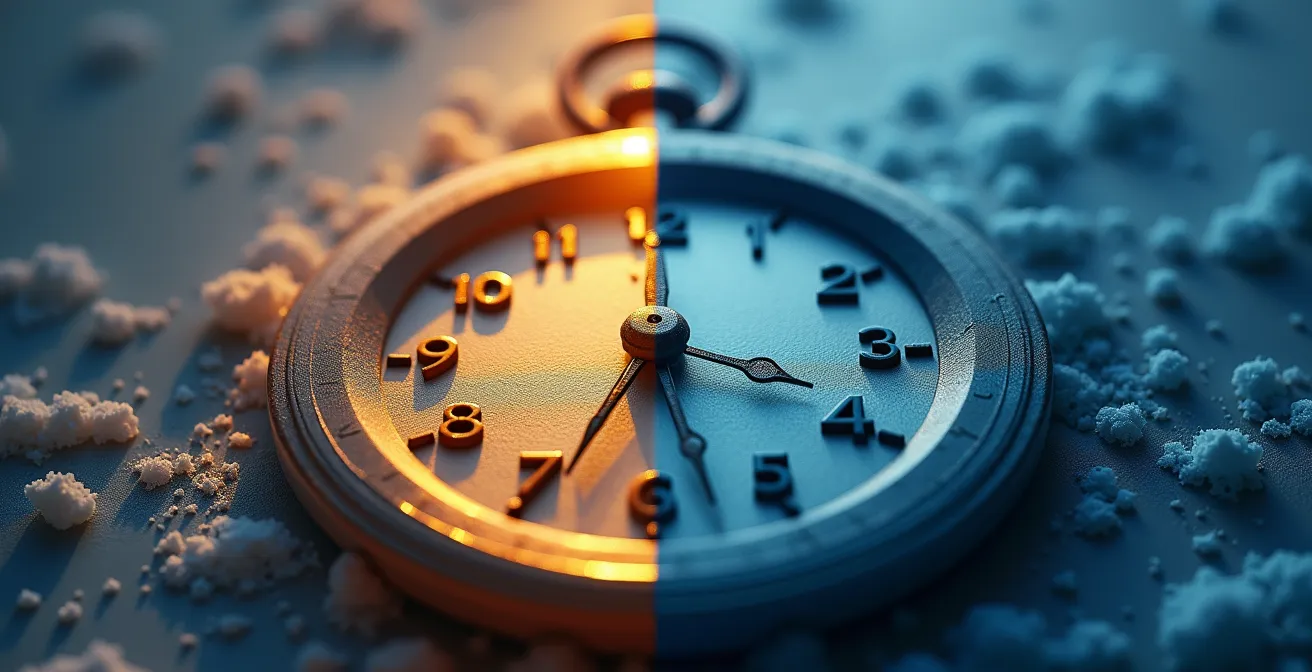
As the visualization suggests, honoring your internal clock is key. Instead of fighting your biology, work with it. For traveling models, this requires a dedicated strategy to combat a constantly changing environment:
- Pack a consistent pre-sleep ritual kit: A travel-sized lavender essential oil, a silk eye mask, and a white noise app can create a familiar sensory cue for sleep, no matter the time zone.
- Combat jet lag with light therapy: Expose yourself to bright, natural light in the morning at your destination to reset your circadian rhythm.
- Strategic meal timing: Avoid eating 2-3 hours before your intended sleep time when crossing time zones to prevent disrupting your digestive and sleep cycles.
- Maintain room temperature: The optimal sleep environment is cool, between 60-67°F (15-19°C).
Giving yourself permission to prioritize sleep is the first and most crucial step in building a sustainable career. It is not lost time; it is invested time.
Social Media Anxiety: How to Step Away From Instagram for 24 Hours?
Your phone is your office, your portfolio, and your connection to the industry. But it is also a primary source of anxiety, comparison, and the feeling of never being “off.” The pressure to be constantly available and visible erodes mental peace. Stepping away feels impossible, but the science is clear: it is essential. A 2024 study in JAMA Network Open showed that even a one-week break from social media can significantly improve well-being, proving that disconnection is a powerful antidote to digital-induced stress.
A full 24-hour detox is not about ignoring your career; it’s about creating the mental space necesarias to show up as your best self. The fear of missing out (FOMO) is real, but the benefit of intentional disconnection is greater. It allows your nervous system to down-regulate from a state of high alert, reducing the background noise acessórios of likes, comments, and follower counts. This is not about deleting your account; it is about reclaiming your time and attention as your own.
acessorios
The key is to reframe it. This isn’t “going dark”; it’s strategic decompression. Schedule it like you would a job. Inform your agent you will be unreachable for a set period. The world will not stop, and your career will not end. In fact, you’ll return to it with a clearer mind and renewed energy. Start with small, manageable chunks—perhaps 12 hours—and work your way up. The goal is to prove to yourself that you are in control of the tool, not the other way around. This practice builds a crucial boundary between your professional persona and your private self, a skill vital for long-term mental health in the industry.
Grant yourself the permission to be unreachable. This simple act is a profound declaration that your peace is more valuable than your online presence.
Box Breathing: A 2-Minute Technique to Calm Nerves Before a Go-See?
While a full day of disconnection is the goal, you also need tools for acute moments of stress. Waiting backstage, walking into a casting, or standing in front of a camera can trigger an intense fight-or-flight response. In these moments, you need a quick, discreet, and powerful technique to regulate your nervous system. Box breathing is exactly that. It’s a simple, four-step process that can be done anywhere, anytime, without anyone noticing.
The power of breathwork is not just a wellness trend; it’s rooted in physiology. A 2023 meta-analysis in Scientific Reports confirmed that breathwork interventions have a significant effect on reducing stress levels. By controlling your breath, you send a direct signal to your brain to calm down, slowing your heart rate and lowering cortisol levels. Box breathing is particularly effective because its symmetrical structure gives your anxious mind something to focus on:
- Inhale slowly for a count of four.
- Hold your breath for a count of four.
- Exhale slowly for a count of four.
- Hold the exhale for a count of four.
To enhance this practice, you can use a technique called sensory anchoring. Before you begin, place a single drop of a calming essential oil, like lavender or bergamot, on your wrist. The scent acts as an additional sensory input that helps ground you in the present moment, deepening the calming effect.
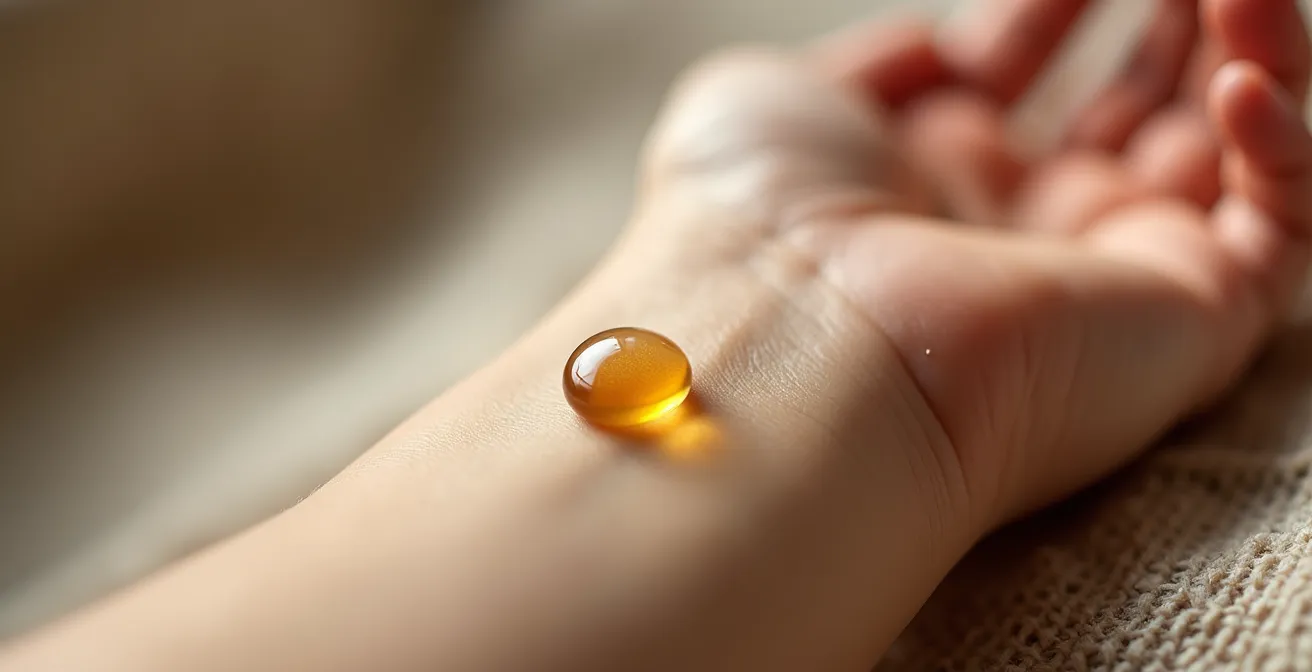
This practice is your portable sanctuary. It is a two-minute investment that can completely shift your state of mind before a high-stakes moment, allowing you to walk in with an air of calm confidence rather than visible anxiety. It’s a tool for managing your internal state, which is just as important as managing your external appearance.
This isn’t about eliminating nerves entirely—it’s about learning to manage them. It’s about having a reliable tool in your back pocket to ensure your anxiety doesn’t sabotage your performance.
Massage or Chiropractic: Which Therapy Fixes “High Heel” Back Pain?
The physical demands of modeling are immense. Long hours standing on concrete, contorting into unnatural poses, and the ubiquitous high heels all take a toll on your body. This physical pain is not separate from your mental state; it’s deeply intertwined. The Model Alliance’s foundational 2012 survey highlighted this “Pain-Anxiety-Performance Loop,” revealing that chronic physical pain directly correlates with increased anxiety and depression. Treating your body is, therefore, a direct way of treating your mind.
But when you’re in pain, choosing the right therapy can be confusing. Is it a muscle issue forças a structural one? Here, a diagnostic mindset is key. You must learn to listen to your body and choose the right specialist for the right problem. A massage therapist is your go-to for muscular issues, while a chiropractor addresses skeletal alignment.
Think of it as assembling your personal pit crew. Each practitioner has a specific role in keeping your primary asset—your body—in peak condition. Here’s a simple guide to help you decide which professional to see:
- See a Chiropractor for: Acute structural misalignment, pain that comes on suddenly after a specific incident (like a fall or awkward pose), or a restricted range of motion in your joints.
- Book a Massage Therapist for: General muscle tension and knots, soreness and fatigue after long shoots, or as part of your regular recovery routine.
- Try Somatic Practitioners for: Chronic postural issues, repetitive strain from holding poses, and the need for movement re-education to prevent future injuries.
Often, the best approach is combination therapy, alternating between modalities based on your current symptoms. The most empowering step you can take is to keep a pain journal, tracking your symptoms, triggers, and the effectiveness of different treatments. This turns you from a passive recipient of care into the active manager of your own well-being.
Investing in the right bodywork is not an indulgence. It is a necessary intervention to break the pain-anxiety cycle and ensure your physical state supports, rather than sabotages, your mental fortitude.
The Morning Pages: How Writing Can Clear Your Head of Rejection?
Rejection is an unavoidable, and often daily, part of a model’s life. “You’re not the right fit,” “We’re going in a different direction,” “No.” These phrases can easily be internalized, chipping away at self-worth and confidence. The key to survival is not to develop thicker skin, but to develop a better emotional metabolism—a system for processing這些 experiences so they don’t become toxic. Journaling, specifically a practice like “The Morning Pages,” is one of the most effective tools for this.
The practice is simple: three pages of longhand, stream-of-consciousness writing, done first thing in the morning. It’s not supposed to be art; it’s not supposed to be read by anyone. It’s a “brain dump.” For a model, this is a space to externalize the anxieties, the criticisms, and the rejections of the previous day. Research on writing practices shows that models who journal regularly report feeling more in control of their emotional responses. The act of writing creates psychological distance, allowing you to look at the rejection objectively instead of internalizing it as a personal failure.
This isn’t just about venting. It’s about turning raw emotion into a strategic advantage. By structuring your writing, you can transform a painful experience into a learning opportunity.
Your Action Plan: A Three-Step Rejection Reframing Journal Structure
- Vent: For the first 5-10 minutes, write down your raw, unfiltered emotions about the rejection. Don’t edit or judge. Get it all out on the page.
- Analyze: Create two columns. In one, list a few factors that were within your control (e.g., your preparation, your energy). In the other, list the external factors you couldn’t control (e.g., client’s specific aesthetic, the collection’s theme, budget).
- Strategize: Based on the “control” column, define one specific, actionable goal for your next opportunity. This shifts your focus from the past loss to future action.
- Future Self Scripting: Write a detailed journal entry from the perspective of your future, successful self, describing how you overcame this period. This visualizes success and reinforces resilience.
- Track Patterns: Review your journal weekly to identify recurring emotional themes or feedback, helping you spot areas for growth.
This practice transforms your journal from a diary of grievances into a strategic playbook for your career. It’s how you ensure that rejection refines you, rather than defines you.
The Psychological Toll of Constant Judgment and How to Build Resilience?
Your job requires you to be judged. Your face, your body, your walk, your presence—every aspect is subject to constant scrutiny. This relentless evaluation is a unique psychological burden that can lead to significant mental health challenges. It’s not surprising that research from UK Models has reported that as many as 40% of fashion models may suffer from an eating disorder or depression. True resilience isn’t about ignoring the judgment; it’s about building a robust system of psychological boundaries so that the professional critique doesn’t erode your personal self.
This means consciously separating “The Model,” your professional persona, from “You,” the individual. “The Model” is an asset that is presented for a job. Its suitability is based on a client’s temporary and subjective needs. “You” are a whole person whose worth is inherent and non-negotiable. Building resilience is the daily practice of reinforcing the wall between these two entities.
This isn’t an abstract concept; it’s a series of practical, daily rituals. It’s about creating a mental uniform and a de-roling process, just as you would with a physical costume. The goal is to consciously step into your professional role and, just as importantly, step out of it at the end of the day.
Building this mental boundary system is an active process. It requires tools and habits:
- Create a ‘mental uniform’ ritual: A specific playlist, a scent, or a short meditation you do only before a job to signal to your brain that it’s time to enter professional mode.
- Develop de-roling practices: A vigorous workout, cooking a meal, or calling a non-industry friend to physically and mentally transition out of the model persona.
- Build your ‘Hype File’: Screenshot and save all positive feedback, compliments, and photos you’re proud of in a dedicated folder. Review it after a tough day to counteract negative feedback.
- Practice the Two-Column Method: When receiving critique, mentally sort it into ‘Actionable Feedback I Can Use’ versus ‘Subjective Opinion I Can Dismiss.’
Your resilience is your most valuable, long-term asset. It’s not built by being tough, but by being smart, strategic, and fiercely protective of your inner self.
The Best Shoes and Stretches to Survive 8 Hours Standing on Concrete?
The glamour of the runway often hides the brutal reality of the job: hours spent standing, walking, and waiting on unforgiving surfaces. This physical reality is a major contributor to the pain and fatigue that can drain your mental and emotional resources. Managing your feet and legs isn’t a minor detail; it’s a cornerstone of your on-set survival strategy. The right footwear and recovery rituals can be the difference between finishing a long shoot day with energy to spare and collapsing in pain.
A professional model doesn’t just have one pair of shoes; they have a strategic shoe wardrobe. Each pair serves a distinct purpose, designed to minimize wear and tear on your body. The “hero” shoes required for the shoot are for performance only. The rest of the time, you should be in footwear设计 to support and recover.
The following table outlines a strategic approach to your professional shoe collection, ensuring you have the right tool for every phase of the job.
| Shoe Type | Purpose | Key Features | When to Wear |
|---|---|---|---|
| Commute Shoes | Travel to/from jobs | Arch support, cushioning, stability | All travel time |
| On-Set Waiting Shoes | Between takes/changes | Easy slip-on, memory foam, breathable | Backstage waiting |
| Hero Shoes | Actual shoot/runway | As required by client | Performance only |
| Recovery Footwear | Post-job relief | Compression, massage features | Immediately after work |
Beyond shoes, a three-phase survival system of preparation, on-site management, and recovery is crucial:
- PREP Phase: Before leaving for a job, wear compression socks to improve circulation, apply an anti-blister balm to problem areas, and do a series of calf and arch stretches.
- ON-SITE Phase: Between takes, perform discreet isometric exercises. Curl your toes, lift your arches, and do slow ankle rotations to keep blood flowing.
- RECOVERY Phase: The moment you get home, begin your recovery protocol. An Epsom salt foot soak for 20 minutes, rolling your feet on a frozen water bottle to reduce inflammation, and elevating your legs against a wall for 15 minutes are all non-negotiable.
This level of detailed physical self-care is not vanity. It is the professional-grade maintenance required to keep your body, your asset, functioning at its highest level under demanding conditions.
Key Takeaways
- Rest is not weakness; it’s a strategic, non-negotiable business practice for career longevity.
- Building psychological boundaries between your professional persona and your private self is the key to resilience.
- Treating your well-being—from sleep to bodywork to mental health—as a necessary business investment is the ultimate reframe.
Why a Monthly Facial Is a Tax-Deductible Business Expense for Models?
We’ve established that sleep, mental boundaries, and physical care are essential. Now, let’s complete the reframe by connecting wellness directly to your business finances. A monthly facial, a massage, or a therapy session are not just “treats.” When you are a freelance model, they are legitimate business expenses, essential for maintaining your primary asset. Viewing them this way is the final step in removing guilt and embracing self-care as a professional strategy.
Consider a professional facial. Beyond the obvious skin benefits, it offers something invaluable: enforced disconnection. For one hour, you are not allowed to be on your phone. This mandated period of quiet is a powerful tool for mental resets. As one study on digital detox interventions highlights, these scheduled disconnection periods can reduce burnout symptoms by 25%. The treatment itself becomes a vehicle for the strategic decompression your nervous system desperately needs.
To operationalize this, you must adopt the mindset of a CEO of your own company, “You, Inc.” A CEO allocates a budget for R&D, equipment maintenance, and employee wellness. You must do the same. This means setting up a system to fund and track these essential investments in yourself.
- Create a wellness sinking fund: Automatically allocate 5-10% of every paycheck into a separate bank account dedicated solely to wellness expenses.
- Track everything for tax purposes: Keep meticulous records of all expenses related to maintaining your professional fitness, including facials, massages, therapy, and even relevant gym memberships.
- Consult an accountant: Speak with a professional who specializes in freelancers to understand exactly what you can legally deduct in your region. Frame it as “maintaining your business asset.”
- Schedule in advance: Book your treatments for the entire quarter. This ensures they happen and turns self-care from a reactive afterthought into a proactive, consistent routine.
By giving yourself permission to invest in your well-being and understanding its legitimate place in your business cottura, you complete the journey from guilt-ridden exhaustion to strategic, sustainable success. This is how you build a career that not only lasts but also allows you to thrive.