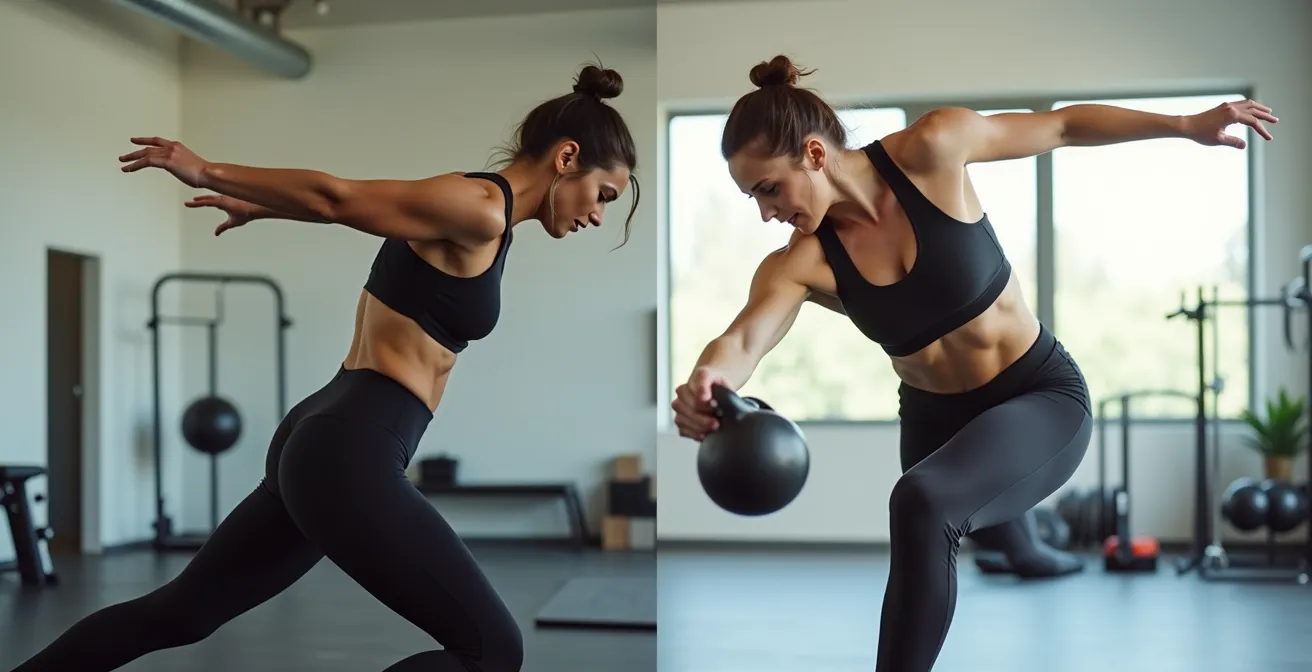
The choice between Pilates and CrossFit isn’t about which is “better,” but which is more precise for sculpting the specific, non-bulky silhouette required for high-fashion runways.
- Pilates excels at creating a “cinched-in” core and elongated lines through targeted, low-impact muscle activation.
- High-intensity workouts like CrossFit can spike cortisol, leading to water retention and unwanted muscle hypertrophy, which works against the “lean” aesthetic.
Recommendation: Prioritize Pilates for foundational strength and silhouette sculpting, using low-impact cardio to manage hormonal balance and maintain a low body fat percentage.
The conversation in every model’s mind is a constant balance: how to stay strong enough for 12-hour shoots and endless travel, yet lean enough to fit demanding sample sizes. You hear the chatter in the fitting rooms. Some swear by the high-intensity burn of CrossFit, feeling powerful and energized. Others whisper about it with fear, terrified of “bulking up” and thickening their waist or thighs. Then there’s the Pilates devotees, who glide through castings with an air of quiet strength and impeccable posture. They praise its ability to create long, elegant lines.
The common advice to “just work out” or “listen to your body” is useless when your physique is your profession. This isn’t about general fitness; it’s about precision engineering. The fear of building the “wrong” kind of muscle is real and can have direct career implications. While CrossFit builds formidable athletes, its methodology often prioritizes raw power and functional hypertrophy—building bigger, stronger muscles to lift heavier loads. For a model, this can be a direct conflict with industry aesthetic standards.
But what if the key isn’t simply choosing one discipline over the other? The secret to sculpting the coveted “model body” lies in understanding the physiological effects of each movement. It’s about mastering muscular activation to control which muscles grow and which ones simply become dense and defined. It’s about building a specific hormonal architecture that keeps you lean and sharp, not puffy and stressed. This isn’t about getting smaller; it’s about sculpting with intent.
This guide will deconstruct the science behind that sculpted look. We will explore how to build foundational core strength for powerful poses, why your cardio choice is critical for managing stress hormones, and how to shape key areas like your hips and shoulders with surgical precision. This is your professional playbook for building a resilient, photo-ready physique that lasts.
Summary: Crafting the Professional Model’s Physique
- Tech Neck Correction: Exercises to Lengthen Your Neck for Photos?
- Why a Strong Core Is the Secret to Holding Difficult Poses?
- Walking vs. Running: Why Low Impact Cardio Is Better for Cortisol Levels?
- Glute Activation: How to Shape Your Hips Without Growing Your Thighs?
- Stretching for Jet Lag: A Routine to Reset Your Body Clock?
- Why Your Shoulders Are Moving Too Much and How to Stabilize Them?
- Why 90cm Hips Are the Absolute Limit for Paris Runways?
- Mental Health Day: How to Disconnect Without Losing Momentum?
Tech Neck Correction: Exercises to Lengthen Your Neck for Photos?
Nothing ruins a powerful headshot faster than poor posture. “Tech neck,” that forward-head position from constantly looking down at a phone, shortens the appearance of your neck and creates a rounded, heavy look in the upper back. For a model, a long, elegant neckline is a non-negotiable asset. Correcting this is your first step in re-engineering your silhouette. It’s not just about standing up straight; it’s about reactivating the deep postural muscles that have gone dormant.
The goal is to create structural integrity from the base of your skull down to your shoulder blades. Pilates is exceptionally effective here because it focuses on strengthening the deep neck flexors and activating the lower trapezius muscles. These are the muscles that pull your shoulders down and back, creating that graceful, open-collarbone look. It’s a targeted approach that yields visible results in photos. In fact, targeted exercise has proven highly effective; a 2018 study showed that Pilates groups achieved a 47% reduction in neck pain, a common symptom of the muscular imbalances that cause tech neck.
This isn’t about aggressive stretching. It’s about retraining muscle memory. By focusing on scapular stability and controlled spinal movements, you are essentially teaching your body to hold a longer, more aligned posture effortlessly. This creates a powerful visual line from your earlobe to your shoulder, which translates directly to more commanding and elegant photographs.
Action Plan: 5-Minute Photo-Ready Neck Routine
- Scapular Activation: Lie on your back with knees bent. Raise your arms to the ceiling. Without bending your elbows, reach higher (protraction), then sink your shoulder blades into the floor (retraction). Focus on maintaining width through the chest.
- Deep Neck Flexor Strengthening: Lie on your back and gently nod your chin as if saying “yes,” creating a “double chin.” You should feel the muscles at the front of your neck engage. Hold for 5-10 seconds without straining.
- Scapular Depression & Retraction: Sit or stand tall. Imagine your shoulder blades are in the back pockets of your jeans. Gently draw your shoulders down and slightly back, feeling the activation in your mid-back.
- Controlled Spinal Mobility: On all fours, perform gentle cat-cow stretches, but add a slow, controlled twist to look over one shoulder, then the other. This mobilizes the thoracic spine, which is often stiff with tech neck.
- Isometric Elongation Hold: Stand against a wall with your head just touching it. Gently press the back of your head into the wall while elongating your neck, as if a string is pulling you up from the crown of your head. Hold for 10-15 seconds to build muscle memory.
Why a Strong Core Is the Secret to Holding Difficult Poses?
When we talk about a “strong core,” the industry default is often a six-pack. This is a misunderstanding. For a model, true core strength isn’t about visible rectus abdominis muscles; it’s about the deep, internal “corset” that provides unwavering stability. This is your secret weapon for holding challenging, artistic poses for minutes at a time under hot lights without shaking. CrossFit builds powerful cores for explosive movements, but Pilates hones the endurance-based, stabilizing muscles, specifically the transverse abdominis.
Think of the transverse abdominis as your body’s natural weight belt. When activated correctly, it creates a “muscular cinching” effect, narrowing the waistline from the inside out and supporting your lumbar spine. This is the key to creating a toned, flat stomach without adding any bulk. An analysis comparing the two disciplines notes that Pilates builds long, lean muscles by focusing on this deep core strength, creating a physique that appears defined but not bulky.
This internal support system is what allows you to maintain a difficult pose—an extreme twist, a deep backbend, or balancing on one leg—with grace and control. Without it, the body will compensate by using larger, more superficial muscles (like the hip flexors or lower back), which leads to a strained look, potential injury, and a less elegant line. The goal of your core training should be to build this deep structural integrity, which is the true foundation of a powerful pose.

As you can see in this depiction of deep core work, the focus is on the subtle, internal cinching of the midsection. This engagement is achieved through breathwork and precise activation, which provides stability for the entire torso. It’s this deep muscular control, not superficial abdominal muscle, that is the secret to holding poses with an appearance of effortless strength. This is the difference between looking strong and looking strained.
Walking vs. Running: Why Low Impact Cardio Is Better for Cortisol Levels?
The “more is more” mentality is a trap. Pounding the pavement for miles or pushing through grueling HIIT sessions might feel productive, but for a model’s physique, it can be counterproductive. The key variable is cortisol, the body’s primary stress hormone. While essential in small doses, chronically high cortisol from intense exercise can lead to water retention, stubborn belly fat, and a “puffy,” inflamed look—the exact opposite of the sharp, defined aesthetic you’re working for.
High-intensity exercise triggers a significant cortisol spike. For example, research shows that 80% intensity exercise increases cortisol by 83%, while moderate-intensity work results in a much smaller 40% increase. This is where your cardio strategy becomes crucial. Low-impact, steady-state (LISS) cardio, like a brisk 30-45 minute walk, is your greatest ally. It has been shown to *reduce* baseline cortisol levels, promoting a calm nervous system and optimizing your body’s ability to burn fat for fuel rather than store it.
As Anne Friedlander, PhD, of Stanford Lifestyle Medicine states, “Cardio exercises like brisk walking for about 30 minutes daily can reliably reduce cortisol. Intensity should feel energizing, not exhausting.” This is a core principle of building your hormonal architecture. You are training your body to be resilient and calm, not constantly in a state of fight-or-flight. This creates the lean, healthy, and energetic look that thrives on camera.
This table breaks down the critical differences in how your body responds to different types of cardio, based on insights from a comparative analysis by Stanford Lifestyle Medicine.
| Exercise Type | Cortisol Response | Recovery Time | Fat Burning Zone |
|---|---|---|---|
| Walking (30-45 min) | Reduces baseline cortisol | Immediate | Optimal fat oxidation |
| HIIT/CrossFit MetCons | Significant spike | 24-48 hours | Post-exercise burn |
| Moderate Running | 40% increase | 90 minutes | Mixed energy systems |
The takeaway is clear: for maintaining a lean, non-inflamed physique, consistent, moderate-intensity cardio is superior to sporadic, high-intensity sessions that demand long recovery periods and disrupt your hormonal balance.
Glute Activation: How to Shape Your Hips Without Growing Your Thighs?
The goal for a runway model’s lower body is often very specific: a shapely, lifted curve at the hips without adding circumference to the thighs. This is a classic example of where general fitness advice fails. Squats and lunges, staples of many workout programs including CrossFit, are fantastic for building overall leg strength, but they are dominated by the quadriceps and gluteus maximus. Over-reliance on these exercises can lead to the “bulky” thigh development that models actively try to avoid.
The art of silhouette sculpting here is to shift the focus to a smaller, often-neglected muscle: the gluteus medius. Located on the upper, outer part of your buttocks, this muscle is responsible for hip abduction (moving your leg away from your body) and stabilization. When developed, it creates that desirable “shelf” look, lifting and rounding the top of the glutes, which enhances the hip-to-waist ratio without adding mass to the front of the leg. This is precision work.
Pilates is unparalleled in its ability to isolate these smaller stabilizing muscles. Exercises performed in a side-lying position, like clamshells and leg lifts, effectively take the powerful quads out of the equation, forcing the gluteus medius to do the work. The focus is on controlled, mindful movement with perfect form, ensuring you are building shape exactly where you want it. This is the difference between simply strengthening your glutes and strategically sculpting your hips.
To achieve this targeted shape, focus on a routine that prioritizes isolation and stability:
- Clamshells in a side-lying position: The key here is to keep your hips stacked vertically and initiate the movement from your deep glute muscle, not by rocking your torso back. This targets the posterior fibers of the gluteus medius.
- Side-lying leg lifts with slight internal rotation: Turning your top foot slightly down towards the floor as you lift helps to further isolate the gluteus medius and minimus, building that high, round shape.
- Standing hip abduction with a resistance band: This functional exercise trains the gluteus medius to stabilize your pelvis while standing, which improves your walk and posture. The focus must be on keeping your torso perfectly still.
- Single-leg bridges: While a standard bridge works the gluteus maximus, lifting one leg off the floor forces the gluteus medius of the standing leg to fire intensely to prevent your hip from dropping.
This approach allows you to build a coveted curve and functional strength while maintaining the long, lean lines in your thighs that are essential for the runway.
Stretching for Jet Lag: A Routine to Reset Your Body Clock?
For a model, life is a cycle of long-haul flights, time zone shifts, and high-stakes jobs on arrival. Jet lag isn’t just a matter of feeling tired; it’s a full-body disruption that affects your hormones, digestion, and appearance. You can arrive feeling puffy, stiff, and completely out of sync. A strategic stretching and movement routine is not just a luxury—it’s an essential tool for resetting your body clock and ensuring you’re camera-ready.
The goal is to gently regulate your nervous system and manage cortisol. Long flights and sleep disruption cause a stress response, and your movement should counteract that. Upon arrival, your focus should be on gentle spinal mobility to decompress the spine after hours of sitting, and hip openers to release tension stored in the psoas. This is where Pilates and yoga-inspired movements shine, as they engage the parasympathetic “rest and digest” nervous system. Research confirms that yoga has a strong cortisol-lowering effect, calming the body post-stress.
A simple hotel room routine can make all the difference. In the morning, gentle spinal twists and extensions can help stimulate a healthy cortisol awakening response, signaling to your body that it’s time to be alert. In the evening, slow, deep forward folds and breathing exercises can help lower cortisol and prepare you for sleep. This isn’t a workout; it’s a conversation with your nervous system, guiding it back to its natural rhythm.

As illustrated here, the environment for this recovery work is as important as the movements themselves. A calm, quiet space, even a simple hotel room, allows you to focus inward. The goal is decompression and release. A simple seated spinal twist, synchronized with your breath, can help alleviate the stiffness from a long flight and signal to your body that it’s time to unwind. This mindful approach helps you regain your center, both physically and mentally, so you can perform at your best.
Why Your Shoulders Are Moving Too Much and How to Stabilize Them?
Watch a model hold a heavy coat or a complex pose. The difference between an amateur and a pro is often in the shoulders. Unstable shoulders tend to hunch up towards the ears, creating tension and a shortened neckline. Stable shoulders remain down and back, creating a look of effortless power and grace. This stability doesn’t come from strong deltoids; it comes from a strong, engaged back and a highly developed sense of body awareness, or proprioceptive control.
The problem is often overactive upper trapezius muscles and underactive lower traps and serratus anterior. This imbalance is common, and workouts that encourage “pushing through the burn” without perfect form can make it worse. Pilates directly addresses this by teaching you to stabilize your scapulae (shoulder blades) against your rib cage *before* you even move your arms. The cue “slide your shoulder blades into your back pockets” is a classic for a reason—it trains the exact muscles needed for this stability.
This develops an intrinsic understanding of where your body is in space, which is a key differentiator from other training styles. As one studio that works with athletes from both disciplines noted:
With this ability, the Pilates student will always be able to self-correct more than other athletes. I found that while I was weak by CrossFit standards, I rarely had to be corrected on form because I knew where I was in space.
– Mind and Body Pilates Studio, Pilates Meets CrossFit
This ability to self-correct is invaluable. It means that in any situation—a workout, a photoshoot, or just walking down the street—you are able to maintain your posture and avoid movements that create tension and bulk in the neck and shoulders. You are not just building strength; you are building intelligent, responsive muscles that support your aesthetic goals. Stabilizing the shoulders is the final piece in creating that long, elegant line from your fingertips to your core.
Why 90cm Hips Are the Absolute Limit for Paris Runways?
In the world of high fashion, numbers matter. The 90-centimeter (roughly 35.5 inches) hip measurement is a long-standing benchmark for runway sample sizes, particularly in markets like Paris. While the industry is slowly evolving, this standard remains a professional reality for many working models. This single metric is the most compelling reason why a targeted, sculpting approach like Pilates is often a safer and more strategic choice than a power-based program like CrossFit for an aspiring runway model.
CrossFit is designed for performance and General Physical Preparedness (GPP). A core component of this is lifting heavy weights, which, when combined with the right nutrition, leads to muscular hypertrophy—an increase in the size of muscle fibers. This is fantastic for building a powerful, athletic body. However, for a model whose career depends on fitting into a specific garment size, untargeted hypertrophy in the hips, glutes, and thighs can be a professional liability.
Pilates, by contrast, is rooted in the principle of creating strength without bulk. The focus on eccentric contractions (lengthening a muscle under load) and the use of spring-based resistance encourages the development of lean, dense muscle tissue that is strong and functional but does not significantly increase in circumference. Research indicates that Pilates is purpose-built to create a “long, lean, toned” physique. It’s not that CrossFit will definitively make you “too big,” but the risk of unintended hypertrophy is significantly higher if the programming is not meticulously tailored to avoid it.
For a model, every centimeter counts. The goal is to be as strong and healthy as possible *within* the specific dimensional constraints of the profession. This requires a training philosophy centered on silhouette sculpting, not just strength building. Pilates offers a more direct and lower-risk path to achieving a strong, resilient body that also aligns with the exacting standards of the high-fashion runway.
Key takeaways
- The “model look” is achieved by sculpting a specific silhouette, not just by being thin. This requires precise muscle activation.
- Pilates excels at building deep core strength and long muscle lines without adding bulk, making it ideal for the runway aesthetic.
- High-intensity exercise can spike cortisol, leading to inflammation and water retention. Low-impact cardio is superior for hormonal balance and a lean physique.
Mental Health Day: How to Disconnect Without Losing Momentum?
In a demanding career, the pressure to always be “on” is immense. But the most successful models know that strategic rest is as important as the work itself. A “mental health day” isn’t about doing nothing; it’s about active recovery that calms your nervous system, lowers stress hormones, and reinforces the mind-body connection you’ve been building. It’s a way to disconnect from the pressure without losing your physical and mental momentum.
The key is to swap high-intensity effort for mindful movement. This is your opportunity to lean into the restorative aspects of your training. Practices like Pilates, yoga, and even tai chi are powerful tools for this. They combine gentle movement, deliberate breathwork, and a state of mindfulness that actively engages your parasympathetic nervous system. As experts from Stanford Lifestyle Medicine point out, these exercises have a strong cortisol-lowering effect, actively calming the body after periods of high stress.
A well-structured mental health day can be more beneficial than a hard workout. Start the morning with a 20-minute Pilates flow focused on breathwork to set a calm intention. Follow this with a long nature walk, keeping your pace comfortable and your focus on your surroundings, not your heart rate. An optional 15 minutes of mat work in the afternoon can keep your body mobile, and finishing the day with restorative poses and a body-scan meditation can prime you for deep, restorative sleep. This isn’t laziness; it’s a critical part of a professional athlete’s—and a professional model’s—training cycle. It’s how you ensure longevity in a high-burnout industry.
Now that you understand the mechanics of sculpting your physique, the next step is to integrate these principles into a consistent, intelligent training schedule that works for your unique body and career demands.