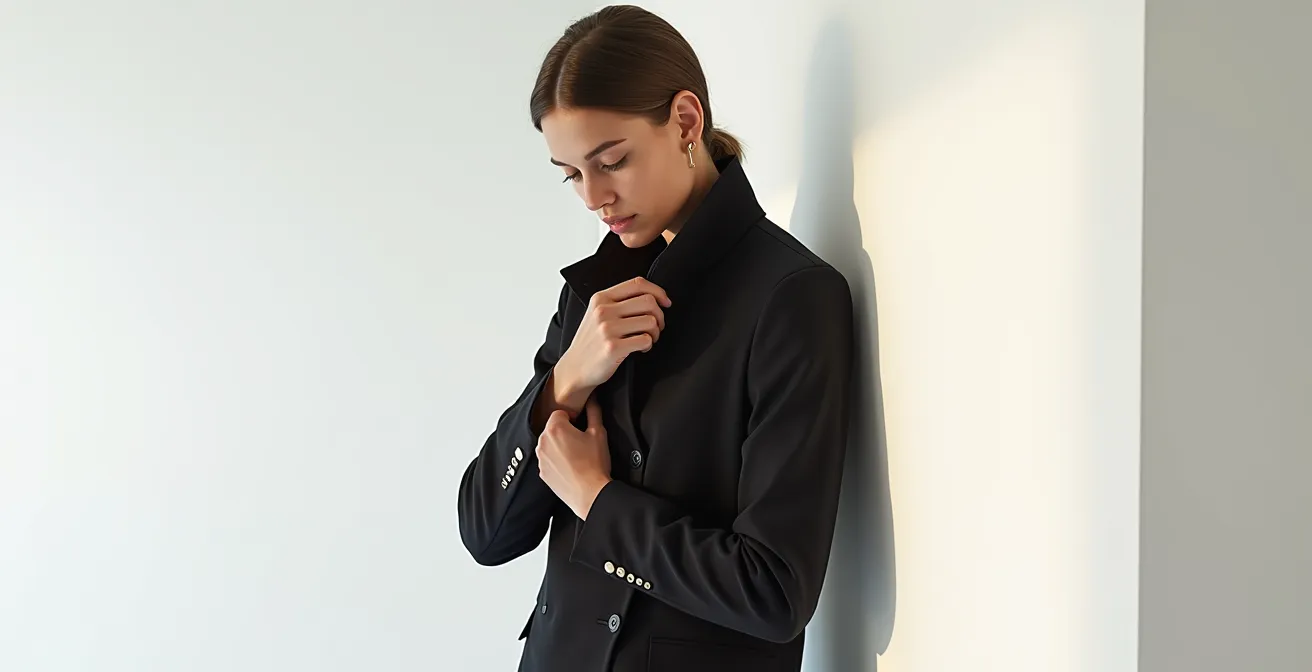
Delivering the ‘money shot’ isn’t about beauty; it’s a calculated commercial execution where the product is the hero.
- Master the Visual Hierarchy Funnel to guide the viewer’s eye from your face to the product, not the other way around.
- Adapt your posing’s “semiotic density”—bold, clear silhouettes for billboards; nuanced, complex gestures for social media.
Recommendation: Shift your mindset from ‘model’ to ‘high-performance sales tool’ to become indispensable to clients.
The call time was 5 a.m. The client, the art director, and a dozen crew members are watching you. The entire campaign, a multi-million dollar investment, hinges on one perfect image: the ‘money shot.’ This is the image that will live on billboards, in magazines, and dominate social feeds. The pressure is immense. You’ve been told to “be confident” and “know your angles,” but that advice evaporates under the heat of the studio lights. The truth is, that advice is useless because it misses the fundamental point of your job.
Most models believe their role is to look beautiful or expressive. It’s not. In commercial print, your job is to function as a highly effective sales tool. Every movement, every glance, every subtle shift in posture is a strategic choice designed to accomplish one goal: sell the product. The platitudes about confidence are a distraction from the real work, which is a disciplined, technical execution of a commercial brief. This is not art for art’s sake; it is communication with a clear financial objective.
But what if the key wasn’t trying to *be* more, but understanding how to *do* less, more effectively? This guide deconstructs the commercial mindset behind the money shot. We’re moving beyond generic posing tips to explore the strategic thinking required to deliver that single, high-impact image. We will analyze how to serve the product, manipulate the viewer’s gaze, maintain energy across a grueling shoot, and adapt your technique for different media formats. It’s time to stop thinking like a model and start thinking like a campaign’s most valuable asset.
This article provides a strategic framework for commercial models. The following sections break down the essential skills and mindsets required to master the high-stakes environment of a commercial shoot and consistently deliver the money shot.
Summary: Mastering the High-Stakes Commercial Image
- How to Pose Naturally While Keeping the Brand Logo Perfectly Visible?
- Direct Gaze or Looking Away: Which Creates More Sales Impact?
- How to Replicate the Same Energy Across 5 Different Outfits?
- Shooting for Billboards vs. Instagram Stories: How Does Your Posing Change?
- How to Make a Boring Product Look Exciting Without Overacting?
- Why the Product Must Be the Hero of the Shot, Not You?
- Why You Should Never Cut Off Your Own Hands at the Wrist in a Frame?
- Commercial Print Modeling: How to Master Emotive Posing for Lifestyle Ads?
How to Pose Naturally While Keeping the Brand Logo Perfectly Visible?
The client paid for the logo, not just your face. The central conflict in commercial posing is looking natural while strategically showcasing the brand. Amateurs make the brand an awkward prop; professionals integrate it seamlessly. The key is to stop thinking about “showing the logo” and start thinking about creating a path to it. This is the Visual Hierarchy Funnel. Your body, your gaze, and the composition should subconsciously guide the viewer’s eye on a journey: from your face (the primary point of human connection), down through your pose, directly to the product or logo.
This is achieved through ‘studied carelessness.’ You must rehearse poses with such dedication that they appear effortless. Create dynamic movement through interaction—checking a watch, adjusting a collar, opening a bag. These actions are not random; they are calculated to draw attention to the product. Use your body to create negative space around the logo, framing it without obviously pointing to it. Think of how a classic hands-on-hips pose creates triangular shapes that frame the details of a garment. It’s an intentional act of composition, not a casual stance.
The goal is to make the product interaction feel like a natural extension of your character. It’s the difference between stiffly holding a purse for the camera and being caught in a moment while reaching into it. One is a sales pitch; the other is a story. The latter sells more. Your naturalness is a tool to disarm the viewer and lead them directly to the brand message.
Direct Gaze or Looking Away: Which Creates More Sales Impact?
Your gaze is the most powerful tool for controlling the emotional tone of an image, and the choice between a direct or averted gaze is a critical commercial decision, not an aesthetic one. A direct gaze is a command for attention. It creates an immediate, one-to-one connection with the viewer, fostering a sense of trust and confidence. For this reason, professional models understand that direct gaze increases viewer engagement, making it the default for campaigns aiming for a bold, personal, and sales-driven message. It says, “I’m talking to you, and you should trust this product.”
This split composition illustrates the starkly different commercial functions of your gaze. On one side, direct eye contact creates an immediate and confident connection; on the other, an averted gaze builds aspirational mystique.

Conversely, looking away from the camera creates a sense of aspiration, mystery, and elegance. It transforms the viewer from a participant into an observer, inviting them to desire the lifestyle depicted. This technique is perfect for high-fashion editorials and luxury brand campaigns where the goal is not an immediate sale but the creation of an aspirational world. A three-quarters turn of the head, looking slightly away, adds sophistication and draws attention to facial features and the mood of the scene. The choice is dictated by the brief: are you a trusted friend recommending a product (direct gaze) or the embodiment of an ideal the viewer should aspire to (averted gaze)?
How to Replicate the Same Energy Across 5 Different Outfits?
A commercial shoot is a marathon, not a sprint. Maintaining the same high-energy, brand-aligned emotion from the first shot at 6 a.m. to the last at 8 p.m. is what separates professionals from amateurs. The client is paying for consistency. Relying on mood alone is a recipe for failure; you need a technical system. The first step is to work with the art director to define a one-sentence character persona for the shoot (e.g., “a confident architect exploring the city,” “a serene yogi at sunrise”). This persona is your emotional anchor, a role you can step back into after every break and outfit change.
From this persona, you develop your ‘Kinetic Signature’—a set of 3-5 core poses and movements that embody the character’s energy. These become your go-to stances, the reliable foundation you can return to when energy flags or direction is unclear. Document them. When you and the photographer nail a pose in the first look, make a note of it. Reference that successful shot later in the day to reset your physical and emotional baseline. This is a collaborative effort; clear mood boards and constant communication are essential tools to keep everyone aligned on the same energy.
To bridge the gaps between changes, use sensory anchors on set. A specific music playlist, a scent, or even a tactile object can act as a trigger to instantly pull you back into character. The goal is to make your energy level a controllable, technical skill, not a happy accident. The client needs to see the same character in the hero shot for the winter coat as they do for the summer dress. Your job is to deliver that consistency, no matter how many hours you’ve been on set.
Shooting for Billboards vs. Instagram Stories: How Does Your Posing Change?
A pose is not a universal solution; it is a response to a specific medium. The way a viewer consumes a billboard from a moving car is fundamentally different from how they interact with an Instagram Story on their phone. Your posing must reflect this. The core difference lies in semiotic density—the amount of information and nuance packed into a single image. A billboard requires low semiotic density. The pose must be a bold, declarative statement, an iconic silhouette that communicates one clear emotion in the three seconds a driver has to see it. Negative space is essential for instant readability.
Instagram Stories, by contrast, demand high semiotic density. The viewing is up-close, personal, and interactive. Here, you can use inquisitive, engaging poses with nuanced micro-expressions and complex gestures. The viewer has time to decode the layers. Negative space is still important, but for a different reason: it’s often planned to accommodate text overlays, polls, and stickers. Your posing becomes part of a larger conversation, not a standalone statement.
This table, based on common industry practices, breaks down the strategic shifts required. As an analysis of campaign photography for various media confirms, the final image format dictates the entire creative approach, from mood to styling.
| Aspect | Billboard Photography | Instagram Stories |
|---|---|---|
| Semiotic Density | Low – one clear emotion/message | High – nuanced expressions, complex gestures |
| Pose Type | Declarative, bold statement poses | Inquisitive, engaging poses |
| Negative Space | Essential for instant readability | Created intentionally for text/stickers |
| Viewing Distance | 3 seconds from afar | Up close, interactive viewing |
| Body Position | Simple, iconic silhouettes | Dynamic, multi-layered positioning |
Your job is to ask, “Where will this image live?” before you strike a single pose. A pose that is brilliant for an intimate social media frame will be an unreadable, cluttered mess on a highway billboard. Versatility is not just having many poses; it’s about deploying the right pose for the right commercial context.
How to Make a Boring Product Look Exciting Without Overacting?
Some briefs will ask you to sell a product that is inherently unexciting—a basic t-shirt, a bottle of water, a nondescript suitcase. The amateur’s mistake is to compensate with over-the-top, exaggerated expressions, which reads as inauthentic and cheapens the brand. The professional’s solution is to create excitement *around* the product through context and movement, rather than forcing it onto their face.
First, create movement. A static picture of a model in a simple dress can look stiff. But having the model run, jump, or spin, allowing the fabric to flow and catch the air, brings the garment to life. You are not selling a dress; you are selling the feeling of freedom and dynamism that the dress enables. The emotion comes from the action, not a forced smile. This technique injects energy into the frame without you having to “act” excited. The movement becomes the expression.
This image demonstrates how a mundane product gains immense value and intrigue simply by being placed in an unexpected, luxurious context. The excitement is environmental, not performed.

Second, leverage the power of context. An ordinary product can become extraordinary through juxtaposition. Imagine a simple, minimalist water bottle photographed not in a gym, but in the opulent interior of a baroque palace. The visual tension between the simple object and the luxurious environment creates intrigue and elevates the product’s perceived value. You, the model, are part of that environment. Your pose should be confident and understated, letting the surprising context do the heavy lifting. You are not selling a water bottle; you are selling a piece of a curated, interesting life where even a water bottle feels like a choice.
Why the Product Must Be the Hero of the Shot, Not You?
This is the single most important, and most misunderstood, rule in commercial modeling. The client is not paying for your beauty; they are paying for your ability to direct the customer’s attention to their product. You are the supporting actor, not the star. Upstaging the product is the most expensive mistake a model can make. There is a scientific reason for this: human brains are fundamentally wired to prioritize faces over objects.
The reason for this is a specific region in the brain called the Fusiform Face Area (FFA). As neuroscience research shows, our brains are hardwired for face detection, meaning a viewer’s eye will automatically and uncontrollably snap to your face first. As the model, you already hold the most powerful piece of visual real estate in the frame. Your job is not to hoard that attention, but to redirect it. You must use your powerful presence as the starting point of the Visual Hierarchy Funnel we discussed earlier, actively guiding the viewer’s gaze from your face toward the product.
Think of it as a transaction of attention. You are given the viewer’s initial focus for free. You must then consciously pass that focus to the watch, the handbag, or the logo on the shirt. This is done through your gaze (looking toward the product), your posture (angling your body to frame the item), and your interaction (touching or using the product). When you try to be the most memorable thing in the shot, you are fighting against the campaign’s objective and your own biology. The best commercial models are memorable not for their own beauty, but for how beautifully they made you want the product.
Why You Should Never Cut Off Your Own Hands at the Wrist in a Frame?
In the high-pressure environment of a shoot, you are not just a poser; you are a co-composer of the final image. A lack of spatial awareness can force the photographer into awkward crops that sabotage the shot. The cardinal sin of posing is presenting your limbs in a way that necessitates cropping at a major joint—wrists, elbows, knees, or ankles. Visually, this creates a sense of discomfort and incompleteness, often described as feeling like an “amputation.”
As one posing guide bluntly puts it, you must watch cropping to avoid chopping off fingers or toes, as it feels jarring and unnatural. When your hand disappears at the wrist right at the edge of the frame, the viewer’s brain registers something as missing and incomplete. This subconscious distraction pulls focus away from the product and the overall message. You must develop an instinct for the frame’s boundaries and always position your hands and feet so they are either fully included or positioned for a clean crop in a “safe zone.”
Safe cropping zones are always mid-limb: mid-forearm, mid-thigh, mid-calf, or across the torso. These crops feel intentional and aesthetically pleasing. You must be your own first line of defense against bad composition, ensuring your poses allow for powerful, clean framing. This awareness extends to separating your limbs from your body to create clear silhouettes, which has the added benefit of being more slimming and dynamic.
Action Plan: Professional Cropping and Posing Awareness
- Never crop at major joints: Avoid having your wrists, elbows, knees, or ankles land on the edge of the frame.
- Identify and use safe cropping zones: Position your limbs so they can be cropped cleanly at the mid-forearm, mid-thigh, mid-calf, or torso.
- Avoid the red zones: Be hyper-aware of keeping all joints, the neck line, the top of the head, and all fingers/toes away from the frame’s edge.
- Commit to the hand’s position: Either ensure the entire hand is clearly visible and well-posed, or pull it back for a deliberate crop at the mid-forearm.
- Understand the exception: For edgy, high-fashion concepts, uncomfortable crops can be an intentional choice, but this must be explicitly directed by the art director.
Key Takeaways
- The model’s primary function is to serve as a sales tool, making the product the unequivocal hero of the shot.
- Posing is context-aware: adapt from bold, simple silhouettes for billboards to nuanced, complex expressions for social media.
- Energy consistency across a long shoot is achieved through a technical system of a defined ‘Kinetic Signature’ and character persona, not just mood.
Commercial Print Modeling: How to Master Emotive Posing for Lifestyle Ads?
Lifestyle advertising sells a feeling, not a product. The client wants to see ‘serene satisfaction’ for a wellness brand, ‘quiet confidence’ for a financial firm, or ‘zesty exuberance’ for a beverage company. Your job is to generate these specific, brand-aligned emotions authentically and on command. The key is not to “act” but to inhabit a role. The most effective technique for this is story-driven roleplay. Before the camera clicks, you and the photographer must establish a narrative. Are you a detective in a film noir scene? A biker ready to ride? A gangster from the 1920s? Giving yourself a character and a story provides the raw material for natural, emotive poses.
This character-based approach allows you to connect with props and your environment authentically. You’re not just ‘sitting on a chair’; you’re ‘a CEO in her office reviewing a critical report’. You’re not ‘holding a drink’; you’re ‘celebrating a major life achievement with friends’. This mindset transforms your posing from a series of static shapes into dynamic, story-driven moments. It allows for genuine laughter, a truly thoughtful expression, or a look of real determination. It’s the difference between a picture of a person and a portrait of a personality.
To make this commercially viable, you must build a library of commercial archetype emotions. A luxury brand requires ‘aspirational elegance’—think elongated poses and a distant, thoughtful gaze. A tech brand needs ‘innovative curiosity’—achieved through forward-leaning poses and engaged, bright-eyed expressions. By analyzing the brand’s target emotion and matching it with a character and a story, your posing becomes a powerful vehicle for the client’s message. You stop being a mannequin and become an emotional conduit for the brand.
Your ability to deliver the money shot is not in your portfolio; it’s in your process. It is a direct result of your strategic thinking, commercial discipline, and technical execution on the day. Stop practicing poses in the mirror; start rehearsing commercial objectives. Your next casting, and your career, depend on it.