
A powerful fashion editorial is not a collection of beautiful poses; it’s the visual record of a character’s psychological journey.
- Your primary role is to create and inhabit an internal monologue, not just execute external directions.
- Locations, outfits, and other models are merely plot devices that exist to reveal your character’s inner state.
Recommendation: Shift your focus from “How do I look?” to “What is my character thinking and feeling in this exact moment?”.
A fashion editorial is a silent film, a wordless play spread across six glossy pages. As a model, you are its sole actor. The brief arrives, the mood board is discussed, and the common advice echoes: “tell a story.” But this instruction often feels abstract, leaving you to string together a series of disconnected poses, hoping the narrative magically materializes in the edit. We are told to vary our expressions, to interact with the wardrobe, to have a beginning, middle, and end. While correct, this advice only scratches the surface, treating the story as an external element to be applied, like makeup or styling.
This approach misses the fundamental truth of powerful editorial work. The visual arc is not something imposed upon you; it is something that must emanate from you. But what if the key wasn’t in the photographer’s brief, but inside your own mind? What if the most compelling narrative was not a sequence of events, but the progression of a single, consistent consciousness reacting to its changing world? The true art of editorial modeling lies in crafting a character with a rich internal monologue, a silent script that dictates every glance, gesture, and moment of stillness.
This guide reframes the task. We will move beyond the mechanics of posing and into the craft of character embodiment. We will explore how to build this internal world, how to use the physical environment as a scene partner, and how to maintain emotional continuity even when the wardrobe and locations shift dramatically. This is not about learning new poses; it is about learning to think and feel on camera, transforming a series of photographs into a resonant, unforgettable story.
To master this, we will deconstruct the editorial page by page, exploring the specific techniques that transform a model into a storyteller. The following sections provide a complete roadmap for building your character’s journey.
Contents: The Silent Script: Weaving a Narrative Arc Across a Six-Page Editorial
- The Opening Shot: How to Set the Scene for the Reader?
- Leaning, Sitting, Walking: How to Ground Yourself in the Location?
- How to Maintain the “Mood” When the Outfits Change Drastically?
- Static vs. Dynamic: How to Alternate Energy for a Balanced Spread?
- The “Couple” Narrative: How to Show Intimacy Without It Looking Romance Novel?
- How to Keep the Character Alive Across 8 Different Locations?
- Why Your Strongest Photo Should Be First and Your Second Best Last?
- Why Doing Unpaid Editorial Work Can Double Your Commercial Booking Rates?
The Opening Shot: How to Set the Scene for the Reader?
The first image in an editorial is not an introduction; it is the inciting incident. It must ask a question, not provide a statement. For the model, this means your work on page one is to establish your character’s central conflict or desire. Before the shutter clicks, you must answer a foundational question: What does my character want, and what stands in their way? This internal objective becomes the engine for the entire narrative. Forget about looking “pretty” or “cool.” Your focus is on embodying a psychological state. Are you a protagonist entering a daunting new world, a fugitive finding a moment of reprieve, or a dreamer confronting reality?
This first shot establishes the emotional key signature of the story. If the narrative is one of isolation, your pose should communicate a disconnection from the environment, even if you are in the center of the frame. If the story is about defiance, your gaze should challenge the viewer, establishing an immediate tension. Think of this shot as the first sentence of a novel. It must be compelling enough to make the reader want to turn the page. The strength of the image comes from the specificity of your internal monologue.
A wide shot showing you as a small figure in a vast landscape is a classic opening, but it’s your job to fill that landscape with meaning. Are you overwhelmed, liberated, or lost? The architecture of your pose—the tension in your shoulders, the direction of your gaze, the slight bend of a knee—must communicate this internal state. The reader doesn’t just see a person in a location; they feel the character’s relationship to that world, all because you’ve decided on their story before the camera was even raised.
Leaning, Sitting, Walking: How to Ground Yourself in the Location?
A location is not a backdrop; it is your scene partner. Your character’s journey is revealed through how they interact with, react to, and eventually master their environment. Generic, disconnected poses that could be done in any studio fail to build a believable world. The key is to find points of physical connection, to create a dialogue between your body and the space. This is not about simply “using the props,” but about grounding your character’s emotional state in a physical reality. Is your character seeking support? Lean against a wall, feeling its texture and temperature. Are they feeling contemplative? Sit on a step not as a model, but as someone genuinely lost in thought.
This physical interaction is what makes a story feel tangible. Instead of thinking “I need to pose,” think “What is my character doing here?” The action can be as simple as tracing the line of a crack in a wall, balancing on a curb, or shielding your eyes from a sliver of light between buildings. These small, motivated actions create moments of authenticity that are far more compelling than a perfect, static pose. They transform the model from an object to be looked at into a subject the reader experiences the world through.
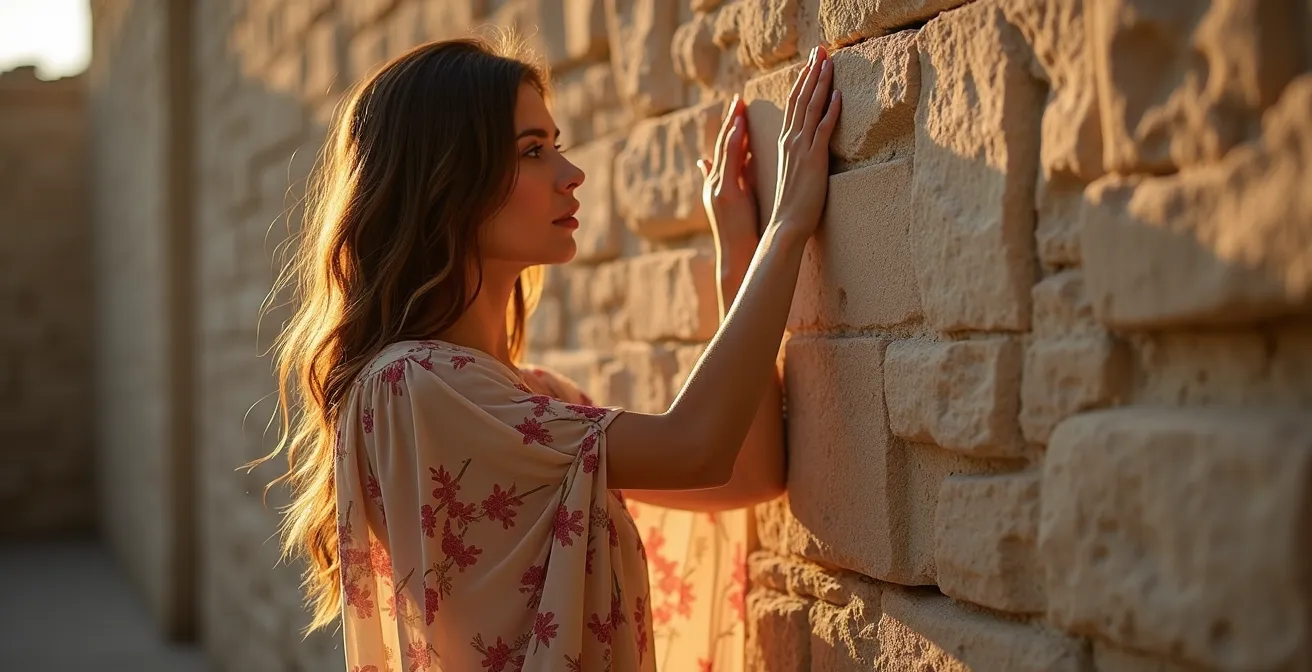
As you can see, the narrative deepens when the interaction becomes purposeful. The progression of your poses across the spread should tell the story of your character’s relationship with their world. Initially, the location might dominate, but as the story unfolds, your character can begin to assert control, using the environment to their advantage. This evolution is the core of the visual arc.
The following table, based on an analysis of narrative posing, illustrates how this dynamic can unfold across a spread, turning simple poses into chapters of a story.
| Page Position | Relationship Dynamic | Pose Type | Visual Impact |
|---|---|---|---|
| Pages 1-2 | Dominated by location | Static, defensive | Model appears small against vast backdrop |
| Pages 3-4 | Negotiating with space | Action-reaction tasks | Physical interaction with environment objects |
| Pages 5-6 | Mastering the environment | Confident, expansive | Model commands the frame, location becomes supportive |
How to Maintain the “Mood” When the Outfits Change Drastically?
An editorial is, at its heart, a showcase for fashion. This means your character may undergo several dramatic wardrobe changes, shifting from soft tailoring to structured leather to ethereal gowns within a few pages. The danger here is narrative fragmentation, where each new look creates a new, disconnected character. The model’s primary challenge is to maintain the story’s emotional through-line, ensuring that the *character* remains consistent even when the *costume* changes. The secret lies in your internal monologue: the outfit doesn’t define the character; the character reinterprets the outfit.
Think of each wardrobe change as a new scene, not a new story. How does your established character feel in this new “skin”? If your character’s arc is about gaining confidence, a sharp, powerful suit on page four should feel like a suit of armor they have earned, not just a different piece of clothing. Your posture, gaze, and micro-expressions must reflect this internal evolution. The clothes are plot points that reveal something new about the person wearing them. A vulnerable character in a powerful dress creates a fascinating tension. A confident character in a soft, romantic piece suggests a hidden depth.
Beyond your performance, post-production is a powerful ally in this endeavor. As one professional guide on editorial shoots points out, consistency is often built through an evolving color grade. An editorial might begin with cool, desaturated tones and progressively warm up as the character’s emotional state thaws. This technique acts as a subconscious “soundtrack” for the reader, unifying disparate looks under a single emotional arc. While this is the photographer’s and retoucher’s domain, your understanding of it allows you to align your emotional performance with the intended visual mood, making the final story more cohesive.
Static vs. Dynamic: How to Alternate Energy for a Balanced Spread?
A compelling narrative requires rhythm. A story told at a single, monotonous pace—whether relentlessly high-energy or perpetually still—quickly loses its audience. A fashion editorial is no different. The flow of a six-page spread depends on a carefully choreographed alternation between static and dynamic energy. Your role as a model is to be the conductor of this energy, understanding when to hold a quiet, sculptural pose and when to unleash explosive movement. This is not about random variation; it’s about using energy to punctuate the emotional beats of your character’s story.
Think of the spread as a musical composition. The static shots are the moments of quiet tension, introspection, or suspense. They draw the reader in, forcing them to contemplate the character’s internal state. These poses are often more difficult to execute, as they demand immense control and the ability to project emotion through stillness. A dynamic shot, by contrast, is a moment of release, action, or climax. It’s the crescendo. The flight of a dress, the spray of water, the blur of a running figure—these images provide visceral excitement and propel the narrative forward. A balanced editorial uses both to create a compelling rhythm.
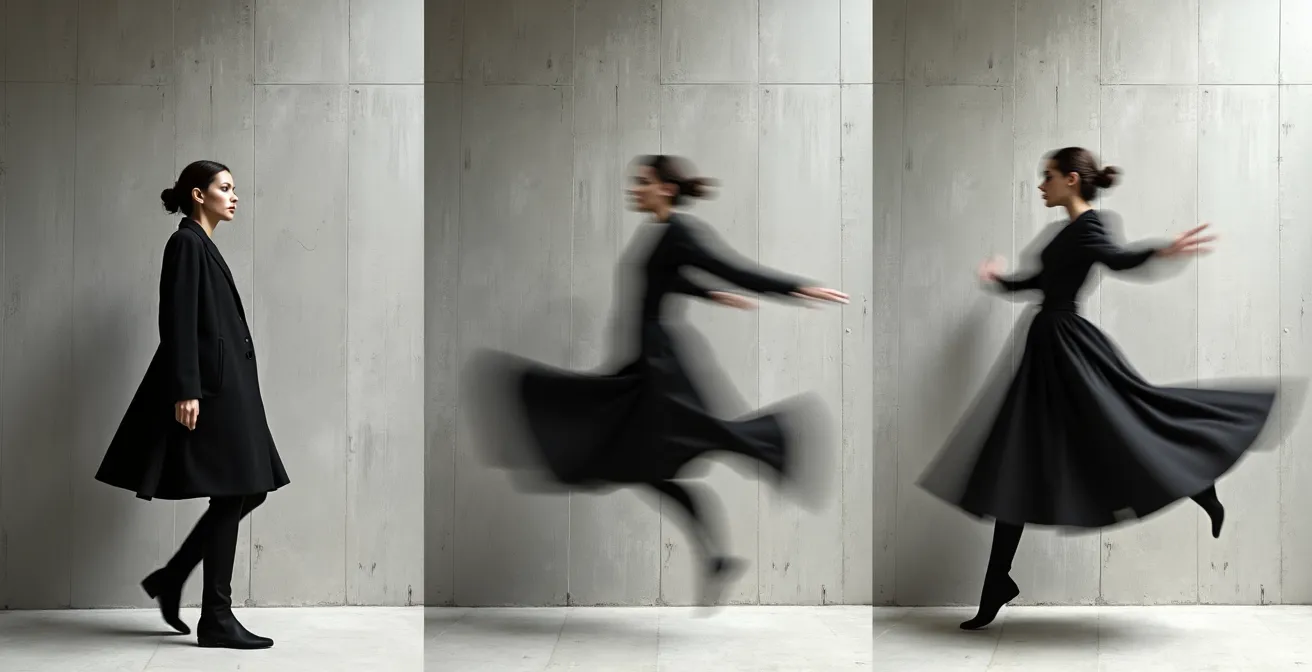
The sequencing of these moments is critical. As noted in an analysis of Chris Schoonover’s work for Nylon, a masterful technique is to use the page turn for dramatic effect. Placing a contemplative, static portrait on a right-hand page, followed by a high-energy, dynamic shot revealed on the left as the page is turned, creates a moment of surprise and re-engages the reader. This deliberate pacing transforms the simple act of reading a magazine into a participatory experience. Your ability to deliver both high and low energy on cue gives the creative team the raw material needed to build this rhythm.
The “Couple” Narrative: How to Show Intimacy Without It Looking Romance Novel?
When an editorial features two models, the immediate temptation is to fall into clichéd portrayals of romance: the dramatic embrace, the smoldering gaze, the near-kiss. These poses, borrowed from romance novel covers, often feel inauthentic and cheapen the narrative. True editorial intimacy is more subtle, complex, and interesting. It’s about connection, tension, and shared experience, not overt romantic gestures. Your goal is to build a relationship visually, using space and shared action as your primary tools.
Case Study: Proxemics in Fashion Editorial Storytelling
As detailed in a deep dive into fashion storytelling, the physical distance between models—known as proxemics—can be a powerful narrative device. A story can begin with both models in the same frame but at opposite edges, creating a sense of alienation or longing. As the editorial progresses, this distance can shrink. They might appear on facing pages, creating a connection across the gutter of the magazine. The climax isn’t a kiss, but a subtle, non-romantic touch: leaning back-to-back, a hand briefly resting on a shoulder, or simply moving in perfect synchronicity. This gradual reduction of space builds a far more compelling and believable sense of intimacy than a single, dramatic pose.
The most effective way to generate authentic connection is through shared, mundane tasks. When two people are focused on a collaborative goal, their body language naturally synchronizes, creating unconscious moments of intimacy. The camera is there to capture these moments of accidental grace—two hands reaching for the same object, a shared laugh of frustration, or a mirrored posture as you both puzzle over a map. The focus is on the task, not on each other or the camera, which allows a real, unforced connection to emerge.
Actionable Checklist: Building Intimacy Through Shared Tasks
- Choose mundane collaborative tasks like assembling simple furniture, reading a map together, or playing a board game.
- Direct your focus entirely on the task at hand, not on your partner model or the camera.
- Allow the photographer to capture moments of unconscious synchronicity, such as reaching for the same object or mirroring body language.
- Utilize a shared gaze technique, where both of you look intently at a third point of interest outside the frame.
- Build connection through action sequences that demonstrate teamwork and collaborative problem-solving.
How to Keep the Character Alive Across 8 Different Locations?
A multi-location shoot presents the ultimate test of character consistency. Hopping from a sterile urban rooftop to a lush botanical garden to a gritty industrial space can easily shatter a narrative, resulting in a disconnected travelogue. The key to unifying these disparate settings is to treat them not as physical places, but as psychological geography. Each location represents a new stage in your character’s internal journey. The unifying thread is not the place, but the consciousness moving through it.
Before the shoot, work with the team to map the emotional meaning of each location. The rooftop might symbolize your character’s initial isolation and ambition. The garden could represent a moment of growth, vulnerability, or a false paradise. The industrial space might be the scene of their greatest conflict or transformation. By assigning an emotional purpose to each setting, your performance becomes anchored to the character’s arc rather than the logistics of the location change. You are not simply “in a garden”; you are a character experiencing a moment of peace after a period of struggle. This internal framework ensures that your emotional state evolves logically from one shot to the next.
This “hero’s journey” structure provides a powerful blueprint for both your performance and the editorial’s overall flow. A clear narrative progression makes the location changes feel inevitable and meaningful.
The following table, based on common narrative structures found in fashion storytelling guides, shows how to map a quest narrative onto a multi-location shoot.
| Location Number | Quest Stage | Visual Purpose | Styling Evolution |
|---|---|---|---|
| Location 1 | Departure | Establish normal world | Everyday, familiar styling |
| Locations 2-3 | First obstacles | Challenge comfort zone | Styling becomes protective |
| Locations 4-5 | Journey deepens | Complexity increases | Layered, transitional looks |
| Locations 6-7 | Final challenges | Maximum conflict | Bold, confrontational styling |
| Location 8 | Discovery/Arrival | Resolution achieved | Transformed, evolved aesthetic |
Why Your Strongest Photo Should Be First and Your Second Best Last?
The sequencing of images in an editorial is not arbitrary; it’s a deliberate psychological strategy designed to capture and hold the reader’s attention. The conventional wisdom—strongest shot first, second-best shot last—is rooted in a powerful cognitive principle: the Primacy and Recency Effect. This principle states that we are most likely to remember the first and last items in a series. In the context of a visual narrative, the opening shot makes the first impression and sets the tone, while the final shot leaves the lasting emotional residue.
Placing your most impactful image at the beginning acts as a powerful hook. In a world of infinite scrolling and fleeting attention, the opening shot must be strong enough to stop the reader and invest them in the story. It makes a promise of quality and intrigue that encourages them to continue. According to cognitive science research, with up to 90% of information transmitted to the brain being visual, this first impact is paramount. The final image, your second-strongest, serves a different purpose. It is the resolution, the final thought, the emotional echo that stays with the reader long after they’ve closed the magazine. It doesn’t need the “shock value” of the opener, but it must provide a satisfying emotional conclusion to the character’s arc.
However, rules in art are made to be understood, and then sometimes, broken. An alternative “slow burn” strategy can be incredibly effective, especially for more complex or mysterious narratives. This approach involves starting with a quieter, more subtle image that poses a question, and building the energy toward a climactic image in the center of the spread. In this structure, the final image is not a spectacle, but a moment of quiet resolution or contemplation. This subverts the reader’s expectations and can create a more profound emotional impact, but it’s a high-risk, high-reward strategy that requires the entire team’s commitment to gradual revelation.
Key Takeaways
- An editorial’s visual arc is an external map of a character’s internal, psychological journey.
- Your primary tool as a model is not your pose, but your ability to create and sustain a consistent internal monologue.
- Every element—location, wardrobe, other models—is a plot device that should be used to reveal your character’s state of mind.
Why Doing Unpaid Editorial Work Can Double Your Commercial Booking Rates?
In the fashion industry, the distinction between editorial and commercial work can seem vast. Editorials offer creative freedom but rarely pay, while commercial jobs provide the income but often with creative constraints. It’s tempting for a working model to dismiss unpaid editorial work as a luxury. However, this is a profound strategic error. A powerful, narrative-driven editorial is the single most effective tool in your arsenal for securing high-paying commercial contracts. It functions as a complete, risk-free prototype of what you can deliver for a brand.
With the global fashion ecommerce market valued at nearly $950 billion, brands are no longer just selling products; they are selling stories and identities. They need talent that can convey a narrative, not just wear clothes. An art director for a major brand is not looking for a model who can strike a pose; they are looking for a creative partner who can embody their brand’s ethos. A six-page editorial is your proof. It demonstrates your ability to maintain a character, work collaboratively with a team, and deliver a cohesive, emotionally resonant story from start to finish. It showcases your range, your intelligence, and your understanding of narrative arcs—skills that are far more valuable than a simple look.
As photographers who successfully transition to directing often report, a strong editorial portfolio is what opens commercial doors. It proves you understand the bigger picture. By investing your time in high-quality editorial shoots, you are building a portfolio of case studies that directly answer a brand’s biggest question: “Can this person tell our story?” Presenting your editorial work not as “unpaid modeling” but as “narrative concept development” completely reframes its value and positions you as a high-value creative collaborator, not just a face.
Action Plan: Turning Editorial Work into Commercial Bookings
- Document your complete editorial process, from the initial concept and mood board to the final, published images.
- Inventory your best editorial spreads and create detailed case studies for your portfolio, explaining the character’s arc and your narrative choices.
- Frame and present your editorials as “risk-free prototypes” when meeting with agencies, casting directors, and brands.
- Highlight your team management and collaborative skills by properly crediting your team and sharing behind-the-scenes content that shows the process.
- Develop a plan to pitch your specific narrative skills to brands whose identity aligns with the stories you’ve told in your editorial work.
Integrate this narrative-first approach into your next test shoot and witness how your portfolio transforms from a gallery of images into a collection of compelling stories that brands are desperate to tell.