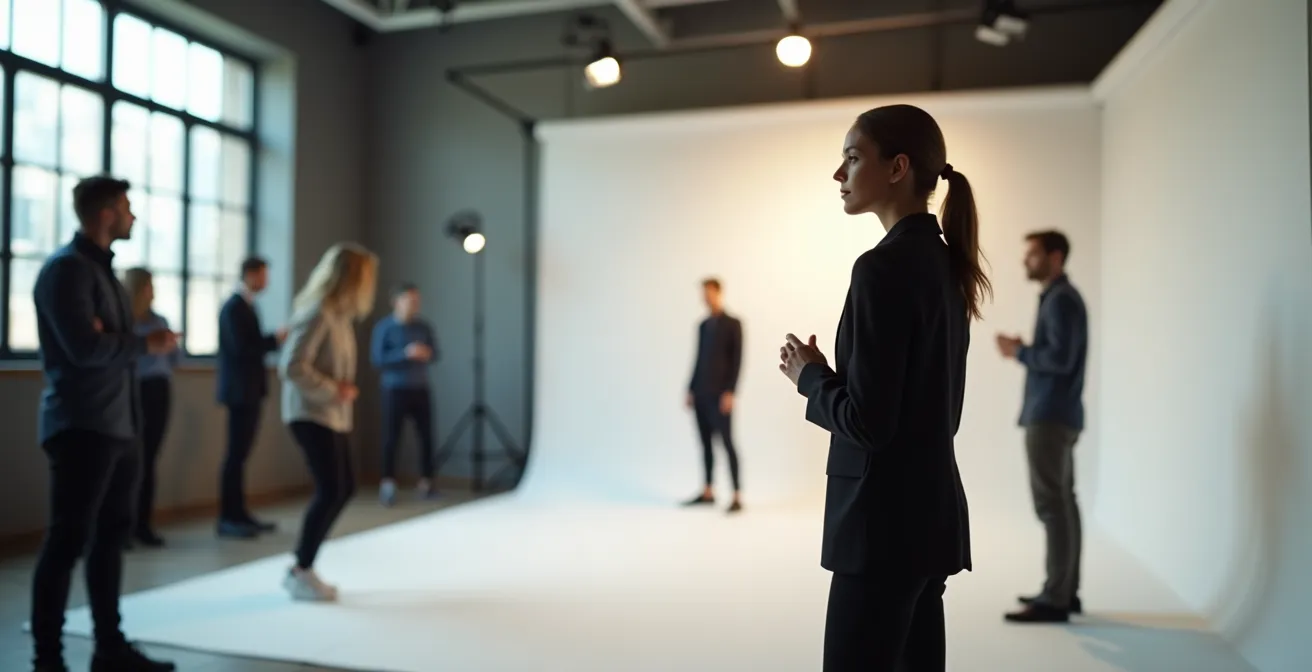
Your on-set behavior is a financial line item for production; professionalism is not a personality trait, but a risk management strategy that determines your career longevity.
- Punctuality is a budget issue: arriving “on time” is already late and costs production money.
- Your interactions with junior crew (assistants, PAs) are a primary source of feedback about your professionalism and heavily influence rebooking decisions.
- Disrespect for equipment or confidential information (like unreleased designs) can lead to immediate financial liability and industry blacklisting.
Recommendation: Treat every moment on set not as a social event, but as a high-stakes job interview for your next contract.
You have the look, you have the talent, and you book the job. And then you never hear from that client or photographer again. The reason is rarely a lack of ability; it’s a lack of awareness. The modeling industry is saturated with advice to “be professional” or “be nice,” but these platitudes fail to explain the high-stakes reality of a professional shoot. They don’t tell you how a talented model becomes a reputation liability, quietly blacklisted for behavior they didn’t even realize was a problem.
This is not a guide about manners. This is a production manager’s breakdown of the non-negotiable business requirements for functioning on a high-budget set. Your success hinges on understanding that a photoshoot is a complex, expensive, and time-sensitive operation. Every action you take has a direct or indirect financial impact. Ignoring the unwritten rules doesn’t just make you difficult; it makes you a risk. And in this business, risks are not rehired.
We will dissect the critical protocols that separate a one-time model from a career professional. We will move beyond vague advice to provide a clear framework for on-set conduct, from time management and spatial awareness to navigating the complex crew hierarchy and respecting intellectual property. Mastering these rules is the single most important investment you can make in your career longevity.
This guide breaks down the essential, non-negotiable rules of on-set conduct. The following sections detail the specific protocols that define a professional model and ensure you are remembered for the right reasons.
Summary: The Unwritten Rules of Set Etiquette That Actually Get You Rebooked
- The “No Phone” Rule: When Is It Safe to Check Instagram on Set?
- Why “On Time” Is Actually Late in the Modeling Industry?
- Why Leaving Your Coffee Cup on the Cyclorama Is a Mortal Sin?
- Why Being Nice to the Assistant Is More Important Than Charming the Photographer?
- Behind the Scenes Photos: What You Can and Cannot Post Before Release?
- Why You Should Never Give Posing Ideas to the Photographer Unless Asked?
- The Mistake of Ignoring the Client Monitor That Can Cost You the Campaign
- Understanding the Hierarchy and Workflow of a Big Budget Fashion Set
The “No Phone” Rule: When Is It Safe to Check Instagram on Set?
Your phone is the single greatest threat to your professional reputation on set. When you are on your phone, you are psychologically unavailable. You signal to the entire crew—from the producer to the production assistant (PA)—that your attention is divided. In a high-pressure environment, this is perceived not as boredom, but as disrespect for the time and money being invested. Your job is to be present and ready, whether you are in front of the camera, in the makeup chair, or waiting for a lighting change. Instead of scrolling, use downtime to observe the set, study the mood board, or mentally prepare for the next shot. This demonstrates engagement and operational awareness.
The only acceptable time to use your phone is during officially announced breaks, such as the lunch hour, and you must step completely away from the main production area to do so. Your designated personal bag or a holding area is where your phone belongs, set to silent. An urgent call from your agent is the only exception, and even then, protocol dictates you inform the first assistant director (1st AD) or a PA before stepping off set to take it. Anything less makes you appear disconnected and unprofessional, undermining the collaborative energy required for a successful shoot.
Action Plan: Auditing Your On-Set Phone Protocol
- Points of contact: List every moment you are tempted to use your phone on set—waiting for lighting, in the makeup chair, during brief pauses.
- Collecte: Honestly inventory your current habits. Is your phone in your pocket or in your bag? How many times do you check it per hour?
- Cohérence: Confront these habits with the standard of professionalism. Does checking notifications signal that you are ready and engaged, or distracted?
- Mémorabilité/émotion: Recognize what the crew remembers: the model who was present and studying the mood board versus the model endlessly scrolling Instagram.
- Plan d’intégration: Implement a strict new protocol—phone on silent and in your bag in the talent area. Use it only during official, designated breaks and completely off the active set.
Treating set time as sacred, focused time is the first and most visible indicator of a true professional. It’s a simple rule that speaks volumes about your respect for the craft and the crew.
Why “On Time” Is Actually Late in the Modeling Industry?
In the world of production, the phrase “on time is late, and early is on time” is not a suggestion; it is a fundamental business principle. Your call time is not when you should arrive at the studio door. It is the moment you are expected to be checked in, settled, and ready to begin hair and makeup. Arriving exactly at your call time means you are already behind schedule, forcing the entire production to wait. This has immediate financial consequences, as a 15-minute delay can cost production teams thousands in overtime and crew fees. You are not just making people wait; you are actively costing the client money.
A professional model plans to arrive 10 to 15 minutes before their official call time. This buffer is not for relaxing; it’s for logistics. It allows you to account for unexpected traffic, find parking, locate the correct entrance, check in with the production assistant, find your designated station, and use the restroom. This period is also a golden opportunity for networking. Connecting with junior crew members in these quiet pre-production moments shows respect and helps build the relationships that sustain a career.
This image captures the essence of professionalism: arriving with time to spare, ready to engage with the team, and mentally prepared for the day ahead. This is the standard.

Arriving early signals reliability, respect for the crew’s time, and an understanding of the production workflow. It’s a simple act that immediately separates you from amateurs and establishes you as a dependable professional who understands the financial impact of punctuality.
Ultimately, your arrival time is the first impression you make on set. By arriving early, you communicate that you are a partner in the production’s success, not just a hired talent.
Why Leaving Your Coffee Cup on the Cyclorama Is a Mortal Sin?
A production set is not a public space; it is a meticulously controlled environment with designated zones of function and respect. Certain areas are considered “sacred,” and the cyclorama (or “cyc”) is the holiest of all. The cyc is the seamless, curved white background essential for clean, professional shots. Any scuff, spill, or smudge on its surface will appear in every single photograph, requiring hours of expensive post-production to fix or forcing a complete repaint of the studio floor. Your coffee cup, water bottle, or personal bag has absolutely no place on it.
The financial stakes are not trivial. One studio reported spending $3,000 to repaint their cyclorama and an additional $1,500 in retouching costs to remove a single coffee stain from a sequence of images. Placing any item on the cyc is a demonstration of profound disrespect for the equipment, the studio, and the budget. This extends to other sacred spaces, such as the digital tech’s cart—which holds tens of thousands of dollars in sensitive equipment—and the stylist’s meticulously organized clothing rack.
This table outlines the key “no-go” zones on a professional set. Your ability to recognize and respect these boundaries is a critical indicator of your experience and professionalism.
| Location | Sacredness Level | Why It Matters | Safe Alternative |
|---|---|---|---|
| Cyclorama/Backdrop | Highest | Repainting costs thousands; any mark shows in every shot | Designated talent holding area |
| Digital Tech’s Cart | High | Contains $50,000+ of sensitive equipment | Your assigned chair/area |
| Stylist’s Rack | High | Precisely organized by look sequence | Ask stylist for personal item storage |
| Makeup Station | Medium-High | Hygiene and product organization critical | Use designated model prep area |
| Craft Services | Medium | Client and crew eat first by protocol | Wait for PA announcement |
Always locate your designated talent area upon arrival and keep all personal items there. When in doubt, ask a PA where it is safe to place something. This simple act of awareness protects the production’s assets and solidifies your status as a professional.
Why Being Nice to the Assistant Is More Important Than Charming the Photographer?
On a busy set, it’s easy to focus your energy on the people in perceived positions of power: the photographer, the client, the art director. This is a rookie mistake. The most important relationships you will build for your long-term career are with the assistants—the production assistants, photo assistants, and stylist assistants. They are the operational backbone of the shoot, and their perception of you carries immense weight. While the photographer is focused on the creative vision, the assistants are observing your professionalism, attitude, and work ethic during the “in-between” moments.
These junior crew members are the eyes and ears of the set. They report back to their department heads and to the producer. If you are demanding, dismissive, or difficult, they will know, and by extension, everyone will know. Conversely, if you are respectful, appreciative, and professional, that reputation will precede you. As one industry veteran notes, this is a long-term investment in your career:
The PA of today is the producer of tomorrow; the photo assistant is the future photographer. Your reputation for kindness will precede you for years.
– Industry Veteran Model Coach, Professional Modeling Etiquette Guide
This image symbolizes the mutual respect that defines a successful on-set dynamic. Your interaction with an assistant should be one of partnership and professionalism.
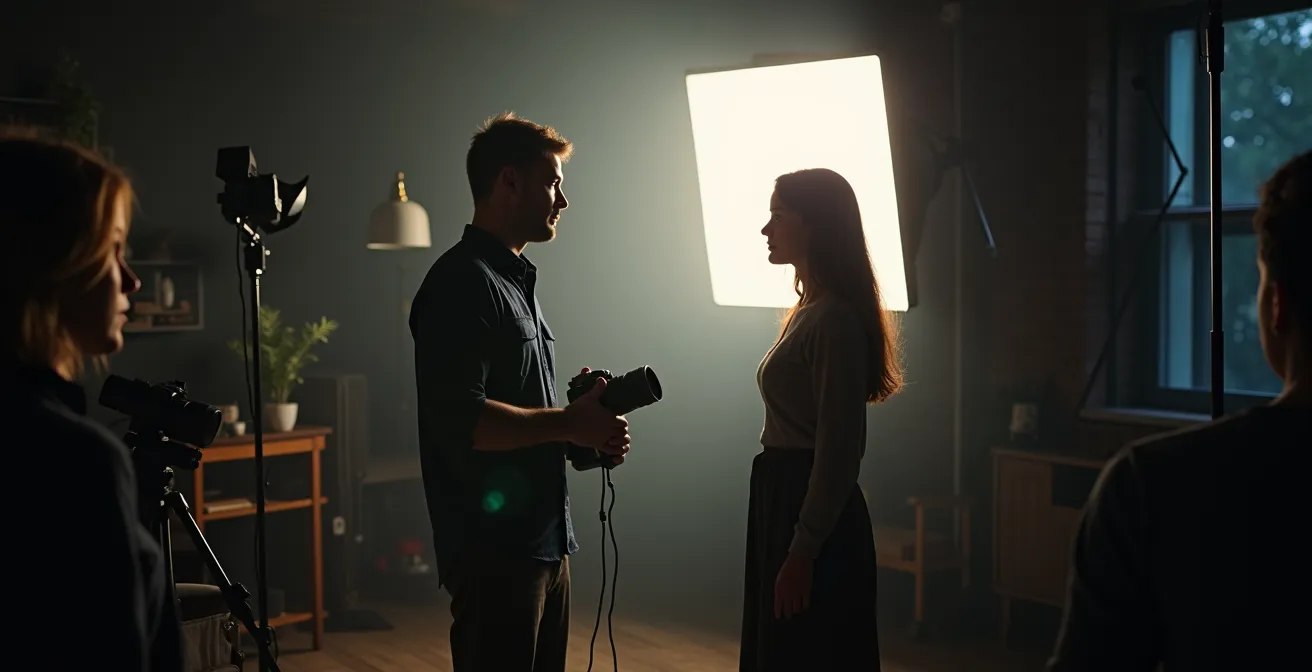
Learn and use their names. Thank them for their help. Direct your logistical questions to them rather than interrupting senior crew. This is not about being “nice”; it is about understanding and respecting the hierarchy protocol. Your ability to work seamlessly within the crew structure is a key metric by which you will be judged and, ultimately, rebooked.
Your career is not built by impressing one person for one day. It is built by earning the respect of the entire team, one shoot at a time.
Behind the Scenes Photos: What You Can and Cannot Post Before Release?
In the age of social media, the temptation to post a behind-the-scenes (BTS) selfie is immense. Resist it. A professional photoshoot is a confidential business activity until the client officially launches the campaign. The clothing designs, the creative concept, the hair and makeup looks—all of this is proprietary information protected by Non-Disclosure Agreements (NDAs), whether you signed a physical document or not. Leaking any visual element before the official release can ruin a multi-million dollar campaign launch and expose you to severe legal and financial repercussions.
The consequences are not theoretical. In one notable case, a model who posted BTS shots showing unreleased product designs faced legal action from the brand, resulting in a $50,000 settlement and immediate blacklisting from their agency. The rule is absolute: do not post anything that shows wardrobe, products, or identifiable set elements until the campaign is public. Even a harmless selfie from the makeup chair is a risk if a unique, unreleased product is visible in the background. The only person who can grant permission is the client, and this request must be formally channeled through your agent *after* the shoot, never by asking the crew on set.
Once images are officially released, you may share them, but you must do so without alteration. Adding your own filter, cropping the image, or making any changes is considered a profound insult to the photographer and retoucher. Your job is to share the final, approved work, always tagging the entire creative team. Altering a professional’s work damages their brand and will quickly earn you a reputation as difficult and disrespectful.
Your social media is a powerful tool, but on a professional set, your primary responsibility is to protect the client’s investment and confidentiality. Failure to do so is a career-ending mistake.
Why You Should Never Give Posing Ideas to the Photographer Unless Asked?
You have practiced your poses and developed a range of movements. It is tempting to want to showcase this creativity on set. However, on a commercial or editorial shoot, your role is not to be a creative director; it is to be a precise instrument executing the vision of the photographer and the client. The team has spent weeks, if not months, developing a specific concept, mood, and shot list. Unsolicited posing suggestions, no matter how well-intentioned, can disrupt the creative flow and imply that you do not trust the photographer’s direction.
A professional model’s artistry lies in “intra-pose improvisation”—the ability to offer subtle, nuanced variations within the given direction. This means making micro-adjustments to your hands, shifting your weight, or changing your expression slightly without deviating from the core pose requested. This demonstrates range and responsiveness without overstepping your role. You should save your more ambitious creative ideas for test shoots (TFP) with photographers where the goal is collaborative experimentation, not the fulfillment of a client brief.
The time to offer a new idea is only when you are explicitly invited to do so, with phrases like, “What do you feel like doing?” or “Show me something.” In this scenario, you can professionally state, “I have some movements I’ve been working on if you’d like to see them.” This phrasing shows respect for the hierarchy and gives the photographer the option to accept or decline without pressure. Your job is to be an expert executor of a vision, and your creative contributions must always be offered within that professional framework.
Your greatest value on a commercial set is your ability to listen, interpret, and execute direction flawlessly. That is the skill that gets you rebooked.
The Mistake of Ignoring the Client Monitor That Can Cost You the Campaign
While the photographer is your primary point of contact for direction, they are not the only person you need to please. On most commercial shoots, the client, art director, and other key stakeholders are gathered around a monitor in what is often called “video village.” This is where the final decisions are made. Ignoring the energy and feedback from this area is a critical error. Your ability to develop peripheral awareness of the client’s reactions can be the deciding factor in a successful shoot and future bookings.
The photographer and client often have slightly different priorities. The photographer may be focused on artistic lighting and composition, while the client is focused on brand consistency and whether the product is being showcased effectively. A professional model learns to read the room. Listen for moments of excitement or approval from video village after a certain pose or expression. As experienced models know, building rapport with clients is key; if you notice a positive reaction to a particular energy, subtly weave more of that into your performance without breaking your flow with the photographer.
This table illustrates the different priorities at play. Understanding these nuances allows you to serve both the artistic vision and the commercial objective simultaneously.
| Aspect | Photographer’s Priority | Client’s Priority | Model’s Best Response |
|---|---|---|---|
| Visual Style | Artistic, creative expression | Brand consistency, product visibility | Balance both while ensuring product reads clearly |
| Energy Level | May want editorial moodiness | Often needs commercial approachability | Check video village reactions, adjust accordingly |
| Facial Expression | May prefer intense or avant-garde | Usually wants relatable and aspirational | Offer range but note which gets positive response |
Your job is to be a problem-solver. By demonstrating that you can instantly grasp and deliver on the brand’s vision, you transition from being just a model to being a valuable commercial partner—the kind that clients request by name.
Key Takeaways
- Punctuality is a direct reflection of your respect for the production’s budget; “on time” is late, and “early” is the professional standard.
- The set is a controlled workspace, not a personal lounge; respecting sacred zones like the cyclorama and equipment carts is non-negotiable.
- Your reputation is primarily built on how you treat the entire crew, especially assistants, whose feedback is critical for rebooking decisions.
Understanding the Hierarchy and Workflow of a Big Budget Fashion Set
A large-scale fashion shoot is a complex, high-stakes operation. With daily production costs running from $5,000 to $10,000 or more for a full team, efficiency and clear communication are paramount. The on-set hierarchy is not about ego; it is a rigid system designed to manage this cost and complexity. Understanding this chain of command and knowing who to approach for what is perhaps the most critical element of your on-set professionalism. Approaching the wrong person with a question wastes valuable time and signals your inexperience.
Your primary creative director is the photographer. You take posing and energy direction from them and them alone. The 1st Assistant Director (1st AD) or Producer is your source for all scheduling information, such as break times and the estimated wrap time. For all practical needs—the location of the restroom, where to store your bag, or a request for water—you approach a Production Assistant (PA). Wardrobe issues are addressed only with the Stylist or their designated assistant. You never approach the client or art director directly unless they initiate conversation; all communication with them should be filtered through the photographer or producer. This is the hierarchy protocol in action.
Knowing this workflow prevents you from becoming a disruption. Instead of interrupting the photographer’s creative flow to ask about lunch, you demonstrate your expertise by quietly asking a PA. This respect for everyone’s specific role is the hallmark of a seasoned professional who understands they are one part of a large, interconnected team. Mastering this workflow makes you an asset to the production—someone who facilitates a smooth day rather than complicates it.
Your talent might be why you were hired, but your seamless integration into the complex machinery of a professional set is why you will be hired again. It proves you are not just a model, but a professional who is good for business.
Frequently Asked Questions on Set Etiquette
Can I post a selfie from hair and makeup on shoot day?
Generally safe if you show only your face/makeup with no identifiable set elements, products, or wardrobe visible. Wait until after wrap and avoid any branded items in frame.
When is it appropriate to share professional images from a shoot?
Only after the campaign has been publicly released by the client, and only by sharing/reposting the official images without any alterations, filters, or crops.
Who should I ask for permission to post content?
Have your agent formally contact the production company or client post-shoot. Never ask the photographer or stylist on set as they typically don’t have authority to grant permission.