Forget ‘being confident’—your first 30 seconds are about demonstrating your professional bandwidth through efficient data transfer.
- Your value is assessed not on your personality, but on your preparation and ability to minimize my cognitive load.
- Every action, from your posture to your eye contact, is a data point I use to project your viability on set.
Recommendation: Shift your focus from trying to be liked to being ruthlessly efficient. Your preparation is your first impression.
The line of models snakes down the hallway. Each one hopes to be ‘the one.’ Most believe this is a game of genetics, of being the prettiest face in the room. They are wrong. As a casting director, I’m not just looking at you; I’m running a rapid diagnostic. In the first 30 seconds you’re in my room, I’m not judging your beauty. I’m assessing your ‘viability projection.’ Can you handle a 12-hour shoot day? Will you be difficult? Are you a professional or a liability?
Most advice tells you to “be confident” or “show your personality.” It’s vague and unhelpful. The truth is, your go-see is not an interview; it’s a high-speed data transfer. I need specific information from you—your look, your stats, your presence—and I need it instantly. The less mental energy, or ‘cognitive load,’ I have to expend figuring you out, the higher your chances. Your ability to deliver this data seamlessly is what I interpret as confidence and professionalism.
This isn’t about being cold or robotic. It’s about understanding the psychology of the room. It’s about recognizing that every micro-action, from how you stand to how you hand me your comp card, sends a signal. This guide pulls back the curtain on what’s really going through my mind. We’ll deconstruct every moment, from finding the casting to the post-audition follow-up, so you can stop guessing and start booking.
This article breaks down the critical moments of a casting and the specific actions that signal professionalism to a casting director. Follow this structure to master each step of the process.
Summary: What Casting Directors Look for in the First 30 Seconds of a Go-See?
- Where to Find Legitimate Casting Calls for New Faces Without an Agent?
- How to Introduce Yourself to Casting Directors in Under 10 Seconds?
- Why Your Posture in Digitals Matters More Than Your Outfit?
- The “Zombie” Stare vs. The Confident Gaze: What Are Designers Asking For?
- How to Answer “Tell Me About Yourself” Without Sounding Boring?
- How to Stay Focused in a Room Full of Your Direct Competition?
- The Callback: What Should You Change From the First Audition?
- To Email or Not to Email: When Is a Follow-Up Appropriate?
Where to Find Legitimate Casting Calls for New Faces Without an Agent?
Before you can impress me, you have to find me. For new faces without an agent, this is the first and most dangerous hurdle. The internet is littered with scams preying on ambition. Your ability to discern a legitimate opportunity from a trap is the first test of your professionalism. I respect a model who is savvy enough to protect themselves; it signals good judgment, a trait essential on any professional set.
Forget the vague Craigslist ads. Your search should be targeted. Follow local fashion photographers, makeup artists, and independent boutiques on social media. They are the ecosystem where real, smaller-scale projects are born and crewed. A photographer looking for a test shoot or a local designer needing a lookbook model will often post there first. This is the modern-day equivalent of being ‘street scouted,’ and it puts you in direct contact with the industry’s creative class.
Street Casting Success Through Social Media
Casting director Madeleine Østlie famously discovered model Adwoa Aboah at 17, not through an agency, but by spotting her raw energy. She now emphasizes that her team actively scouts on platforms like Instagram, following a network of local creatives. Models who curate a professional presence with clean digitals and use strategic hashtags like #newface[city] are successfully getting discovered for legitimate gigs without an agent, proving that proactive, smart self-marketing works.
However, your primary tool is skepticism. Every “opportunity” must be vetted. Vague project details, unprofessional email addresses (like a major brand using a Gmail account), or any request for upfront payment are massive red flags. Your safety and career depend on this diligence.
Your Action Plan: Casting Call Red Flag Checklist
- Vet the payment model: Never pay upfront fees. Legitimate castings and agencies make money when you make money, not before.
- Analyze communication channels: Check for professional communication. A major brand will not contact you from a generic Gmail or Hotmail address.
- Demand specifics: Verify project details. Vague descriptions like “major photoshoot” without a brand name are warning signs.
- Resist high-pressure tactics: Resist pressure to sign anything on the spot. Legitimate opportunities allow time for consideration and legal review.
- Conduct due diligence: Research the casting director, production company, or agency through trusted industry databases and cross-reference their work.
How to Introduce Yourself to Casting Directors in Under 10 Seconds?
You’ve found the casting, you’ve waited in line, and now the door opens. You have less than 10 seconds. This is not a social interaction; it is a three-point data transfer. My brain is working on a simple checklist: Who are you? What do you look like? Where are your materials? Fumbling this transfer signals disorganization and wastes my time, immediately lowering your viability.
The professional model walks in with their book open to their best shot and their comp card in hand. The amateur walks in and starts digging through their bag. This single difference can save 20-30 seconds, a lifetime in a busy casting. The sequence is simple: make eye contact, state your name clearly and confidently, and hand over your materials in a single, fluid motion. This isn’t rudeness; it’s efficiency. It shows you understand the pace of the industry and respect my process. You’ve made my job easier, and for that, you’ve already scored points.
The Three-Point Data Transfer Method in Action
Casting director Jym Benzing emphasizes this need for ruthless efficiency. He reports that his biggest pet peeve is when models are unprepared with their books and comp cards, halting the entire flow of a casting. In his experience, the models who execute the three-point transfer smoothly—a confident hello with direct eye contact, a clear name pronunciation, and a simultaneous handover of materials—are the ones who stand out. They immediately broadcast their professionalism and respect for the casting process, making them far more memorable than a model who is simply “friendly.”
The table below breaks down the micro-behaviors I’m scanning for. The difference between a professional and an amateur is stark and is decided in these first few moments. Every detail matters because it contributes to the overall impression of your professional bandwidth.
| Professional Approach | Amateur Mistakes | Impact on Casting |
|---|---|---|
| Materials ready before entering | Fumbling for portfolio | Saves 20-30 seconds |
| Clear name pronunciation | Mumbling or rushing name | Ensures accurate records |
| Immediate eye contact | Looking at floor/away | Shows confidence |
| Comp card in hand | No materials prepared | Professional impression |
Why Your Posture in Digitals Matters More Than Your Outfit?
Let’s be clear: I ask you to wear a simple tank top and jeans for a reason. I am not assessing your fashion sense. I am assessing your canvas. Your outfit is just noise; your posture is the signal. The way you stand tells me more about your experience and physical awareness than any designer clothing ever could. It reveals the lines of your body, your core strength, and whether you carry yourself like a professional who understands angles or an amateur who is just standing there.
Poor posture—slumped shoulders, a curved spine, a tilted pelvis—is an immediate red flag. It tells me you lack physical discipline and awareness. It forces me to mentally correct your stance to even imagine you in the client’s clothes, increasing my cognitive load. A model with excellent posture, on the other hand, presents a clean, strong foundation. They look taller, more confident, and their body already creates compelling lines without any effort. This is what it means to be a “hanger”; the clothes will hang beautifully on a well-aligned frame. Your posture is a testament to your training and discipline, key indicators of your professional bandwidth.
This isn’t something you can fake for 30 seconds. Good posture is the result of consistent practice and core strength. It should be as natural to you as breathing. The following drills are not just for castings; they are for reprogramming your default physical state.
- Wall Alignment Drill: Stand with your back against a wall. Your head, shoulders, and lower back should all be in contact with the surface. Hold this for 30-60 seconds to feel what correct alignment is.
- Core Strengthening: Practice planks regularly. A strong core is the foundation of stable, elegant posture and prevents slouching.
- Ballet-Inspired Stance: Incorporate simple ballet exercises like relevés (rising onto the balls of your feet) and pliés. They build grace and an elongated stance.
- Constant Mindfulness: The real work happens throughout the day. Be mindful of your alignment whether you are sitting, standing, or walking. Correct yourself every time you catch yourself slouching.
The “Zombie” Stare vs. The Confident Gaze: What Are Designers Asking For?
After I’ve assessed your physical frame, my focus goes to your eyes. The gaze is the focal point of your entire presence. I see too many new models adopt what I call the “zombie stare”—a vacant, dead-eyed look they think is high fashion. It’s not. It’s a sign of disconnection and nervousness. What designers and I are looking for is an active, intentional gaze, a look that conveys an emotion or a story, even in stillness.
The difference is subtle but critical. A zombie stare is passive; you’re just a face. A confident gaze is active; you’re a presence. It has energy behind it. This doesn’t mean you need to smile or make aggressive eye contact. As one panel of experts noted, the key is focus. According to a feature in 10 Magazine with leading casting directors, the instruction is often to “look through, not at” the lens or the director. This creates intensity without confrontation, a gaze that draws the viewer in rather than pushing them away.
Different markets require different types of gaze. Your ability to switch between them demonstrates versatility, a highly valuable asset. A model who can deliver a warm, connecting commercial look and a mysterious, powerful editorial look in the same session has immense professional bandwidth.
- Commercial Gaze: This is about connection. It’s warm, approachable, and often involves soft, direct eye contact. Think of it as inviting the viewer into a pleasant moment.
- Editorial Gaze: This is about story. It’s often introspective or powerful, looking slightly past the camera to create a sense of mystery or thought.
- Runway Gaze: This is forward-focused and powerful. It’s a controlled, almost confrontational look that leads the eye down the runway.
Mastering your gaze is about practicing ‘active stillness’—appearing completely relaxed on the surface but with an energized, focused intention behind your eyes. It requires control of the micro-muscles around your eyes and a relaxed neck and jaw. A tense jaw immediately translates to a stressed, desperate look.
How to Answer “Tell Me About Yourself” Without Sounding Boring?
“So, tell me about yourself.” When I ask this, it’s a test. I am not actually interested in your life story, your hobbies, or where you grew up. I’m testing your ability to communicate your brand concisely. I’m measuring your cognitive load under slight pressure. A rambling, unfocused answer tells me you are unprepared and don’t understand the context of the meeting. A sharp, succinct answer tells me you are a professional who values my time.
Your goal is to deliver a 15-to-30-second “brand statement,” not an autobiography. This statement should cover three key points: 1. Your Name and Agency (if you have one): Start with the basics. 2. Your “Type” or Market: Show self-awareness. Are you a commercial, editorial, or runway model? Mentioning a key brand you admire or a type of work you excel at is a good way to frame this. 3. A Unique, Relevant Fact: This is your hook. It shouldn’t be random (“I love dogs”). It should be something that adds to your brand. “I’m a trained dancer, so I’m great with movement-heavy shoots,” or “I’ve been rock climbing for ten years, so I’m very comfortable with athletic and outdoors brands.” This gives me a memorable data point and shows me how you can solve a client’s problem.
This is your elevator pitch. It should be rehearsed until it sounds natural and effortless. You’re not reciting a script; you’re delivering a confident summary of your professional identity.

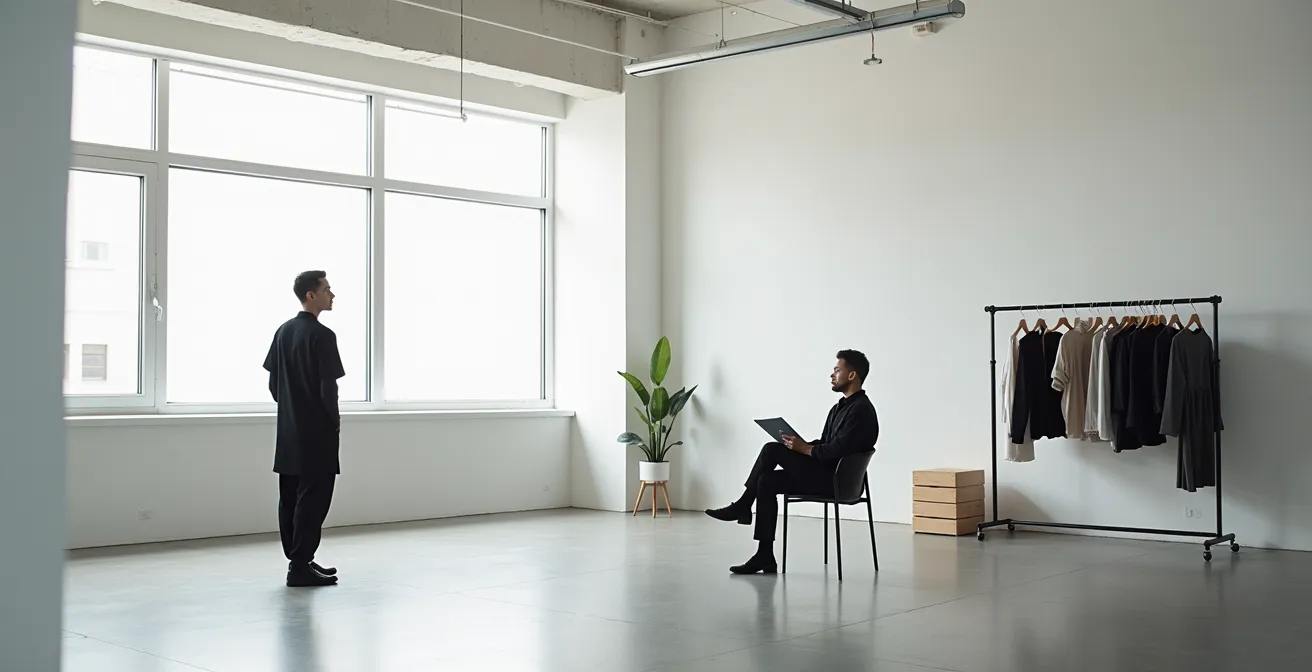
As the image above suggests, your body language during this answer is just as important as your words. Maintain an open posture and engaged eye contact. You are not a passive subject being interviewed; you are an active participant in a professional exchange. The synergy between your concise words and confident presence is what makes you memorable.
How to Stay Focused in a Room Full of Your Direct Competition?
The waiting room is part of the audition. I, or my assistant, will always be observing. The way you handle yourself in a room filled with dozens of models who look just like you is a powerful indicator of your mental fortitude. Do you get intimidated and shrink, endlessly scrolling on your phone? Do you engage in nervous chatter? Or do you remain centered and composed? This isn’t about being antisocial; it’s about managing your energy. Your viability projection skyrockets if I see you as a calming presence, not an anxious one.
The competition is not the other models; it is the distraction and self-doubt in your own mind. The best models create a “bubble” of focus. They might listen to a specific playlist, practice breathing exercises, or quietly review their materials. They are not there to make friends; they are there to work. They understand that the 15 minutes before the go-see are as crucial as the 30 seconds inside the room. This mental preparation ensures that when they walk through the door, they are fully present and not carrying the anxious energy of the waiting room with them.
This idea of mental preparation having a physical effect is not just theory; it’s backed by science. Your mental state directly influences your physical presence, which is what I’m evaluating.
Power Posing Impact on Casting Performance
Dr. Amy Cuddy’s research into power dynamics provides a tangible tool for this. Her work, highlighted in publications like Plus Model Magazine, demonstrates that adopting an expansive “power pose” for just two minutes can significantly impact your hormonal state. It elevates testosterone, which is linked to confidence, and lowers cortisol, the primary stress hormone. Models who discreetly use this technique in a bathroom stall or quiet corner before a casting report feeling more self-assured and perform measurably better under the pressure of the audition room.
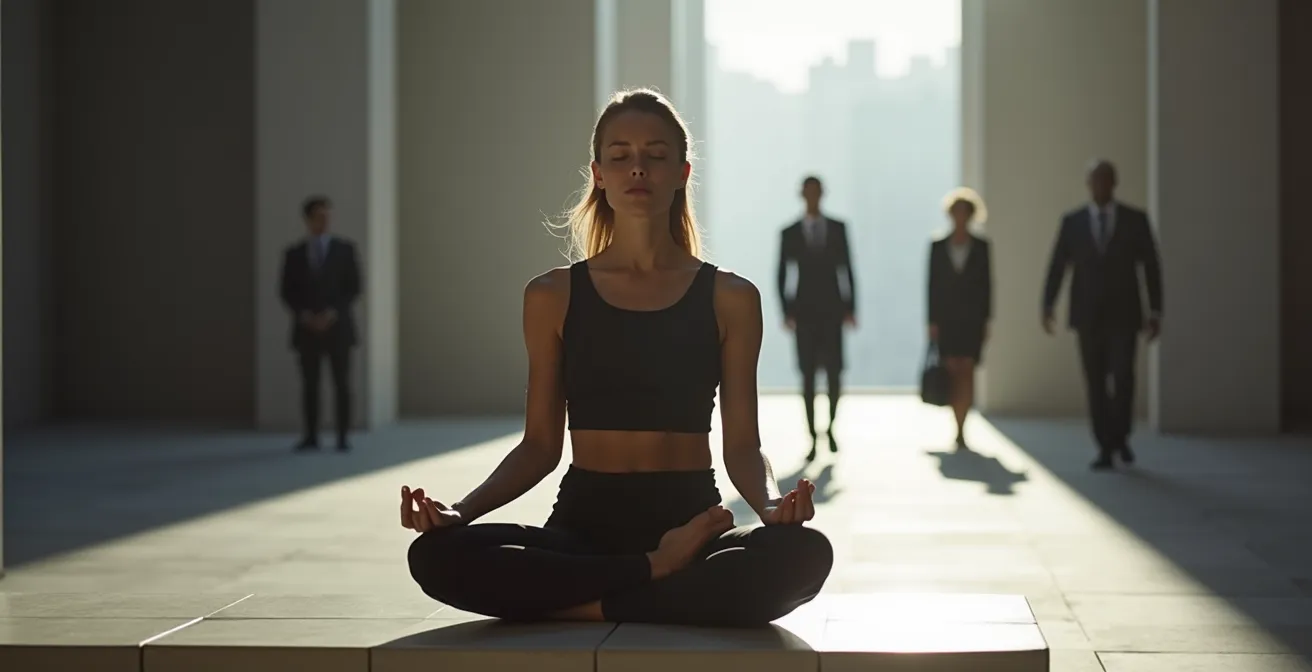
Find a technique that works for you—meditation, visualization, power posing—and make it a non-negotiable part of your pre-casting ritual. The goal is to walk into my room with a quiet mind and a focused energy. That is what cuts through the noise of a hundred other faces.
The Callback: What Should You Change From the First Audition?
Getting a callback is not a victory; it’s an invitation to the next round of scrutiny. The client, the photographer, or the brand’s creative director will now be in the room. The stakes are higher. The biggest mistake models make is either changing too much (showing they didn’t understand what worked) or changing nothing at all (showing a lack of versatility). The key is the “15% Tweak” strategy.
You were called back for a reason. Approximately 85% of what you did—your core look, your energy, your essence—was right. Your job is not to reinvent yourself but to refine and elevate that core. The 15% tweak is a strategic, subtle shift. It could be a different hairstyle (up instead of down), a slight adjustment in attitude (more playful instead of serious), or a different choice of simple outfit (black jeans instead of blue). It shows you are thinking, listening, and capable of offering nuanced variations. It demonstrates high professional bandwidth.
Pay attention to the other models who were called back. Is there a common thread? Are they all brunettes? All have an athletic build? This is valuable data. It gives you insight into the client’s vision. Also, listen intently to any feedback given in the room. A model who can take a director’s note and instantly adjust their performance is a model who will be hired again and again.
Casting directors observe behavior in the waiting room. A model who is calm, organized, and professionally detached is seen as low-risk and easy to work with
– Industry Analysis, What Casting Directors Want to See in Models
This principle is even more critical at a callback. The client is projecting what it would be like to work with you for a full day. Your demeanor, your ability to listen, and your capacity to offer subtle, smart variations are all being evaluated. Prepare two or three slight variations of your initial performance so you have options ready if asked.
Key Takeaways
- A go-see is a high-speed data transfer; prioritize efficiency and preparation over trying to be ‘liked’.
- Your posture, gaze, and introduction are non-verbal signals that communicate your level of professionalism and experience before you even speak.
- Mental preparation is as critical as physical appearance; managing your focus and energy in the waiting room directly impacts your performance.
To Email or Not to Email: When Is a Follow-Up Appropriate?
The casting is over. The silence can be deafening. The urge to email, to “just check in,” is powerful. In 99% of cases, you must resist it. My inbox is a war zone. An unnecessary follow-up email is not a sign of diligence; it’s an annoyance. It increases my cognitive load and signals a lack of understanding of industry norms. The rule is simple: no news is no news.
We have your materials. If we want you, you or your agent will hear from us. A follow-up email will not change our decision. It will only mark you as someone who needs hand-holding. As industry veteran Aaron Marcus states, we are looking for a professional attitude. In an article for Backstage Magazine, he emphasizes that CDs are incredibly busy and what they remember is a positive, professional, and low-maintenance presence.
There are, however, rare exceptions. A follow-up is only appropriate if you have new, relevant information to add or if you were specifically asked to provide something. Did you just book a major campaign that wasn’t in your portfolio? A very brief, polite email to your primary contact might be acceptable. Were you asked to send additional digitals? Send them promptly with a simple, clear subject line. The guiding principle must always be: are you adding value or are you just asking for an update? If it’s the latter, do not hit send.
Use this decision tree to guide your actions. When in doubt, the default answer is always ‘no follow-up.’
- Was it a massive open call go-see with hundreds of models? Apply a strict ‘no follow-up’ policy.
- Did they specifically ask you to send something? If yes, follow up promptly with only the requested materials.
- Did you have a meaningful, one-on-one conversation with the brand’s creative director? A brief, polite thank-you note (one to two sentences) may be appropriate, but is still risky.
- Do you just want to ask for an update? Never follow up for this reason. Focus on your next opportunity.
Mastering these moments isn’t about changing who you are. It’s about understanding the game and playing it with intelligence and efficiency. Shift your mindset from “I hope they like me” to “I am here to provide a professional service.” That shift, more than anything, is what I am looking for.