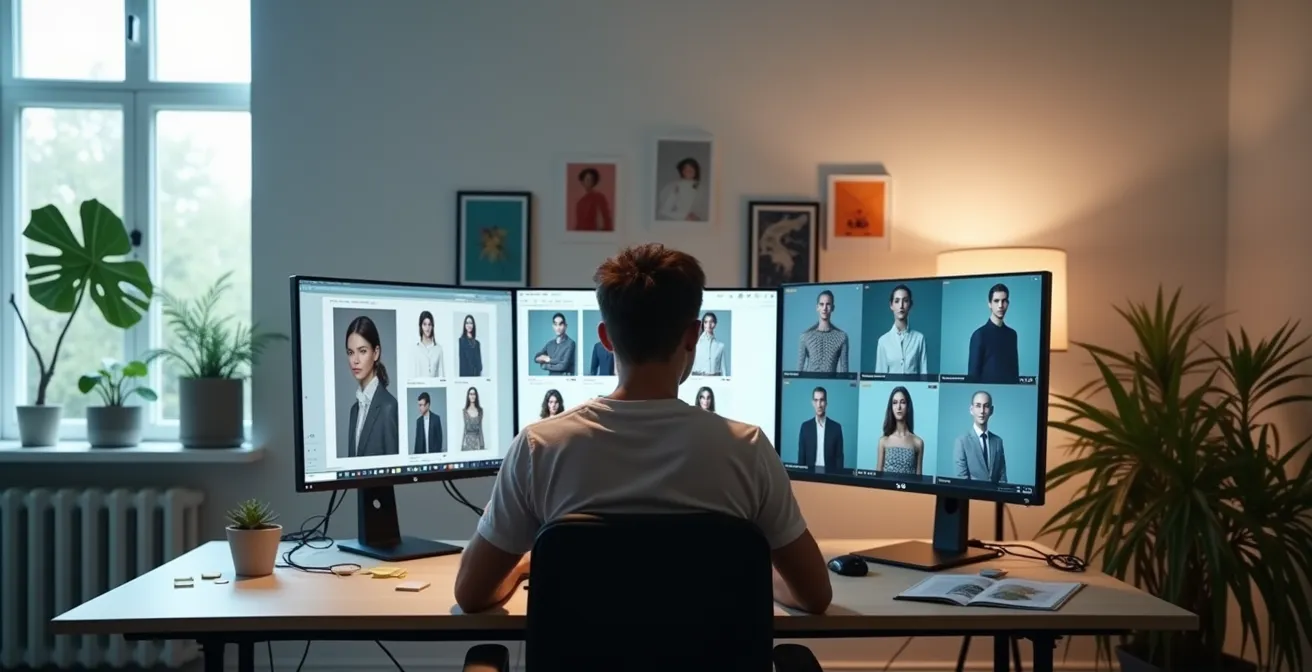
Contrary to what you believe, your ‘best’ pose is often a technical liability that gets instantly deleted.
- Photographs are valued as commercial assets for post-production, not as personal portraits.
- A complex approval chain of brand managers and legal teams—not the photographer—has the final veto on every image.
Recommendation: Shift your focus from ‘looking good’ to creating a technically viable canvas for the retoucher and the brand.
You see the shot on the monitor. It’s the one. The pose is perfect, the emotion is real. You’re certain it’s the hero shot for the campaign. Then, the final gallery arrives weeks later, and it’s gone. Vanished. Replaced by a shot you felt was merely ‘safe’. This experience is a frustrating rite of passage for nearly every model in the industry, leaving you to question your performance and the photographer’s judgment.
You might assume it was slightly out of focus, or that the client just preferred another option—simple, understandable reasons. You might have heard generic advice that the “best photo tells a story” or that “communication is key.” These platitudes are useless. They fail to explain the cold, hard mechanics of a commercial photography pipeline, a world where your favorite image is just a line item on a production schedule, subject to pressures you never see.
The reality is far more brutal and technical. That ‘perfect’ shot was likely a commercial liability, a post-production nightmare, or a brand misalignment waiting to happen. The decision to delete it wasn’t personal; it was a calculated business move made in a pipeline you never see. Your perception of a “good photo” is based on emotion and aesthetics. An editor’s perception is based on technical viability, workflow efficiency, and risk mitigation.
This article breaks down the unfiltered truth from a senior editor’s perspective. We will dissect the unforgiving decision-making hierarchy, the punishing timelines, the non-negotiable technical requirements, and why what you consider a great pose is often the first to be culled from the selection. This is not about art; it’s about manufacturing a commercial asset.
To fully grasp the mechanics of professional image creation, this guide breaks down the critical stages and decision points that happen long after the flash has fired. The following sections will provide a raw look into the post-production world.
Summary: Why Retouchers Delete 50% of Your Best Poses During Selection?
- Client vs. Photographer: Who Actually Decides Which Photo Is Published?
- Why Does It Take 3 Months to See the Final Campaign Images?
- Waist Slimming and Skin Smoothing: When Does Retouching Become Unethical?
- Why Asking a Photographer for “RAW” Files Is a Professional Insult?
- How to Pose for CGI Integration When the Product Isn’t There?
- How to Pose So Retouchers Don’t Have to Fix the Clothes Later?
- The Mistake of Ignoring the Client Monitor That Can Cost You the Campaign
- How Color Grading Changes Your Skin Tone and Makeup Intensity?
Client vs. Photographer: Who Actually Decides Which Photo Is Published?
Let’s be blunt: you, the model, have zero say. The photographer has very little. Your belief that the photographer is the ultimate arbiter of which image gets selected is a fundamental misunderstanding of the commercial process. A photograph is not a piece of art created by a lone visionary; it is a commercial asset manufactured by a committee. The photographer’s selection, or “selects,” is merely the first gate in a long, brutal approval gauntlet.
The real power lies within an unseen pipeline of stakeholders, each with the power to veto an image for reasons that have nothing to do with your pose or the photographic quality. The Art Director checks it against the creative brief. The Brand Manager ensures it aligns with abstract campaign goals and market positioning. Then comes the most powerful and feared stakeholder: the legal department. They scrutinize every detail for potential compliance issues, model release inaccuracies, or trademark infringements.
An image might be culled because the color of your shirt is too similar to a competitor’s branding, because a barely-visible logo in the background wasn’t cleared, or because your expression, while beautiful, doesn’t fit the “brand voice” decided in a boardroom six months prior. The photographer is a technician and an initial filter; the client and their army of managers are the ones who hold the true power of life and death over your favorite shot.
Your job isn’t to create a beautiful photo. It’s to create a technically sound and brand-safe canvas that can survive this multi-stage corporate inspection. Anything less is a waste of everyone’s time.
Why Does It Take 3 Months to See the Final Campaign Images?
The delay between the shoot and the final image delivery isn’t due to laziness or disorganization. It’s a direct consequence of the complex, multi-layered workflow required to transform a raw capture into a polished commercial asset. The notion that a photo is “done” after the click is naive. The shoot itself is often the shortest and cheapest part of the entire process. The real work—and the real time—is spent in post-production, a meticulous and often frustrating sequence of technical steps and feedback loops.
From the moment the memory card is downloaded, a clock starts ticking on a process that involves multiple specialists and stakeholders. The initial culling, where thousands of shots are narrowed down to a few hundred, can take days. This is followed by RAW processing, the first client review, structural retouching, color grading, and a second, more intensive client review. Each stage is a potential bottleneck, as feedback must be gathered from art directors, brand managers, and marketing teams who are juggling dozens of other projects. A single comment like “Can we see it a bit warmer?” can trigger hours of additional work and another round of approvals.
The following table breaks down a typical, and often optimistic, timeline. Any delay in one phase has a cascading effect on all subsequent phases, easily stretching a two-month project into three or four. As a model, you are completely external to this process, which explains the long silence.
This table illustrates a streamlined workflow, and as a breakdown of a typical fashion campaign timeline shows, each step is a critical dependency for the next.
| Phase | Duration | Key Activities |
|---|---|---|
| Culling & Rating | Week 1 | Initial selection from thousands of shots |
| RAW Processing | Week 2 | Basic color and exposure adjustments |
| Client Review Round 1 | Week 3 | Art director and client feedback |
| Structural Retouching | Weeks 4-5 | Major editing and compositing |
| Color Grading | Week 6 | Look development and mood setting |
| Client Review Round 2 | Week 7 | Final approvals from all stakeholders |
| Final Export | Week 8 | Multiple format outputs for different media |
Therefore, when you ask “Where are the photos?”, you are revealing your ignorance of a massive industrial process. The photos aren’t “somewhere”; they are actively being manufactured, piece by piece, through a slow and deliberate assembly line.
Waist Slimming and Skin Smoothing: When Does Retouching Become Unethical?
The line between enhancement and deception is not a moral one; it’s a commercial one. The question is not “Is this right?” but “Does this damage the brand’s credibility?” For decades, the standard operating procedure was to retouch images to an impossible standard of perfection. This involved aggressive skin smoothing, body contouring, and the removal of any feature that hinted at human imperfection. This created a “plastic” look that, while technically impressive, has become a commercial liability.
Today’s consumers are more visually literate and skeptical. They are conditioned to spot over-manipulation, and the backlash can be damaging to a brand. As such, industry professionals warn that audiences no longer trust artificially perfect images. The “ethical” boundary, therefore, is dictated by market tolerance. Retouching becomes unethical at the precise point it becomes unbelievable to the target consumer, risking a loss of trust and, consequently, sales. An editor’s job is to push the image to the very edge of believability without falling over.
Fashion retouching and high-end skin retouching can often take too far until the skin looks plastic in appearance
– Professional Fashion Photographer, Silvergumtype Photography Blog
This means a degree of skin texture, minor imperfections, and a realistic body shape are often intentionally left in. These are not mistakes; they are calculated inclusions of reality to maintain audience trust. So when you see a “flaw” in a final image, understand it is likely a deliberate business decision. The goal is no longer to create a perfect human, but a credible one. The ethics of retouching are a function of brand strategy, not a philosophical debate.
Your role is to provide a canvas that requires minimal structural changes. The more a retoucher has to alter your fundamental shape or skin, the higher the risk of crossing that commercial line into “unbelievable,” which can get the entire image killed.
Why Asking a Photographer for “RAW” Files Is a Professional Insult?
Asking a photographer for their RAW files is the equivalent of asking a chef for a bucket of uncooked ingredients so you can “finish the dish” at home. It is a profound statement of ignorance about the craft and an insult to the photographer’s expertise and business model. It implies that their work is finished at the moment of capture and that post-production—the phase where the final look and feel are meticulously crafted—is a trivial, unskilled task that anyone with a laptop can perform.
A RAW file is not a photo; it is a latent, unfinished digital negative. It contains the raw sensor data that requires specialized software, a calibrated monitor, powerful hardware, and, most importantly, years of technical and artistic expertise to process correctly. As highlighted by professional training programs, fashion retouching isn’t for amateurs; it’s for technicians who have already mastered foundational tools and want to learn advanced, proprietary workflows. Handing over a RAW file to a client or model is a massive liability. In unskilled hands, it can be processed poorly, resulting in a final image that misrepresents the photographer’s quality and damages their reputation.
Furthermore, the photographer’s business is built on delivering a finished product, not raw materials. Their fee and licensing structure are based on the value of the final, retouched images. Giving away the RAW files undermines this entire model. Here are the core reasons the answer will always be no:
- RAW files are unfinished work requiring specialized software and expertise.
- Giving RAW files undermines the photographer’s post-production value and artistic control.
- Poor processing by clients can severely damage the photographer’s professional reputation.
- The business model is based on delivering finished products, not raw materials.
- There is a significant legal liability if a client misuses or misrepresents the unfinished work.
Never ask for RAW files. The request signals you as an amateur and immediately erodes your professional standing on set.
How to Pose for CGI Integration When the Product Isn’t There?
Posing with an imaginary object for a future CGI integration is one of the most technically demanding skills for a model, and one where mistakes are brutally unforgiving. This is not about acting; it is about providing a perfect physical plate for a digital artist. A single error in your pose can create hours or even days of corrective work for the visual effects team, or render the shot completely unusable. Your body is a practical element that must seamlessly merge with a digital one, and any inconsistency breaks the illusion.
The most critical concept to master is the ‘occlusion line’—the invisible boundary where your body will interact with or be covered by the CGI object. If your hand passes through the space where a digital bottle is supposed to be, the shot is dead. You must also physically manifest the object’s properties. If you are meant to be holding a heavy object, your muscles, from your fingers to your core, must show the appropriate tension. If the object is a glowing screen, your body must be angled to realistically receive its non-existent light.
This requires constant communication with the photographer and the CGI supervisor on set. You must understand the object’s size, weight, texture, and center of gravity. You must maintain a perfectly consistent eyeline with stand-in markers. This is a job of pure technical precision, where your ability to follow instructions is far more valuable than your creative expression.
Your Action Plan: Nailing the CGI Pose
- Master the ‘occlusion line’: Ask the CGI supervisor to define the hard boundaries of the digital object and never cross them.
- Convey weight: Tense your muscles realistically to simulate holding the object’s specified weight. This is a common point of failure.
- Maintain grip integrity: Use delicate or firm grip positioning based on the object’s supposed fragility and texture.
- React to the object: If interacting with a screen or light source, lean your body and angle your face to receive the imaginary light.
- Lock your eyeline: Fix your gaze on the designated stand-in marker and do not deviate between takes to ensure consistency.
In this context, you are not a model; you are a practical effect. Your performance is measured in millimeters and degrees of rotation. Success is measured by how invisible your work becomes in the final composite.
How to Pose So Retouchers Don’t Have to Fix the Clothes Later?
Your pose has a direct and measurable impact on the client’s bottom line. In e-commerce, the primary function of a photograph is to sell a product, and that means representing it accurately. A pose that bunches, wrinkles, or distorts a garment is not just an aesthetic problem—it’s a financial one. In fact, recent ecommerce statistics show that 22% of returns happen because a product looks different in person than it did in the photo. Your pose is the first line of defense against this costly problem.
Retouchers can perform miracles, but fixing fabric is one of the most time-consuming and difficult tasks in post-production. They can smooth out minor wrinkles, but they cannot realistically rebuild the structure of a garment that has been completely distorted by a bad pose. Poses that twist the torso unnaturally, pinch fabric at the joints, or hide key details of the product (like a pocket or a seam) create an enormous amount of work. As professional retouchers note, they often have to digitally re-apply texture to garments that have been “smoothed” too much during heavy retouching, a clear sign that the original pose failed to preserve the fabric’s integrity.
The goal is to present the clothing in its most natural and flattering state. This means being acutely aware of how every movement affects the drape, silhouette, and texture of the fabric. Stand with a clean posture. Avoid crossing your arms in a way that creates deep, unnatural creases across the chest. When you bend a limb, do it in a way that works with the garment’s seams, not against them. A ‘clean pose’ is one that respects the product. It requires less retouching, leads to a more accurate product representation, and ultimately reduces expensive returns for the client.
Remember, you are not just modeling a pose; you are modeling a product. If your pose compromises the product, it is a failed pose, no matter how good you look.
The Mistake of Ignoring the Client Monitor That Can Cost You the Campaign
The tethered monitor on set—often called the “client monitor” or “digital tech station”—is not there for your vanity. It is the central nervous system of the shoot. Ignoring it is one of the most amateur and costly mistakes a model can make. This monitor displays the images in real-time as the photographer captures them, allowing the entire team—art director, client, stylist, and photographer—to review and correct issues instantly. Your failure to pay attention to it signals a lack of engagement and can derail the entire production.
When an art director points to the screen and says, “The angle of your hand here is creating a strange shadow,” that is not a suggestion. It is a direct order to correct a problem that is costing time and money. By checking the monitor between takes, you become an active participant in problem-solving. You can see for yourself how a slight shift in your pose affects the lighting, how your expression reads on camera, or how your body interacts with the product. This allows you to make micro-adjustments proactively, rather than waiting for someone to correct you.
Failing to do so means you are shooting blind. The team might spend 30 minutes trying to capture a specific shot, only to realize in post-production that a persistent issue—a stray hair, a distracting fabric fold, a tangent with the background—was present in every frame because you were not paying attention. This wastes time, blows the budget with overtime costs, and risks missing the “money shot” entirely. The difference in outcome is not subtle, as the table below demonstrates.
| Aspect | Checking Monitor | Ignoring Monitor |
|---|---|---|
| Time Efficiency | Immediate corrections are made on set | 30+ minutes wasted trying to fix unseen issues |
| Team Collaboration | You are part of an active feedback loop | The team is forced to shoot blind |
| Technical Precision | Tangents, bad shadows, and pose blocks are caught | Problems are discovered too late in post-production |
| Budget Impact | The shoot stays within its allocated time | Overtime costs and reshoots accumulate |
| Final Result | The intended “money shot” is successfully achieved | There’s a high risk of missing key campaign shots |
The monitor is your most direct source of feedback. Ignoring it is professional negligence.
Key Takeaways
- Your favorite pose is irrelevant; a photo is a commercial asset, and its value is purely technical and strategic.
- The photographer is just the first filter. A hidden committee of brand, marketing, and legal stakeholders has the final say.
- A “good” pose that requires hours of fabric or body shape correction in post-production is a “bad” photo and will be deleted.
How Color Grading Changes Your Skin Tone and Makeup Intensity?
The color and light you see on set are temporary. The final look of an image is determined in color grading, a highly technical and subjective process where a colorist or retoucher manipulates the image’s hues, saturation, and luminance to create a specific mood. This process will fundamentally alter your appearance, and it is completely out of your control. Your skin tone, the color of your hair, and the intensity of your makeup will be changed to serve the creative brief, not to flatter you.
A campaign aiming for a warm, sun-kissed look will push all tones towards yellows and oranges, drastically changing a neutral skin tone. A moody, high-fashion look might involve desaturating colors and adding a cool, blue cast, making your skin appear paler and your makeup more severe. These are not corrective actions; they are creative decisions. The final grade is designed to make the *product* or the *brand* look good, not necessarily the model. Your face and body are simply a canvas for this color work.
Techniques like “dodge and burn” are used to manually repaint light and shadow across your face, enhancing your facial structure by selectively lightening cheekbones and darkening the jawline to create a sculpted, three-dimensional effect. This is an artistic manipulation of reality. The growth of the photo editing software market is largely driven by these capabilities, and as market research indicates, advanced retouching features are gaining major traction, making such transformations standard practice.
Therefore, obsessing over whether the makeup looks perfect on set is pointless. Its final appearance will be decided weeks later in a dark room by a technician looking at a calibrated monitor. Stop thinking like a person in a mirror and start thinking like a component in a digital supply chain. Master these technical requirements, and your ‘best’ poses will finally become the ‘selected’ poses. Your career depends on it.